
Create tailored campaigns, track performance, and make informed decisions with AI-driven analytics.

Beaconn
$29/moStarting price
0Popularity
About Beaconn
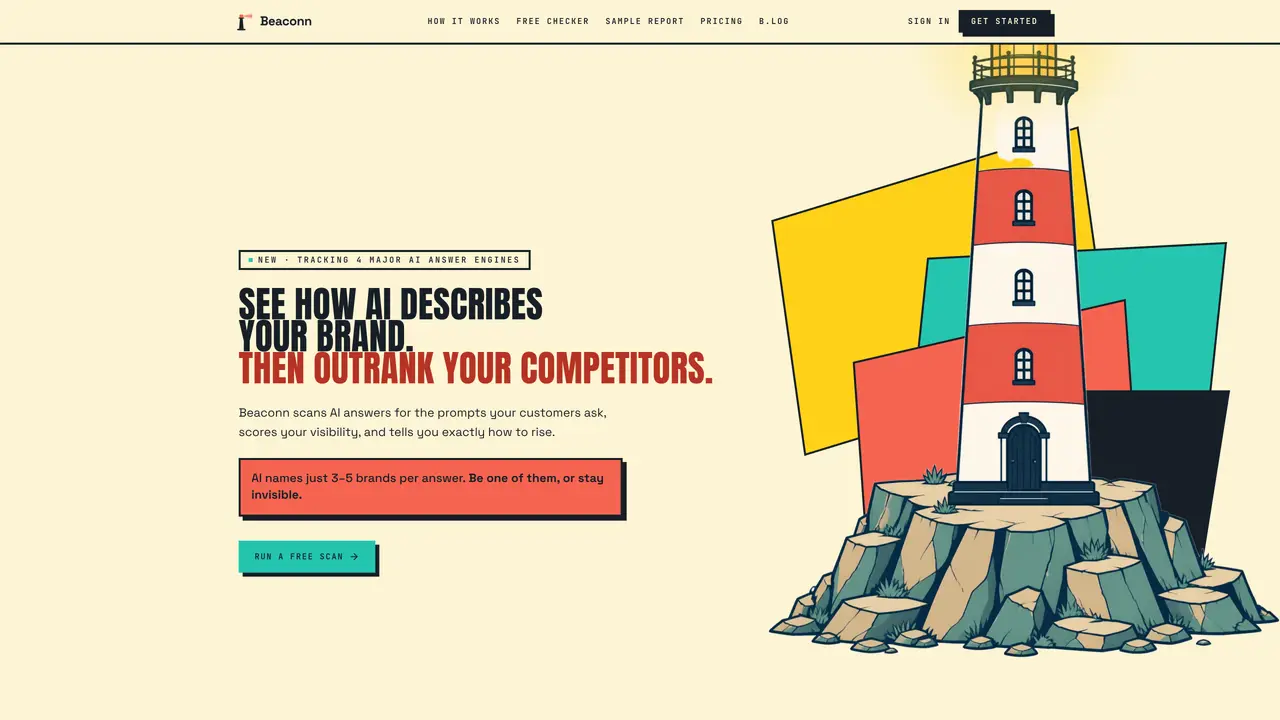
Beaconn analyzes how AI tools such as Perplexity, ChatGPT, Gemini, and Claude describe brands in response to buyer-intent queries. It scores a brand’s visibility across these engines, compares share of voice against competitors, and provides evidence-backed reports showing exact AI answers, wording, and sources. The tool measures AI-sourced traffic by classifying visits by AI assistant, referrer, and UTM source, distinguishing AI-driven traffic from traditional web visits. It generates prioritized action plans with paste-ready answers and FAQ schema to help brands appear in AI recommendations. Category scans assess market ownership by testing broad, category-level prompts across all four engines, identifying which brands dominate in unbranded searches. Beaconn focuses on pipeline impact rather than dashboard metrics, evaluating whether a brand is included in AI-generated shortlists that buyers use to make decisions.
Key features
- Real-time AI answer tracking across Perplexity, ChatGPT, Gemini, and Claude
- Visibility scoring and competitor share-of-voice analysis
- Evidence capture including engine, date, wording, and sources
- AI-sourced traffic classification by assistant, referrer, and UTM
- Prioritized action plans with paste-ready answers and FAQ schema
- Category-level market scans for unbranded buyer queries
- Jarvis integration for drafting comparison pages and outreach emails
- Monthly auto-tracking on paid plans
Use cases
- Assessing brand visibility in AI-generated recommendations for buyer-intent queries
- Identifying gaps where brands rank on Google but are missing from AI answers
- Benchmarking market share against competitors in AI answer engines
Pros
- Tracks visibility across four major AI answer engines in real time
- Provides evidence-backed reports with exact AI answers and sources
- Generates prioritized action plans with ready-to-use content
- Measures AI-sourced traffic and distinguishes it from traditional web visits
- Offers category scans to assess market ownership in unbranded searches
Cons
- No automatic re-scans on free plan; scans must be run manually
- Fixed prompt sets on lower tiers with no prompt editing
- No Google AI Overview readings included in any plan
- No PDF export or shareable report links on free tier
Frequently asked questions about Beaconn
What does Beaconn do?
Beaconn analyzes how AI tools like Perplexity, ChatGPT, Gemini, and Claude describe brands in response to buyer-intent queries. It scores a brand’s visibility across these engines, compares share of voice against competitors, and provides evidence-backed reports showing exact AI answers, wording, and sources.
Who is Beaconn for?
Beaconn is designed for brands and businesses that want to understand their visibility in AI-generated answers, particularly those competing for buyer attention in markets where AI tools are increasingly used for recommendations.
How does Beaconn measure AI traffic?
Beaconn classifies each visit by the AI assistant that sent it, by referrer, and by UTM source, distinguishing AI-driven traffic from traditional web visits without relying on cookies.
What is a category scan in Beaconn?
A category scan assesses market ownership by testing broad, category-level prompts across all four AI engines, identifying which brands dominate in unbranded searches rather than focusing solely on a single brand’s performance.
How does Beaconn help brands improve their AI visibility?
For every visibility gap, Beaconn generates paste-ready answers and FAQ schema tailored to the prompts, enabling brands to publish content that AI engines are more likely to cite in their recommendations.
Does Beaconn provide real-time data?
Yes, Beaconn queries Perplexity, ChatGPT, Gemini, and Claude live at the moment a scan is run, ensuring the visibility score and competitor comparisons are based on current AI answers rather than outdated data.