
Unify customer data, automate workflows, and scale experiences with Einstein AI, Copilot, and Data Cloud in one CRM platform.

Openai
204MMonthly visits
89Popularity
About Openai
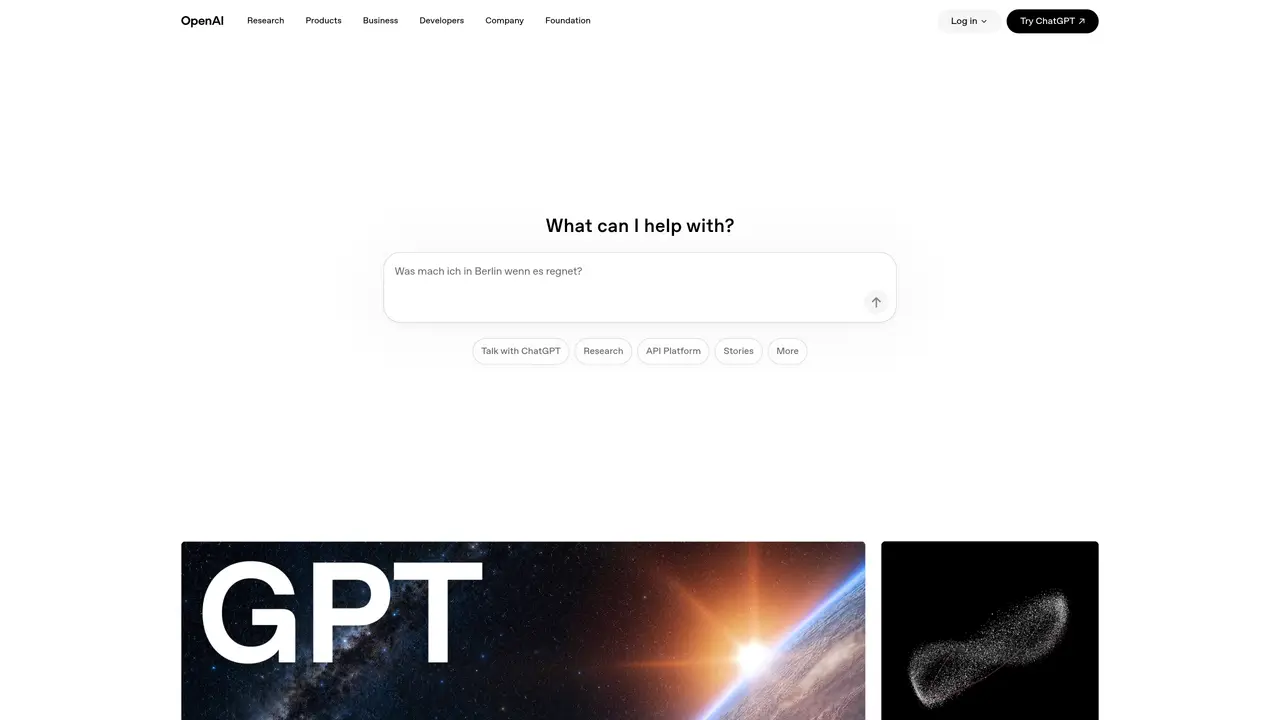
OpenAI develops and provides access to large-scale AI models such as GPT-4o, enabling users to build and deploy autonomous agents and workflows. The platform supports a range of applications from natural language processing to complex task automation. OpenAI’s tools are designed for developers, researchers, and businesses seeking to integrate cutting-edge AI capabilities into their products or services. The platform offers both cloud-based APIs and interactive interfaces for experimentation and production use. Users can fine-tune models, leverage pre-built agents, or create custom workflows tailored to specific needs. OpenAI emphasizes scalability, flexibility, and ease of integration across industries like customer support, content creation, and data analysis. The company also provides documentation, tutorials, and community resources to support adoption and innovation.
OpenAI
San Francisco, California, US · Founded 2015
- Founders
- Sam Altman, Greg Brockman, Ilya Sutskever, Elon Musk, Wojciech Zaremba, John Schulman
- Founded
- 2015
- Headquarters
- San Francisco, California, US
- Legal status
- Private (capped-profit)
Key features
- Access to GPT-4o and other foundation models
- APIs for integrating AI into applications
- Pre-built autonomous agents for common tasks
- Customizable workflows and automation
- Fine-tuning capabilities for specialized use cases
- Interactive interfaces for testing and prototyping
- Scalable cloud-based infrastructure
- Comprehensive documentation and developer resources
Use cases
- Building AI-powered customer support chatbots
- Automating content generation for marketing or documentation
- Developing autonomous agents for data analysis and reporting
Pros
- Access to state-of-the-art large language models like GPT-4o for advanced natural language processing
- Flexible deployment options including cloud-based APIs and interactive interfaces
- Supports customization through fine-tuning and pre-built agent templates
- Comprehensive documentation, tutorials, and community resources for developers
- Scalable solutions suitable for both experimentation and production environments
Cons
- Requires technical expertise for advanced customization and integration
- Potential latency in responses for complex or high-volume queries
- Limited transparency regarding model training data and decision-making processes
Frequently asked questions about Openai
What does OpenAI do?
OpenAI develops and provides access to large-scale AI models, enabling users to build and deploy autonomous agents and workflows for applications such as natural language processing and task automation.
Who is OpenAI suitable for?
OpenAI’s tools are designed for developers, researchers, and businesses looking to integrate advanced AI capabilities into their products or services.
How does OpenAI's pricing model work?
OpenAI offers both cloud-based APIs and interactive interfaces, with pricing typically based on usage metrics such as the number of tokens processed or API calls made.
What integrations does OpenAI support?
OpenAI provides APIs that can be integrated with a wide range of platforms and services, supported by extensive documentation and community resources.
What are the main limitations of OpenAI?
Users may encounter latency in responses for complex queries and require technical expertise for advanced customization. Transparency regarding model training data is also limited.
How do I get started with OpenAI?
Users can begin by exploring OpenAI’s documentation and tutorials, then accessing the platform through cloud-based APIs or interactive interfaces to experiment and deploy solutions.
Openai Website Engagement
Last Update: 9 days ago
Total Monthly Visits
0
Bounce Rate
0%
Visit Duration (avg)
0.00s
Pages Per Visit
0
Country Rank
0
United States
Global Rank
0
Category Rank
#0
Ai Chatbots & Tools
Monthly Traffic
Traffic Sources
Traffic Share By Country
- United States24.4%
- India7.1%
- Japan5.4%
- Brazil4.7%
- South Korea4.3%