Easy-to-use CRM platform that automates lead capturing, prioritizes tasks, and provides sales pipeline analytics for businesses of all sizes.

Salesforce
FreeStarting price
108MMonthly visits
78Popularity
About Salesforce
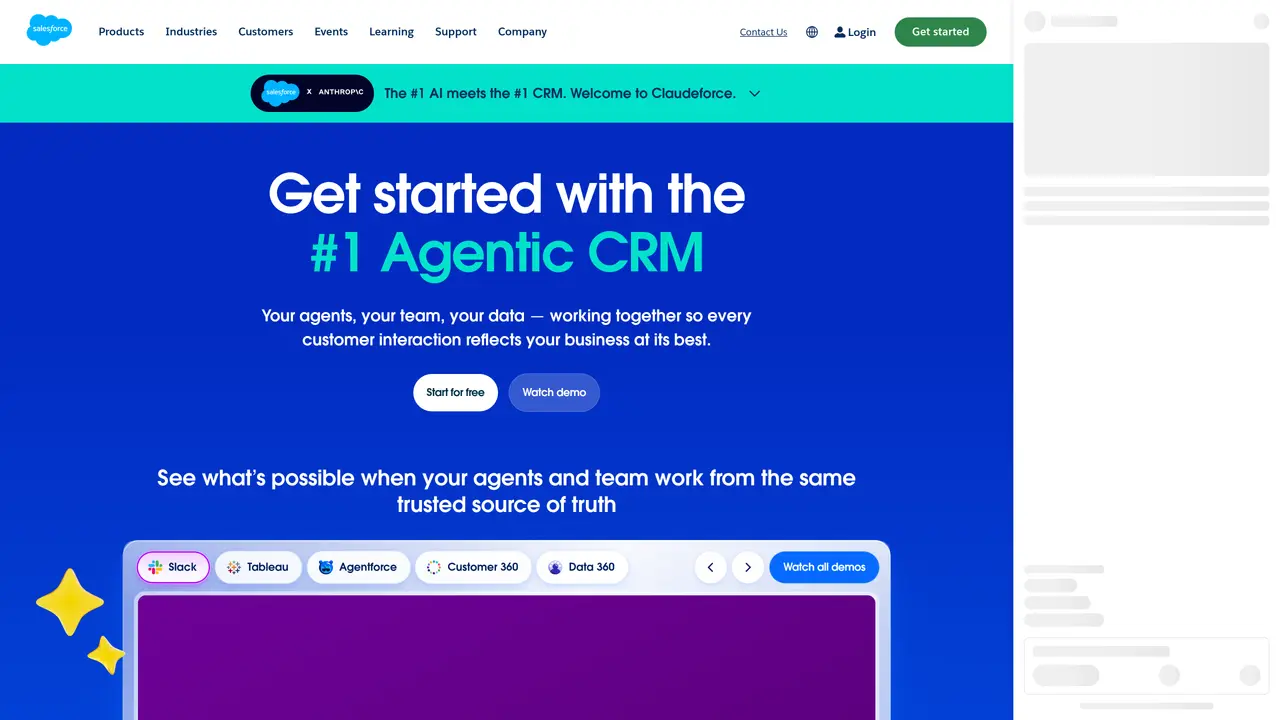
Salesforce is the leading AI-powered CRM platform that unifies customer data, automation, and analytics across Sales, Service, Marketing, and Commerce. With Einstein 1, teams access AI-driven insights, predictions, and content generation embedded directly in workflows. Copilot assists with drafting emails, summarizing records, and generating actionable plans, while Data Cloud consolidates real-time customer profiles for personalized engagement. Admins build automations and custom apps rapidly using low-code tools and the AppExchange ecosystem. The platform delivers enterprise-grade security, governance, and scalability, making it ideal for growth-stage to enterprise teams focused on revenue growth and customer satisfaction. Companies use Salesforce to centralize pipelines, resolve cases faster, and orchestrate cross-functional workflows with measurable impact through real-time dashboards.
Salesforce
Salesforce Tower, United States · Founded 1999
- Founder
- Marc Benioff
- Founded
- 1999
- Headquarters
- Salesforce Tower, United States
- Legal status
- Public company
Key features
- Einstein 1 AI for predictions, content generation, and task assistance
- Copilot for AI-assisted drafting, summarization, and planning
- Data Cloud for unified, real-time customer profiles
- Automation with low-code Flow builders
- Sales, Service, Marketing, and Commerce cloud integration
- AppExchange ecosystem for extensibility
- Enterprise-grade security, governance, and compliance
- Real-time dashboards for performance tracking
Use cases
- AI-driven deal insights and next-best actions in Sales Cloud
- Automated case summaries and replies in Service Cloud
- Personalized customer journeys with Marketing Cloud and Data Cloud
Pros
- Unified AI-powered CRM platform integrating Sales, Service, Marketing, Commerce, and Analytics
- Einstein 1 provides embedded AI-driven insights, predictions, and content generation within workflows
- Low-code tools and AppExchange ecosystem enable rapid customization and automation
- Enterprise-grade security, governance, and scalability for growth-stage to enterprise teams
- Real-time customer profiles via Data Cloud for personalized engagement across channels
Cons
- Complexity may require significant training and onboarding for new users
- Pricing structure can be opaque and potentially high for small businesses
- Integration with non-Salesforce systems may require additional development effort
Salesforce videos
Frequently asked questions about Salesforce
What is Salesforce and what does it do?
Salesforce is the leading AI-powered CRM platform that unifies customer data, automation, and analytics across Sales, Service, Marketing, Commerce, and Analytics. It provides AI-driven insights, workflow automation, and real-time customer profiles to drive revenue growth and customer satisfaction.
Who is Salesforce best suited for?
Salesforce is ideal for growth-stage to enterprise teams focused on revenue growth, customer satisfaction, and operational efficiency. It serves industries like financial services, healthcare, manufacturing, and communications, as well as small businesses seeking scalable CRM solutions.
How does Salesforce integrate AI into its platform?
Salesforce embeds AI capabilities through Einstein 1, which provides AI-driven insights, predictions, and content generation directly within workflows. Features include Copilot for drafting emails and summarizing records, as well as AI agents for automation and personalized engagement.
What integrations does Salesforce support?
Salesforce supports integrations with a wide range of third-party applications and systems through its AppExchange ecosystem, MuleSoft for connectivity, and connectors directory. It also integrates with Slack for unified collaboration and productivity.
What are the main limitations of Salesforce?
Salesforce may present a steep learning curve due to its complexity, requiring significant training and onboarding. Additionally, its pricing can be high for small businesses, and integrating with non-Salesforce systems may demand extra development effort.
How do I get started with Salesforce?
Prospective users can explore Salesforce's product portfolio, request demos, or sign up for a trial through the official website. The platform offers industry-specific solutions, free starter suites for small businesses, and customer success services to guide implementation.
Salesforce Website Engagement
Last Update: 9 days ago
Total Monthly Visits
0
Bounce Rate
0%
Visit Duration (avg)
0.00s
Pages Per Visit
0
Country Rank
0
United States
Global Rank
0
Category Rank
#0
Programming & Developer Software
Monthly Traffic
Traffic Sources
Traffic Share By Country
- United States41.7%
- Japan24%
- India6.9%
- United Kingdom3.7%
- Australia2.1%