Discover keywords, analyze competitors' SEO strategies, and make data-driven decisions for website performance.

Terrank
$30Starting price
0Popularity
About Terrank
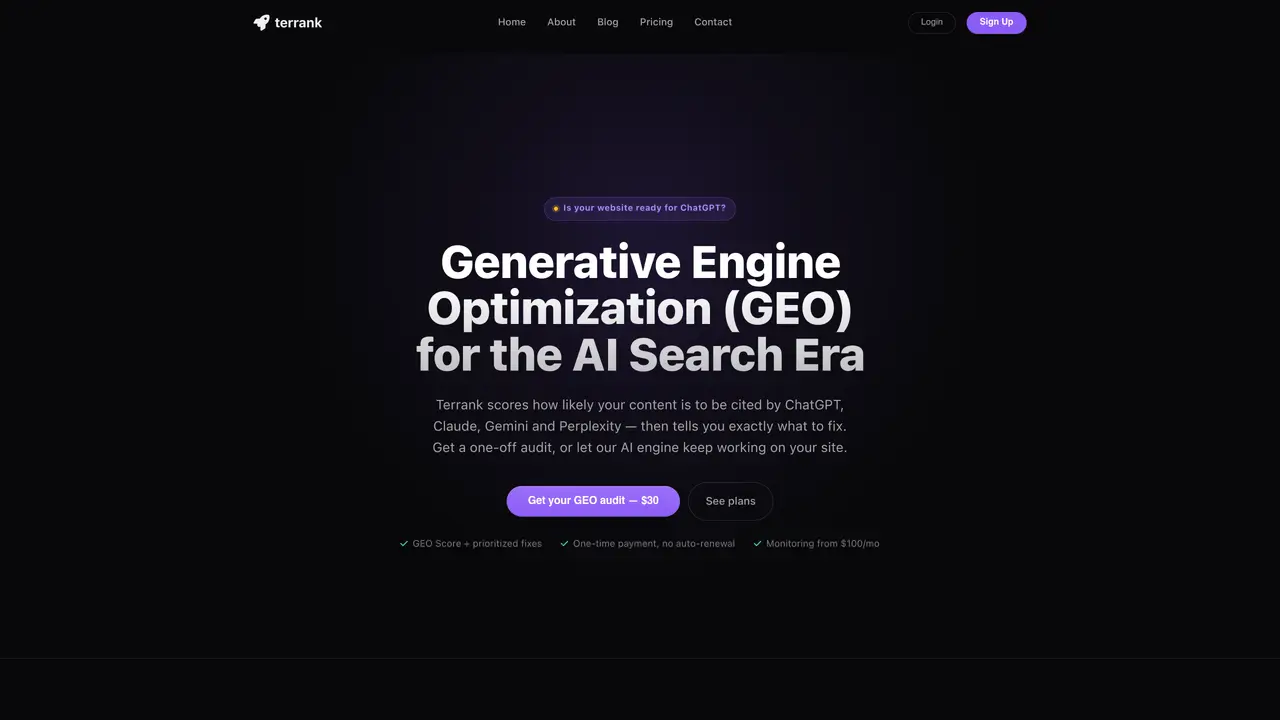
Terrank provides Generative Engine Optimization (GEO) audits to evaluate how likely a website’s content is to be cited by AI search engines such as ChatGPT, Claude, Gemini, and Perplexity. The tool scores content based on extractability, structured data, authority signals, and freshness, then delivers a prioritized list of fixes. It identifies target queries and competitor performance, checks whether AI engines cite the site, and offers structural analysis including schema markup and technical readiness. Terrank offers both one-time audits and recurring monitoring plans, with the latter including automated AI-driven improvements between scheduled audits. The service simulates real AI assistant queries in a given industry to assess how content performs and adapts recommendations as both the site and AI engines evolve.
Key features
- GEO Score for AI readiness
- Target query and prompt identification
- Competitor analysis and citation checking
- Structural analysis including schema markup
- Performance reports across AI engines
- LLM probing and SERP analysis
- Prioritized change recommendations
- Recurring audits with automated AI improvements
Use cases
- Evaluating website content for AI search engine visibility
- Identifying gaps in AI citations compared to competitors
- Optimizing content structure for AI extractability
Pros
- Scores content readiness for AI search engines across multiple platforms
- Provides prioritized, dependency-ordered change recommendations
- Includes competitor analysis and citation tracking
- Offers both one-time audits and recurring monitoring plans
- Uses a self-evolving AI engine tailored to each client's site and industry
Cons
- No free tier or trial available
- Pricing starts at $30 for a single audit with limited features
- Recurring plans require monthly subscription
- Focuses exclusively on AI search optimization, not traditional SEO
Frequently asked questions about Terrank
What is Generative Engine Optimization (GEO) and how is it different from SEO?
Generative Engine Optimization (GEO) focuses on structuring content so AI search engines like ChatGPT, Claude, and Gemini cite it directly in their responses, rather than competing for a link on a results page. While SEO prioritizes crawlability and indexing, GEO emphasizes extractability, structured data, authority signals, and freshness to ensure AI models can lift and reference the content.
Who should use Terrank?
Terrank is designed for website owners, content teams, and SEO professionals looking to optimize their content for AI search engines. It suits businesses in industries where AI assistants are increasingly used for research, such as SaaS, e-commerce, and B2B services.
How does Terrank determine which fixes to prioritize?
Terrank uses a self-evolving AI engine that simulates real AI assistant queries in your industry, compares what gets cited with what gets skipped, and generates a prioritized list of changes based on dependency and potential impact. The engine adapts its recommendations as both your site and AI engines evolve.
Can Terrank check if my site is already being cited by AI engines?
Yes, Terrank includes a citation checking feature that identifies whether AI engines like ChatGPT, Claude, Gemini, and Perplexity cite your site. It also shows which competitors are being cited instead when your site is not referenced.
Does Terrank offer ongoing support or just one-time audits?
Terrank provides both one-time audits and recurring monitoring plans. The monitoring plans include automated AI-driven improvements between scheduled audits, ensuring your content stays optimized as AI engines and your site evolve.
What does the GEO Score measure?
The GEO Score is a single 0–100 metric that evaluates how likely your content is to be surfaced and cited by AI engines. It is scored per engine (e.g., ChatGPT, Claude, Gemini, Perplexity) so you can see which engines already trust your content and which do not.