
OpenAI builds and deploys advanced AI models like GPT-4o for autonomous agents and workflows.

GeroQubit
0Popularity
About GeroQubit
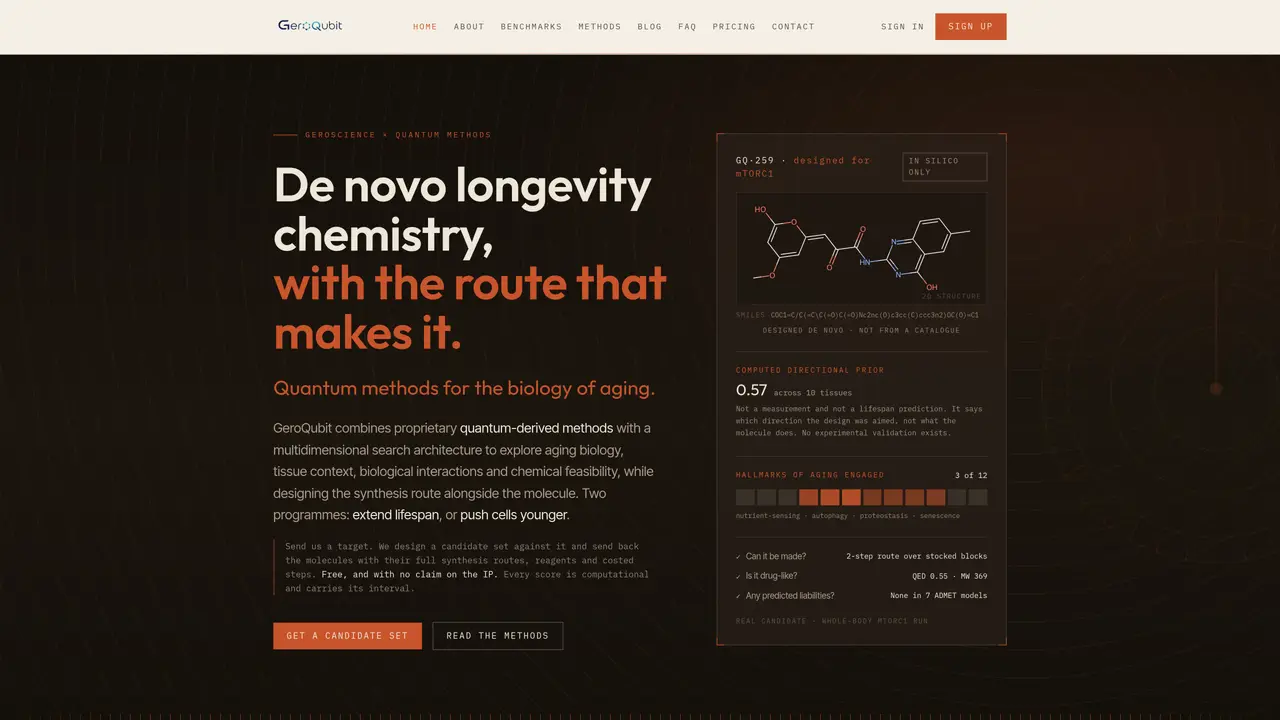
GeroQubit applies proprietary quantum-derived methods to explore aging biology and chemical feasibility simultaneously. The platform designs candidate molecules against specified targets while generating full synthesis routes, reagents, and costed steps. It operates through two programmes: extending lifespan or pushing cells toward a younger state. Users submit a target and receive a set of computationally generated molecules with directional aging scores, tissue-specific responses, and predicted liabilities. The system integrates data from multiple aging datasets and hallmark gene sets to evaluate interventions across ten tissues and twelve hallmarks of aging. Each candidate is represented as a state vector rather than a single score, allowing for nuanced biological context. The platform emphasizes computational design without experimental validation, providing interval estimates for all scores. Outputs include SMILES notation, synthesis routes, and chemistry reports, with no claim on intellectual property.
Key features
- Quantum-derived state vector representation of aging
- Multidimensional search across tissues and hallmarks
- Automated synthesis route generation
- ADMET and liability predictions
- Directional aging scores per tissue
- Candidate export with chemistry reports
- Support for both lifespan and rejuvenation programmes
- Integration with public aging datasets
Use cases
- Designing longevity drugs for academic research
- Developing anti-aging interventions in biotech teams
- Exploring tissue-specific aging interventions
Pros
- Generates de novo molecules with full synthesis routes
- Combines aging biology, tissue context, and chemical feasibility in one search
- Provides directional aging scores across multiple tissues and hallmarks
- Offers free tier for academic research
- Delivers computational outputs with interval estimates
Cons
- No experimental validation of designed molecules
- Limited to computational design without biological testing
- Free tier restricted to one discovery run per month
- Industry pricing not publicly disclosed
Frequently asked questions about GeroQubit
What does GeroQubit do?
GeroQubit uses proprietary quantum-derived methods to explore aging biology and chemical feasibility simultaneously. It designs candidate molecules against specified targets while generating full synthesis routes, reagents, and costed steps, focusing on extending lifespan or pushing cells toward a younger state.
Who is GeroQubit designed for?
The platform is designed for researchers and scientists in geroscience, drug discovery, and longevity research who need computationally generated molecules with directional aging scores, tissue-specific responses, and predicted liabilities.
Does GeroQubit provide experimental validation for its outputs?
No, GeroQubit operates purely in silico and does not provide experimental validation for its candidate molecules. All scores and predictions are computational and include interval estimates.
What kind of outputs does GeroQubit provide?
Outputs include SMILES notation, synthesis routes, chemistry reports, and state vectors representing molecules with directional aging scores, tissue-specific responses, and predicted liabilities across ten tissues and twelve hallmarks of aging.
How does GeroQubit generate synthesis routes for molecules?
GeroQubit integrates reactions as part of its computational genome, meaning the synthesis route exists before the molecule is designed. This approach avoids the common issue of generating a structure first and then guessing the route afterward.
What data sources does GeroQubit use to evaluate aging interventions?
The platform integrates data from multiple aging datasets and hallmark gene sets, including GenAge, CellAge, Open Targets, DrugAge, ChEMBL, GTEx, and the López-Otín hallmarks, covering 15,705 genes with measured aging directions.