
OpenAI builds and deploys advanced AI models like GPT-4o for autonomous agents and workflows.

Neon
$15/moStarting price
1.5MMonthly visits
53Popularity
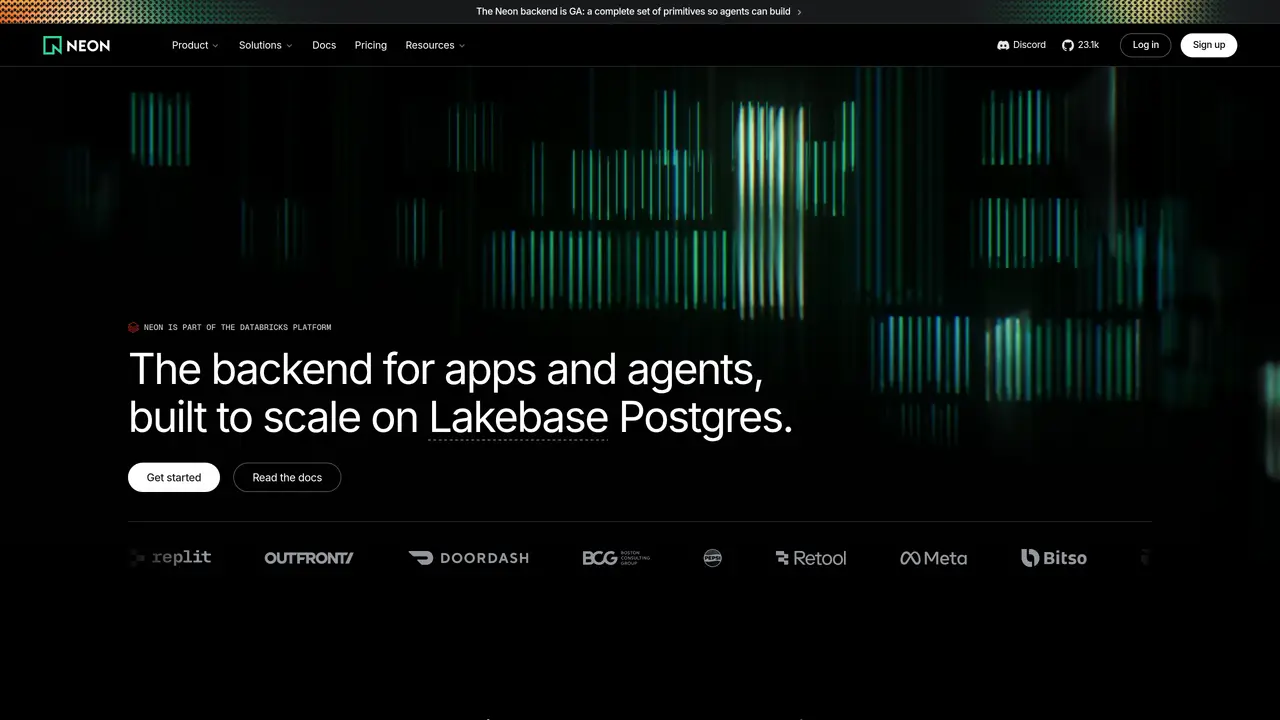
About Neon
Neon provides a backend platform designed for building applications and agents, centered around Lakebase Postgres, a serverless Postgres database that supports branching and automatic scaling. The platform includes managed authentication, S3-compatible object storage, serverless functions, and an AI Gateway for accessing both frontier and open-source models. By decoupling storage and compute, Neon enables instant operations, autoscaling, and efficient resource usage, making it suitable for full-stack application development, bursty workloads, and large database management. Features like instant restore and vector search further enhance its capabilities. Neon is built to scale from early-stage startups to enterprise workloads, offering usage-based pricing and a free tier for experimentation. It is trusted by developers and agent platforms for deploying isolated backends and supporting critical workloads with reliability and performance.
Key features
- Lakebase Postgres with storage-compute separation
- Automatic instance sizing and autoscaling
- Database branching for isolated environments
- Instant restore for quick recovery
- Vector, keyword, and hybrid search
- Serverless functions running close to data
- AI Gateway for unified model access
- S3-compatible object storage
Use cases
- Deploying full-stack applications with backend primitives
- Simplifying database operations for faster development cycles
- Handling bursty workloads without overprovisioning resources
Pros
- Serverless Postgres database with branching and autoscaling
- Managed authentication integrated into the database
- S3-compatible object storage that branches with projects
- AI Gateway providing unified access to multiple models
- Usage-based pricing with a free tier available
Cons
- Pricing details require navigating multiple tiers
- No explicit mention of multi-region support
- Agent plan requires contacting sales for custom rates
Frequently asked questions about Neon
What is Neon and what does it do?
Neon is a backend platform built around Lakebase Postgres, a serverless Postgres database that supports branching and scales automatically. It provides managed authentication, S3-compatible object storage, serverless functions, and an AI Gateway for accessing AI models, enabling developers to build and scale applications efficiently.
Who is Neon designed for?
Neon is designed for developers, startups, and enterprises looking to build and scale applications or agents. It supports use cases ranging from early-stage startups to Fortune 500 companies, offering tools for full-stack development, bursty workloads, and large database management.
How does Neon's pricing model work?
Neon operates on a usage-based pricing model, where users pay for the resources their applications actually consume. It also offers a free tier with 100 projects, including database, storage, functions, and authentication features, with no fixed fees for security and compliance.
What integrations does Neon support?
Neon supports integrations via its AI Gateway, which provides a single API for accessing frontier and open-source AI models. It also offers MCP, CLI, and SDK access for managing environments and operations, making it compatible with various development workflows.
What are the key limitations of Neon?
Neon's reliance on a serverless architecture may introduce latency for certain workloads, and its branching feature, while powerful, requires careful management to avoid resource overhead. Additionally, advanced features like autoscaling and instant restore depend on the decoupled storage-compute model, which may not suit all use cases.
How do I get started with Neon?
To get started with Neon, users can sign up and create a project through the platform's documentation or CLI. The free tier allows experimentation, and users can deploy backends, set up authentication, and integrate AI models via the AI Gateway to begin building applications.
Neon Website Engagement
Last Update: 4 days ago
Total Monthly Visits
0
Bounce Rate
0%
Visit Duration (avg)
0.00s
Pages Per Visit
0
Country Rank
0
United States
Global Rank
0
Category Rank
#0
Computers Electronics & Technology
Monthly Traffic
Traffic Sources
Traffic Share By Country
- United States16.2%
- India13.5%
- Brazil5.8%
- Pakistan3%
- France2.8%