
OpenAI builds and deploys advanced AI models like GPT-4o for autonomous agents and workflows.

Lizard
$5Starting price
0Popularity
About Lizard
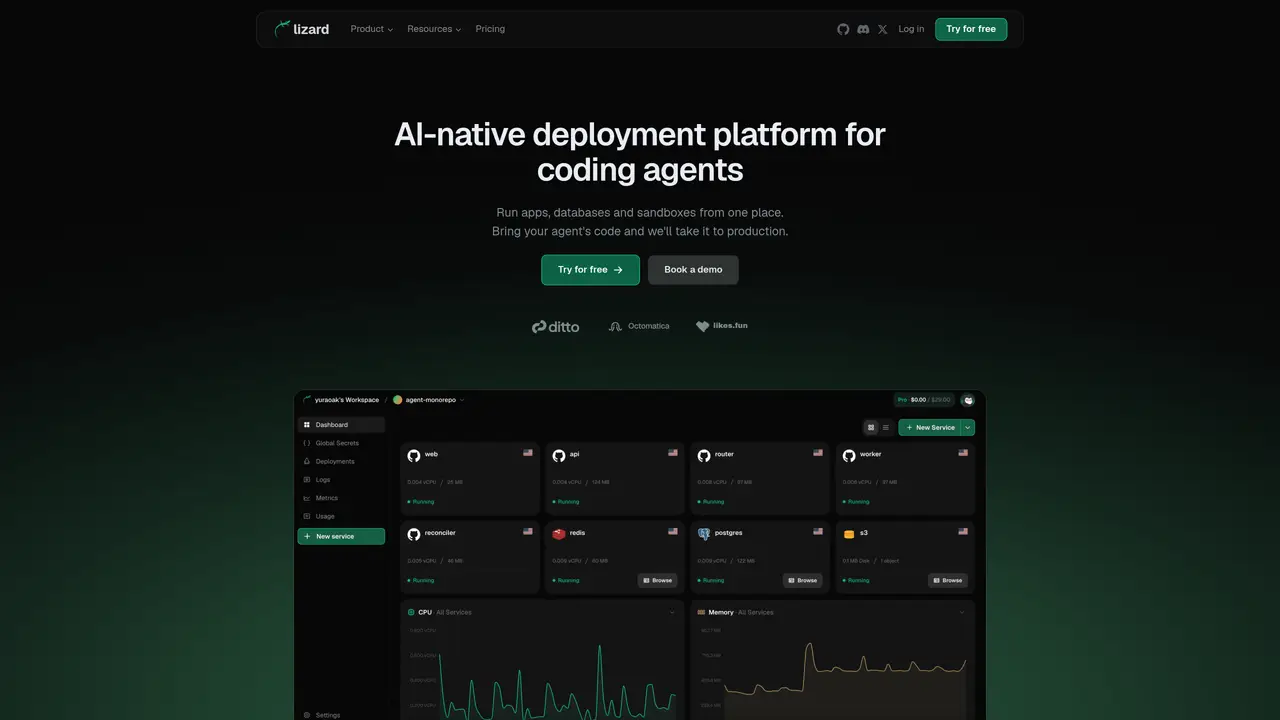
Lizard is an AI-native cloud deployment platform built specifically for coding agents such as Claude Code, Codex, and Cursor. It provides a machine-readable CLI that enables agents to deploy applications, provision managed Postgres, Redis, and S3 databases, and read structured logs without manual intervention. Deployments run in isolated containers, ensuring security and consistency across environments. The platform supports all major languages and frameworks through an automatic build planner, simplifying setup for developers. Lizard bills per second based on measured CPU and memory usage, making it cost-effective for applications with variable workloads compared to traditional platforms that charge for reserved instances. This pricing model aligns costs directly with actual resource consumption, reducing expenses for bursty or intermittent workloads. The platform is designed to integrate seamlessly into agent-driven workflows, enabling end-to-end automation from code to deployment.
Key features
- Machine-readable CLI for agent-driven deployments
- Automatic provisioning of managed Postgres, Redis, and S3 databases
- Structured log access for agents without human intervention
- Per-second billing based on CPU and memory usage
- Isolated containerized deployments for security
- Automatic build planner supporting all major languages and frameworks
- Agent-native architecture for seamless integration with coding agents
- Cost-effective for variable workloads compared to reserved instance pricing
Use cases
- Automated deployment of applications by AI coding agents
- Provisioning and managing databases for agent-driven projects
- Cost-efficient hosting for applications with fluctuating resource demands
Pros
- Designed specifically for coding agents like Claude Code, Codex, and Cursor with machine-readable CLI output
- Supports provisioning managed Postgres, Redis, and S3 databases in a single command
- Per-second billing based on measured CPU, memory, and egress usage, reducing costs for idle or variable workloads
- Every deployment runs in isolated containers, ensuring security and consistency across environments
- Automatic build planner supports all major languages and frameworks without manual configuration
Cons
- Limited to agent-driven workflows, which may not suit traditional manual deployment processes
- Enterprise-grade compliance features like SOC 2 or HIPAA are only available on higher-tier plans
Frequently asked questions about Lizard
How do I deploy from Claude Code, Codex, or Cursor?
Tell your agent to deploy with Lizard. It installs the CLI, runs 'lizard up', and provides machine-readable output for every command, deploy event, and log line, enabling automated error handling and fixes.
Do I need a credit card to try Lizard?
No. The Free plan includes a limited credit amount for your first month without requiring a credit card; you only add one if you choose to upgrade to a paid plan.
Which languages and frameworks does Lizard support?
All major languages and frameworks are supported. Lizard's build planner, lizardpack, automatically detects the stack and generates a multi-stage Dockerfile for deployment.
Can I migrate an app from Railway, Render, or Heroku?
Yes. You can use a coding agent to migrate by installing the Lizard skill and redeploying services, provisioning databases, and importing data with automated support.
Does Lizard support SOC 2 or HIPAA compliance?
SOC 2 and HIPAA compliance are available on the Enterprise plan, along with additional features like SSO/SAML.
How does Lizard's pricing model work?
Lizard bills per second based on measured CPU, memory, and egress usage, ensuring you only pay for active resources and reducing costs for idle or bursty workloads.