
OpenAI builds and deploys advanced AI models like GPT-4o for autonomous agents and workflows.

UsageGate
$19/moStarting price
0Popularity
About UsageGate
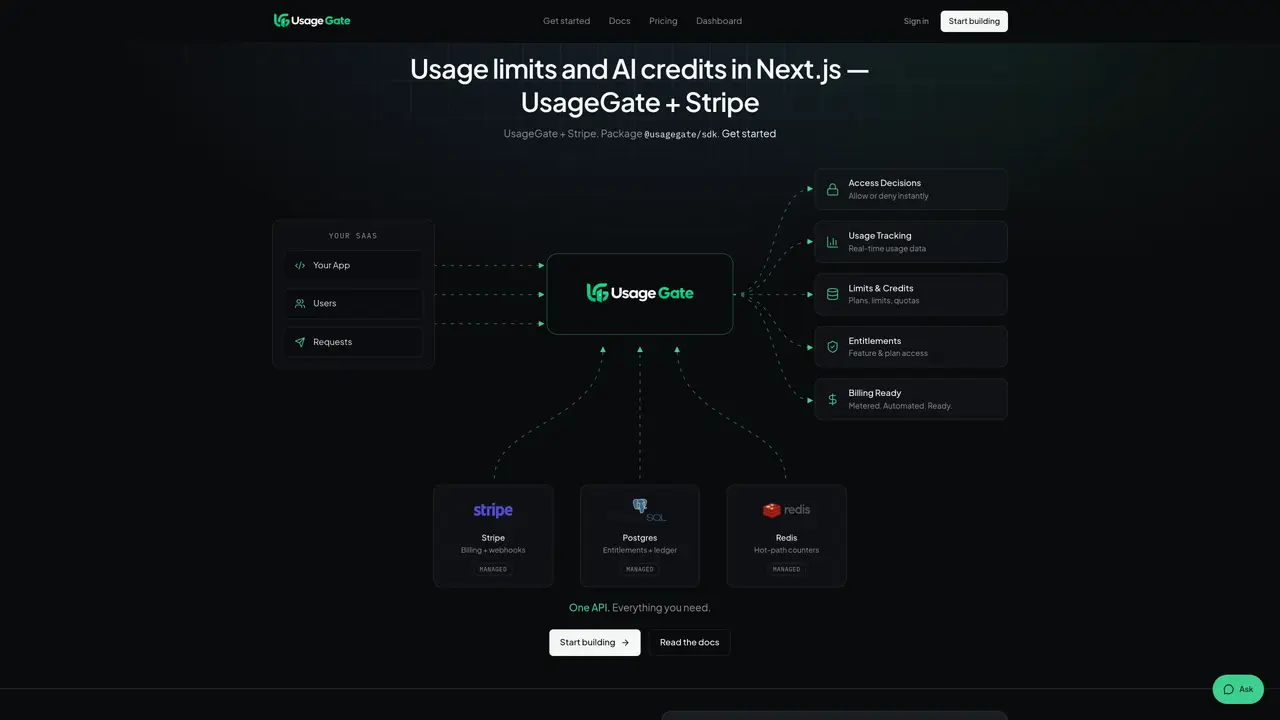
UsageGate provides a managed system for enforcing usage-based limits and tracking AI credits in Next.js applications. It acts as a middleware that checks whether a user can access a specific feature or consume credits before executing resource-intensive operations. The tool integrates with Stripe for billing synchronization and uses Redis for real-time counters and Postgres for maintaining a ledger of entitlements. Developers define plans with specific quotas, such as background removals or API calls, and UsageGate enforces these limits automatically. It supports metered billing, where credits are deducted upon feature usage, and ensures no double-spending occurs even under concurrent requests. The service handles infrastructure management, including Redis and Postgres, allowing developers to focus on product logic rather than building usage-tracking systems from scratch.
Key features
- Usage-based feature limits and AI credit tracking
- Real-time access decisions with Redis-backed enforcement
- Stripe subscription synchronization
- Metered credit consumption
- Concurrency-safe ledger for entitlements
- Plan and quota management via dashboard
- TypeScript SDK for integration
- Postgres ledger for tracking user entitlements
Use cases
- Enforcing feature limits in SaaS applications
- Tracking AI credit usage in Next.js apps
- Metered billing for API calls or resource consumption
Pros
- Real-time usage tracking with sub-10ms response times
- Managed Redis and Postgres infrastructure included
- Stripe subscription synchronization for billing
- Concurrency-safe credit consumption to prevent double-spending
- TypeScript SDK for integration with Next.js applications
Cons
- Limited to Next.js applications
- No free tier beyond basic usage limits
- Requires Stripe integration for billing
Frequently asked questions about UsageGate
What is a 'check' in UsageGate?
A check refers to the canAccess operation, which determines whether an end user can use a specific feature at a given moment. These checks are counted in the UsageGate dashboard as access decisions.
What does a 'consume' operation do?
A consume operation deducts credits from a metered grant, such as API calls, tokens, or feature-specific quotas. Boolean features, which are on or off, are not consumed.
Does UsageGate handle my customers' billing?
No, UsageGate does not handle customer billing directly. It integrates with Stripe to synchronize subscription entitlements and enforce usage limits, while your Stripe account continues to bill your users.
Can I change plans later if my usage grows?
Yes, you can upgrade your plan at any time through the UsageGate dashboard under the Billing section. The plan limits will adjust according to your billing cycle.
How does UsageGate prevent double-spending of credits?
UsageGate uses a managed Postgres ledger and Redis-backed counters to ensure that concurrent requests cannot spend the same credit. The system enforces atomic operations to prevent double-spending.
What happens if a user exceeds their usage limit?
If a user exceeds their limit, UsageGate denies access to the requested feature, returning a 402 status code. The expensive operation is not executed, and the user is informed of the limit being reached.