
AI chatbot for conversation, work, research, coding, and content creation.

Semanticscholar
6.6MMonthly visits
64Popularity
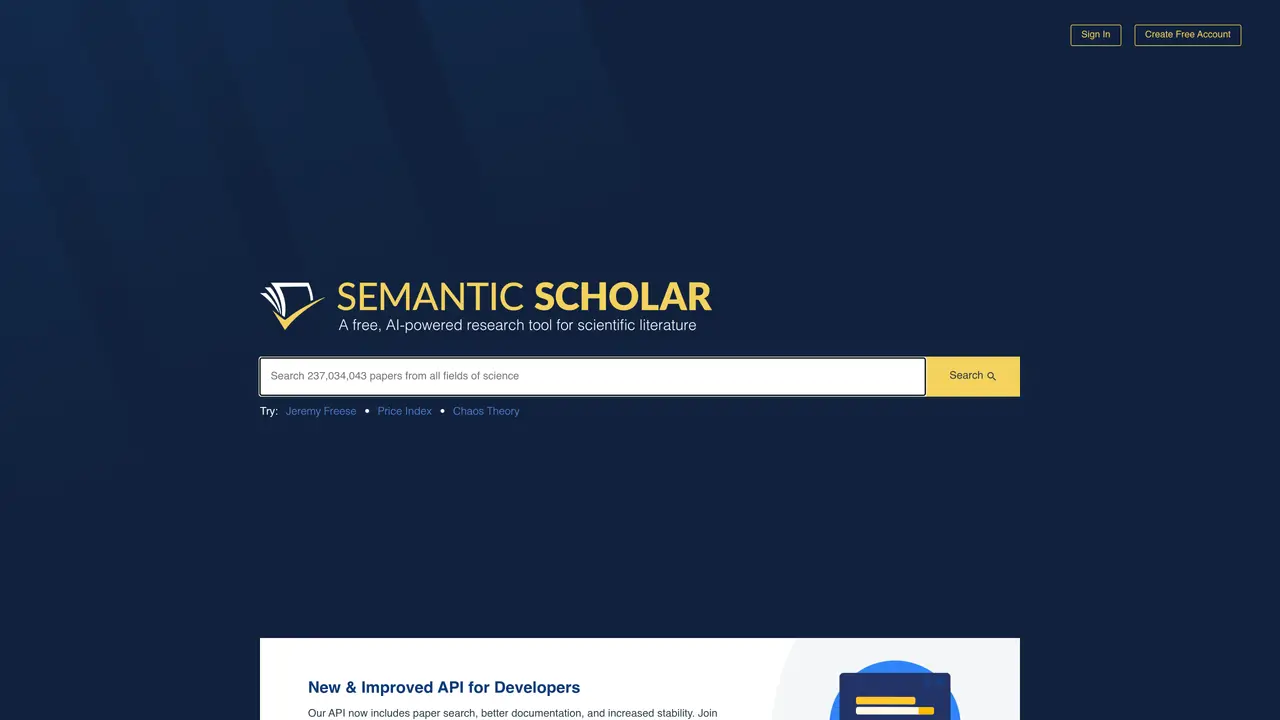
About Semanticscholar
Semantic Scholar is a free AI-powered research tool designed to help users discover, understand, and navigate scientific literature across diverse fields. It leverages advanced machine learning models to analyze and extract key insights from research papers, enabling users to quickly identify relevant publications based on semantic understanding rather than just keywords. The platform aggregates over 211 million papers from various disciplines, including computer science, biology, medicine, and physics, providing a comprehensive and continuously updated repository of scientific knowledge. Semantic Scholar also offers tools like citation analysis, paper recommendations, and author disambiguation to enhance research efficiency. Additionally, its beta program, Semantic Reader, transforms the way users interact with papers by offering an augmented reading experience that highlights key findings, definitions, and connections within the text. The platform is widely used by researchers, students, and professionals seeking to stay informed about the latest developments in their fields. It supports open access to research while maintaining high standards for data accuracy and relevance. Semantic Scholar is developed and maintained by the Allen Institute for AI, ensuring a commitment to advancing scientific discovery through technology.
Key features
- Quickly search for scientific papers relevant to a research topic
- Discover the most relevant publications for a specific field of science
- Utilize the Semantic Reader to gain a better understanding of scientific literature
Use cases
- Researchers looking to stay up-to-date with the latest developments in their field
- Students seeking to access and understand academic literature
- Anyone looking to discover new publications and research relevant to their interests
Pros
- Aggregates over 237 million scientific papers across all fields of science
- Uses AI to understand research semantics and surface relevant publications
- Offers a free, accessible platform for researchers, students, and the public
- Provides an augmented reading experience through Semantic Reader in beta
- Includes a developer API for building scholarly applications
Cons
- Beta features like Semantic Reader may not be fully stable or available for all papers
- Relies on AI interpretation, which may occasionally miss nuanced or emerging research
Frequently asked questions about Semanticscholar
What is Semantic Scholar?
Semantic Scholar is a free, AI-powered research tool designed for scientific literature. It aggregates and organizes papers from all fields of science, enabling users to search and discover relevant publications efficiently.
Who should use Semantic Scholar?
The platform is intended for researchers, students, academics, and anyone interested in accessing and staying updated with the latest scientific literature across diverse fields.
Does Semantic Scholar offer an API for developers?
Yes, Semantic Scholar provides an API that allows developers to integrate paper search functionality into their applications. The API includes improved documentation and increased stability for better usability.
What is Semantic Reader?
Semantic Reader is a beta program that offers an augmented reading experience for scientific papers, making them more accessible and providing richer contextual information to enhance understanding.
How do I get started with Semantic Scholar?
Users can start by visiting the Semantic Scholar website, where they can search for papers directly or create a free account to access additional features and tools.
Is Semantic Scholar affiliated with any organization?
Semantic Scholar is proudly built by the Allen Institute for AI (Ai2), an independent research organization focused on artificial intelligence.
Semanticscholar Website Engagement
Last Update: 9 days ago
Total Monthly Visits
0
Bounce Rate
0%
Visit Duration (avg)
0.00s
Pages Per Visit
0
Country Rank
0
United States
Global Rank
0
Category Rank
#0
Science & Education
Monthly Traffic
Traffic Sources
Traffic Share By Country
- United States18.6%
- India7.9%
- Indonesia7.9%
- Germany4.9%
- China3.8%