
OpenAI builds and deploys advanced AI models like GPT-4o for autonomous agents and workflows.

BrowserGateway
$5Starting price
0Popularity
About BrowserGateway
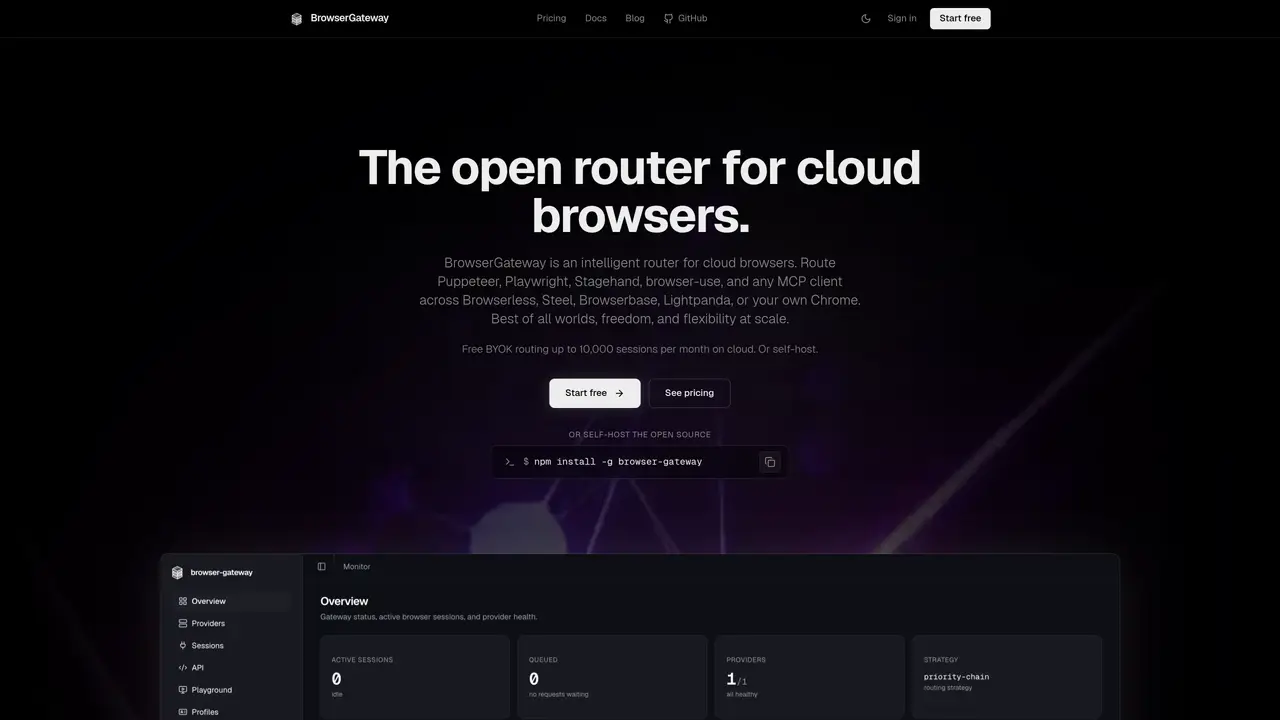
BrowserGateway provides a routing layer for cloud browsers that connects clients such as Puppeteer, Playwright, Stagehand, browser-use, and MCP clients to various browser providers including Browserless, Steel, Browserbase, Lightpanda, or a self-hosted Chrome instance. The tool abstracts provider differences behind a single endpoint, enabling automatic failover, persistent profiles, and session replay. It supports routing strategies like priority chain, round-robin, least-connections, latency-optimized, and weighted distribution, with configurable timeouts and concurrency limits. The platform includes a built-in MCP server offering eight browser tools for AI agents, such as navigation, screenshots, and JavaScript evaluation, without requiring additional setup. Session data including cookies, localStorage, and IndexedDB can be captured and replayed across providers, encrypted at rest with AES-256-GCM. A web dashboard allows managing providers, monitoring live sessions, and editing configurations, while observability features integrate with tools like Datadog and Sentry.
Key features
- One endpoint for multi-provider routing
- Automatic failover with zero downtime
- Persistent profiles with encrypted storage
- Session replay with frame timeline
- MCP server for AI agents
- Configurable routing strategies
- Live session monitoring dashboard
- Observability integration with Datadog, Sentry, PostHog
Use cases
- Running automated browser tests across multiple providers
- Providing AI agents with persistent browser sessions
- Scaling browser automation workloads with failover
Pros
- Single endpoint routing across multiple browser providers
- Automatic failover and persistent session profiles
- Built-in MCP server for AI agent integration
- Session replay with frame-by-frame timeline
- Free BYOK routing up to 10,000 sessions per month
Cons
- Metered features require prepaid credits beyond free tier
- No free tier for session recording or observability
- Enterprise features require contract negotiation
- Self-hosting requires container deployment
Frequently asked questions about BrowserGateway
What is BrowserGateway and what does it do?
BrowserGateway is an intelligent routing layer for cloud browsers that connects clients like Puppeteer, Playwright, and MCP clients to multiple browser providers such as Browserless, Steel, or Browserbase through a single endpoint. It abstracts provider differences, enabling automatic failover, persistent profiles, and session replay.
Who should use BrowserGateway?
The tool suits developers and teams working with browser automation, AI agents, or testing workflows that require scalable, multi-provider browser access. It is designed for those who need flexibility, failover capabilities, and session persistence across different cloud or self-hosted browser environments.
How does BrowserGateway handle pricing?
BrowserGateway offers a free tier with routing for up to 10,000 sessions per month on cloud providers. Users can also self-host the open-source gateway or opt for a cloud-based solution with a prepaid credit wallet for additional features like recording and observability.
What integrations does BrowserGateway support?
BrowserGateway supports integration with Puppeteer, Playwright, Stagehand, browser-use, and any MCP client. It also works with browser providers like Browserless, Steel, Browserbase, Lightpanda, or a self-hosted Chrome instance, and offers observability integrations with tools like Datadog and Sentry.
What are the main limitations of BrowserGateway?
BrowserGateway requires configuration for routing strategies and provider management, which may involve a learning curve for new users. Session replay and persistent profiles depend on provider support and may not be available in all configurations.
How do I get started with BrowserGateway?
To get started, users can install the gateway via npm, configure their preferred providers, and route connections through a single endpoint. The open-source version is available for self-hosting, while cloud-based options provide additional infrastructure management.