
OpenAI builds and deploys advanced AI models like GPT-4o for autonomous agents and workflows.

BrowserOS neo
FreeStarting price
0Popularity
About BrowserOS neo
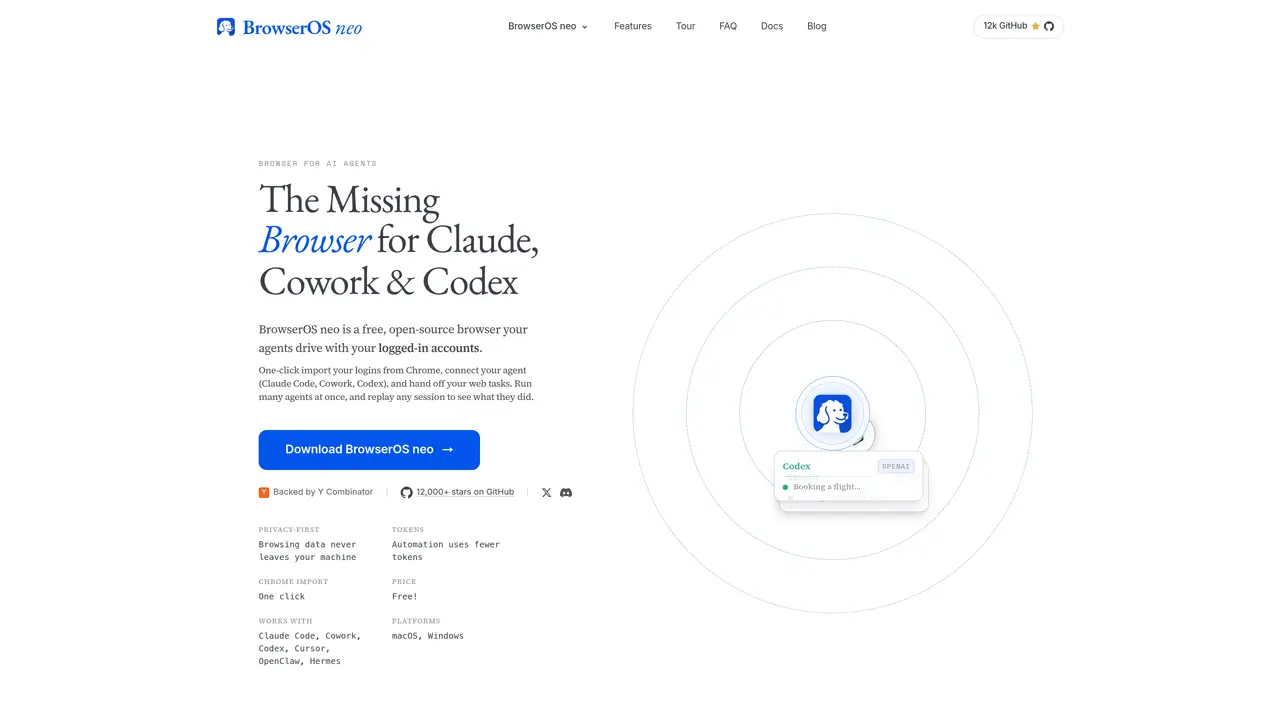
BrowserOS neo is a free, open-source browser designed for AI agents to perform web tasks using the user’s logged-in accounts. It allows agents such as Claude Code, Cowork, Codex, Cursor, OpenClaw, and Hermes to operate in a separate browser instance while the user continues working in their primary browser. The tool enables one-click import of logins from Chrome and connects to supported agents via the MCP standard with no configuration required. Agents can navigate, click, and read web pages in real time, with each agent running in isolated tabs. Sessions are recorded as full-screen, scrubbable videos, enabling users to review, rewind, and verify agent actions. All browsing data remains on the user’s machine, ensuring privacy, and the tool supports parallel execution of multiple agents without interrupting the user’s workflow.
Key features
- One-click login import from Chrome
- Real-time agent browsing with user accounts
- Parallel agent execution in isolated tabs
- Session replay with scrubbable video
- MCP integration for AI agent connectivity
- Compact page snapshots to reduce token usage
- Local storage of all session data
- Cockpit dashboard for monitoring agent activity
Use cases
- Automating repetitive web tasks like form filling or data entry
- Running multiple AI agents in parallel for complex workflows
- Debugging and verifying agent actions through session replay
Pros
- Free and open-source
- Supports real user logins and accounts
- Records and replays agent sessions for verification
- Runs multiple agents simultaneously in isolated tabs
- Privacy-first with all data stored locally
Cons
- Limited to macOS and Windows platforms
- Requires supported AI agents to function
- No cloud-based option for remote access
Frequently asked questions about BrowserOS neo
What is BrowserOS neo and what does it do?
BrowserOS neo is a free, open-source browser designed specifically for AI agents to perform web tasks using the user’s logged-in accounts. It enables agents like Claude Code, Cowork, Codex, Cursor, OpenClaw, and Hermes to operate in a separate browser instance while the user continues working in their primary browser.
How do I connect an AI agent to BrowserOS neo?
Connecting an AI agent to BrowserOS neo is done in one click via the MCP standard. The browser automatically detects supported agents like Claude Code, Cowork, or Codex on your machine and establishes a connection without requiring configuration files or CLI commands.
Can BrowserOS neo run multiple agents simultaneously?
Yes, BrowserOS neo supports parallel execution of multiple agents, each working in isolated tabs. A cockpit dashboard on the new-tab page shows the status of each agent, allowing users to monitor progress without interrupting their own workflow.
Does BrowserOS neo keep my browsing data private?
All browsing data remains on the user’s machine, ensuring privacy. Session history, screenshots, replays, and settings are stored as files on the local disk, and nothing is sent to a cloud dashboard or external servers.
How can I review what an AI agent did in BrowserOS neo?
Every agent session is recorded as a full-screen, scrubbable video. Users can replay these sessions to review, rewind, and verify the agent’s actions, helping to identify mistakes or improve future interactions.
What platforms does BrowserOS neo support?
BrowserOS neo is available for macOS and Windows, with a free download for both platforms.