OpenAI builds and deploys advanced AI models like GPT-4o for autonomous agents and workflows.

JoyMux
$29/moStarting price
0Popularity
About JoyMux
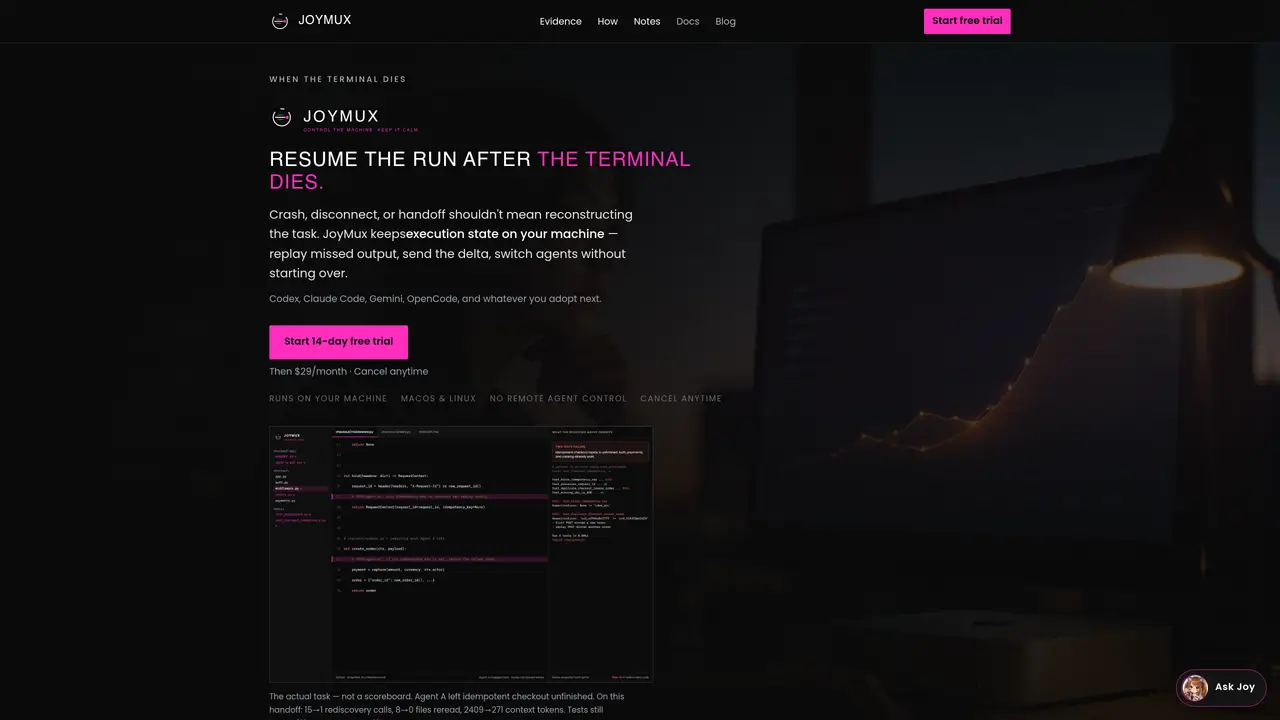
JoyMux provides a local persistent execution layer designed to enhance the reliability and continuity of coding agents by maintaining execution state directly on the user’s machine. It enables interrupted coding sessions to resume seamlessly without requiring tasks to be reconstructed from chat history, which is particularly useful for long-running workflows or complex debugging sessions. The tool supports crash recovery, agent handoffs, and continuous task execution, ensuring that agents can pick up where they left off without losing progress or context. JoyMux preserves detailed execution evidence, including outputs, errors, and context tokens, allowing agents to avoid rediscovering or re-executing previously completed work. This reduces redundant computations and improves efficiency in multi-step coding tasks. The platform supports multiple coding agents, such as Codex, Claude Code, Gemini, and OpenCode, all sharing the same durable execution substrate without requiring separate histories. By operating locally on macOS and Linux systems, JoyMux stores session data on the user’s machine, eliminating dependence on remote agents or cloud-based memory solutions. This local-first approach enhances privacy, reduces latency, and ensures that sensitive data remains under the user’s control.
Key features
- Local persistent execution state storage
- Session resumption after crashes or interruptions
- Shared runtime substrate for multiple coding agents
- Bounded context views to limit context token usage
- Compact delta transmission for efficient handoffs
- Exact execution evidence preservation
- PTY and subprocess isolation
- SQLite-based session persistence
Use cases
- Resume interrupted coding sessions without reconstruction
- Handoff agent tasks while preserving execution history
- Run long sessions that survive disconnections
Pros
- Preserves execution state locally after crashes or interruptions
- Supports multiple coding agents sharing the same runtime substrate
- Reduces agent rediscovery work by maintaining durable execution evidence
- Operates offline with no remote agent control required
- Maintains exact execution evidence including output and context tokens
Cons
- No Windows support
- No cloud-based functionality or remote access
- Requires local machine resources for persistent storage
- Free trial limited to 14 days
Frequently asked questions about JoyMux
What does JoyMux do?
JoyMux provides a local persistent execution layer for coding agents that maintains execution state on the user’s machine. It allows interrupted sessions to resume without reconstructing tasks from chat history, supporting crash recovery, agent handoffs, and long-running work.
Who is JoyMux for?
JoyMux is designed for developers and teams using AI coding agents such as Codex, Claude Code, Gemini, or OpenCode. It is particularly useful for those who need to maintain execution state across interruptions, handoffs, or long-running tasks.
How does JoyMux handle pricing?
JoyMux offers a free trial for 14 days, followed by a monthly subscription model. The tool operates locally on macOS and Linux systems, with pricing details available on the website.
Does JoyMux integrate with existing AI coding agents?
Yes, JoyMux supports multiple coding agents including Codex, Claude Code, Gemini, and OpenCode. It allows these agents to share the same durable execution substrate without separate histories.
What are the main limitations of JoyMux?
JoyMux operates only on macOS and Linux systems and does not support remote agent control. It requires local storage for execution state and does not function as an orchestrator.
How do I get started with JoyMux?
Users can start with a 14-day free trial available on the JoyMux website. After the trial, a subscription is required to continue using the tool. Installation and setup instructions are provided in the documentation.