GitHub hosts HunyuanVideo, Tencent's open-source framework for large-scale video generation models, enabling AI-driven video creation.

Leanroute
FreeStarting price
0Popularity
About Leanroute
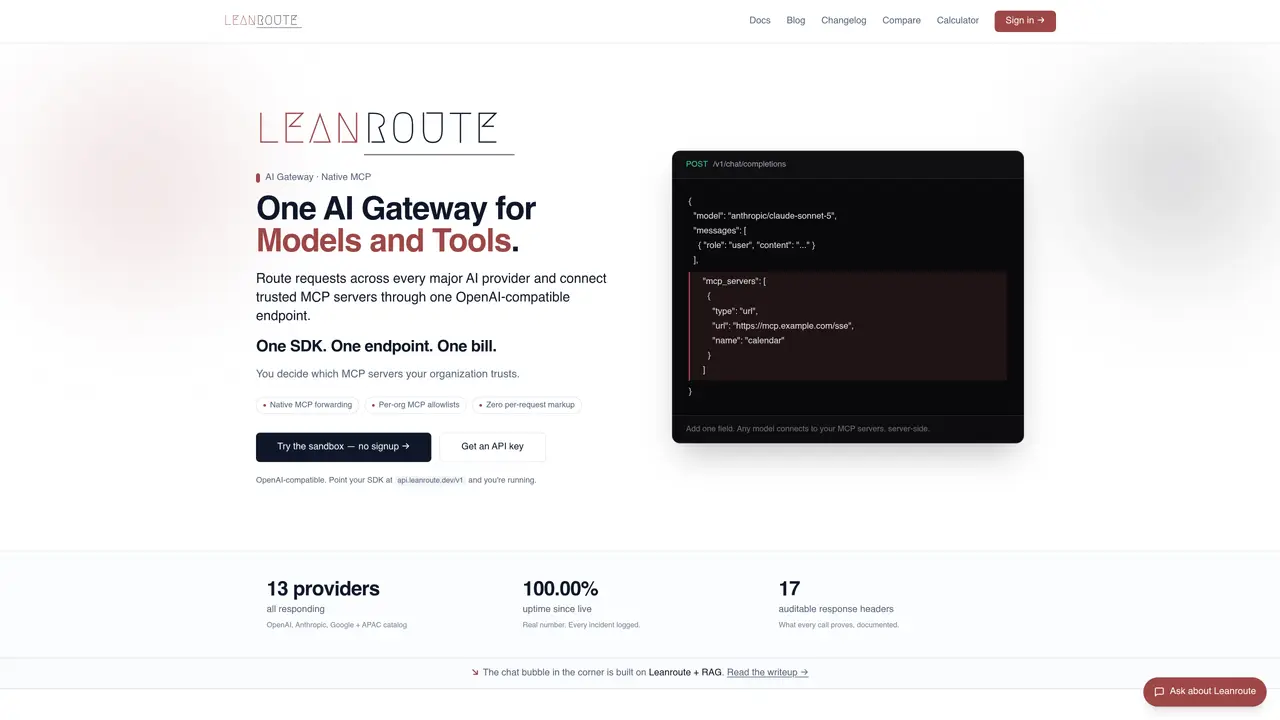
Leanroute acts as an AI gateway that consolidates access to major large language model providers and Model Context Protocol servers through a single OpenAI-compatible endpoint. It allows organizations to route chat completions and other requests to providers such as OpenAI, Anthropic, Google, xAI, DeepSeek, Meta, Groq, Qwen, GLM, Doubao, Kimi, Sarvam, and Krutrim without rewriting code. The service supports native MCP forwarding, enabling models to connect to trusted MCP servers server-side and return responses in OpenAI format. Users can manage per-organization allowlists for MCP servers and control which providers and models are accessible. Leanroute offers two pricing models: a bring-your-own-keys subscription with flat monthly fees and zero per-request markup, or a prepaid credits system with a 5% platform fee at top-up. The gateway includes features like multi-account failover, spend caps, rate limits, and observability across all plans. It is designed for developers and teams building applications that require consistent access to multiple AI models and tools without managing separate integrations.
Key features
- OpenAI-compatible endpoint routing to 13+ LLM providers
- Native MCP server forwarding with allowlist control
- Multi-account failover for provider errors
- Spend caps and rate limits per organization
- Observability and guardrails included
- Vision input support across all providers
- Cheaper-model swaps billed at actual model cost
- Cache hits billed at $0
Use cases
- Consolidating multiple LLM providers under one integration
- Building applications that require MCP tool access
- Managing AI spend with flat-rate pricing and zero markup
Pros
- Single OpenAI-compatible endpoint for multiple LLM providers
- Native MCP forwarding with per-organization allowlists
- Flat pricing with zero per-request markup on inference
- Multi-account failover included on all plans
- Observability and per-organization guardrails included
Cons
- No self-hosted or private single-tenant deployment option currently available
- Managed credits system adds a 5% platform fee at top-up
- Hard 429 rate limits on Starter plan with no overage headroom
Frequently asked questions about Leanroute
What is Leanroute and what does it do?
Leanroute is an AI gateway that consolidates access to major large language model providers and Model Context Protocol servers through a single OpenAI-compatible endpoint. It allows users to route chat completions and other requests to providers like OpenAI, Anthropic, Google, and others without rewriting code.
Who should use Leanroute?
Leanroute is designed for developers and teams building applications that require consistent access to multiple AI models and tools without managing separate integrations. It suits solo builders, small teams, and production applications.
How does Leanroute handle pricing?
Leanroute offers two pricing models: a bring-your-own-keys subscription with flat monthly fees and zero per-request markup, or a prepaid credits system with a 5% platform fee at top-up. Both models ensure no per-request markup on inference costs.
Does Leanroute support integrations with other tools or services?
Yes, Leanroute supports native Model Context Protocol (MCP) forwarding, allowing models to connect to trusted MCP servers server-side and return responses in OpenAI format. It also integrates with 13 major LLM providers through a single endpoint.
What are the limitations of Leanroute?
Leanroute has rate limits and spend caps depending on the pricing plan. The Starter plan includes 30 RPM and 1M requests per month, while the Pro plan offers 150 RPM and 5M requests per month. Enterprise plans may have custom limits.
How do I get started with Leanroute?
To get started, sign up for an account, obtain an API key, and configure your application to use the OpenAI-compatible endpoint at api.leanroute.dev/v1. You can try the sandbox without signing up or get an API key directly.