GitHub hosts HunyuanVideo, Tencent's open-source framework for large-scale video generation models, enabling AI-driven video creation.

OpenRouter
$25Starting price
22MMonthly visits
72Popularity
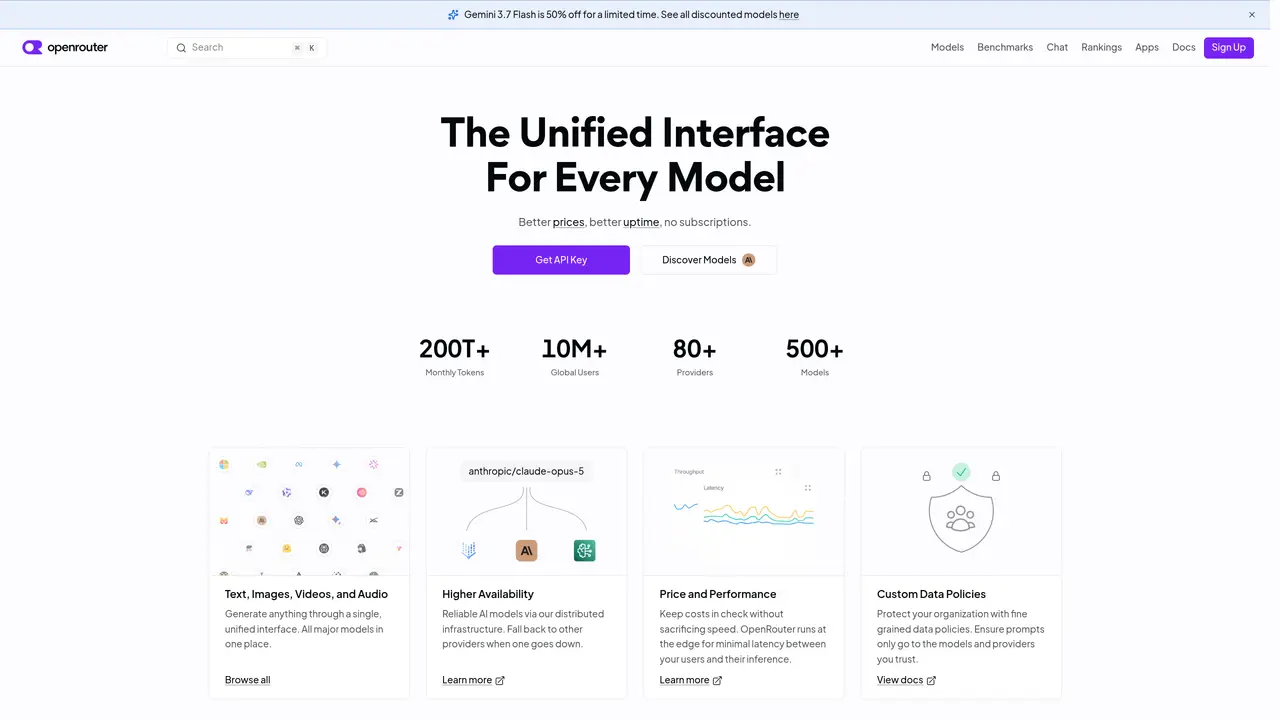
About OpenRouter
OpenRouter provides a single interface to access more than 500 AI models from providers such as ChatGPT, Claude, Gemini, and DeepSeek. It lets users route requests to the most suitable model for each task and automatically switches to a fallback model if the primary one fails, helping applications stay online. The platform supports auto-routing to the lowest-cost model and exposes a unified API so developers can integrate multiple models without rewriting their code. Teams can test new models quickly, compare outputs, and optimize costs by selecting cheaper alternatives for non-critical tasks. OpenRouter is aimed at software engineers, data scientists, and teams building AI-powered products who need flexibility and reliability across providers. It is commonly used to prototype with the latest models, run A/B tests between different LLMs, and deploy production applications that require high availability and cost control.
OpenRouter
New York City, United States
- Headquarters
- New York City, United States
Key features
- Unified API for 500+ AI models
- Auto-route requests to lowest-cost model
- Automatic fallback to maintain uptime
- Switch models per request without code changes
- Supports ChatGPT, Claude, Gemini, DeepSeek and others
- Cost optimization via model selection
- Single integration point for multiple providers
Use cases
- Prototyping with the latest AI models across providers
- Running A/B tests between different LLMs in one application
- Deploying production AI features with built-in redundancy
Pros
- Unified interface to access over 500 AI models from 80+ providers
- Automatic model routing with fallback options for higher availability
- Supports multimodal inputs including text, images, videos, and audio
- Cost optimization through auto-routing to lower-cost models
- Fine-grained data policies for customizable privacy and compliance
Cons
- Requires credit-based pricing model which may not suit all budgeting preferences
- Dependency on third-party providers for model availability and performance
Frequently asked questions about OpenRouter
What is OpenRouter?
OpenRouter is a unified interface that provides access to over 500 AI models from more than 80 providers, including ChatGPT, Claude, and Gemini. It allows users to route requests to the most suitable model for each task while supporting fallback mechanisms for reliability.
Who should use OpenRouter?
OpenRouter is designed for software engineers, data scientists, and teams building AI-powered products who need flexibility, reliability, and cost control across multiple AI models and providers.
How does OpenRouter handle pricing and costs?
OpenRouter allows users to select models based on cost and performance, with options to route requests to the lowest-cost model for non-critical tasks. It operates on a credit-based system where credits can be used with any model or provider.
Does OpenRouter support integrations with other tools?
Yes, OpenRouter provides a unified API that is fully OpenAI-compatible, enabling integration with existing tools and workflows without requiring code rewrites.
What are the key features of OpenRouter?
Key features include model routing, fallback mechanisms for higher availability, custom data policies for security, and support for multimodal inputs such as text, images, videos, and audio.
How do I get started with OpenRouter?
To get started, users can create an account, buy credits, and generate an API key to begin making requests. The platform supports both individual users and teams through organizational setups.
OpenRouter Website Engagement
Last Update: 9 days ago
Total Monthly Visits
0
Bounce Rate
0%
Visit Duration (avg)
0.00s
Pages Per Visit
0
Country Rank
0
United States
Global Rank
0
Category Rank
#0
Ai Chatbots & Tools
Monthly Traffic
Traffic Sources
Traffic Share By Country
- United States16%
- India11%
- China9.8%
- Germany4.6%
- Indonesia3.9%