
Scales efficient language processing with open-source accessibility.
357M visits/mo+1%#2 Coding & Development

Tesla’s AI stack powers Full Self-Driving, Optimus humanoid robots, and real-world autonomy with neural networks, custom hardware, and Dojo-scale training.
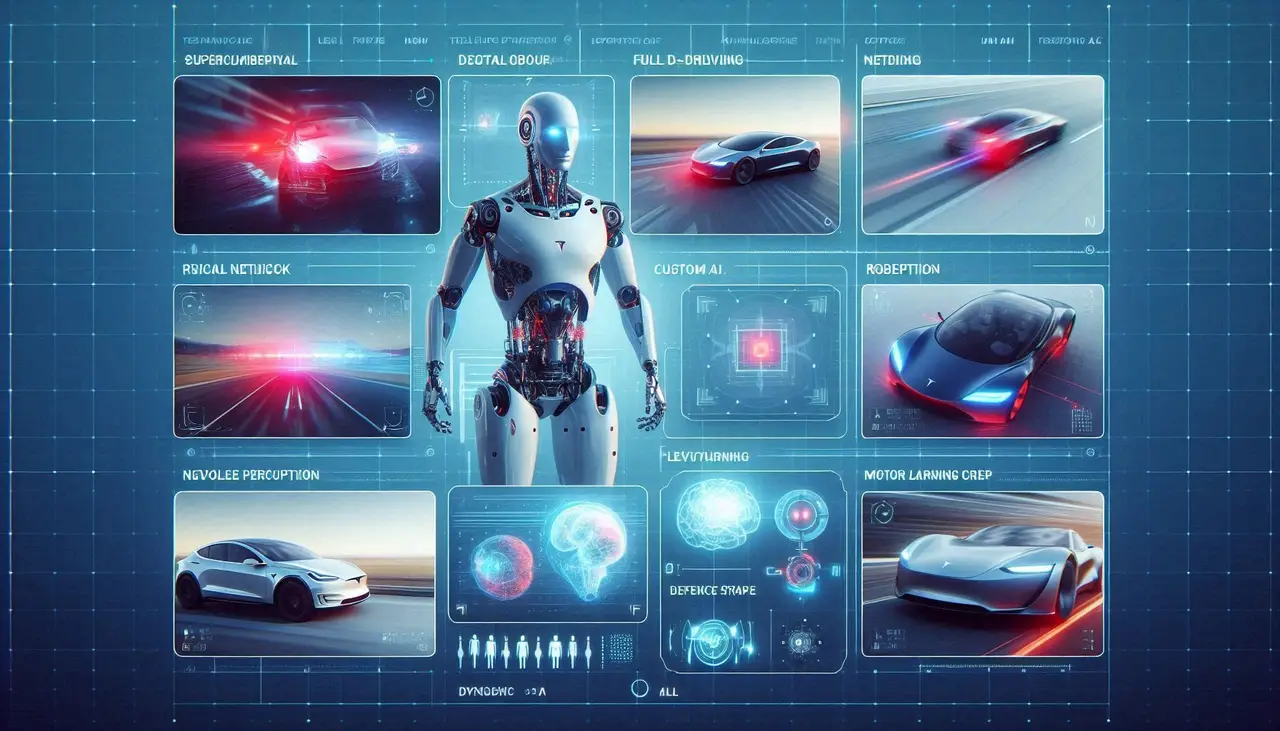
Tesla AI is an integrated autonomy and robotics platform designed to unify Full Self-Driving capabilities, Optimus humanoid robots, AI inference hardware, and Dojo-scale neural network training. The platform combines computer vision, motion planning, controls, and fleet learning to enable real-world physical AI systems. It serves autonomy researchers, robotics engineers, AI infrastructure teams, and organizations deploying large-scale AI in physical environments. Tesla AI provides end-to-end workflows for vehicle autonomy, humanoid robot development, and hardware-software co-design, bridging perception, planning, and real-world interaction. The stack includes neural networks trained on fleet-scale video data, simulation environments, and custom inference chips optimized for autonomy and robotics workloads. By integrating these components, Tesla AI enables the development of advanced AI systems capable of operating in dynamic, real-world environments with high precision and adaptability. The platform is particularly suited for teams focused on autonomous systems, robotics, and AI-driven physical applications where real-time decision-making and interaction are critical.
Tesla
Palo Alto, United States · Founded 2003
Tesla AI provides an integrated platform for autonomy and robotics, combining Full Self-Driving, Optimus humanoid robots, AI inference hardware, and neural network training. It enables real-world physical AI systems through computer vision, motion planning, and fleet learning.
The platform is designed for autonomy researchers, robotics engineers, AI infrastructure teams, and organizations deploying large-scale AI in physical environments. It suits teams focused on autonomous systems and robotics.
Tesla AI integrates neural networks trained on fleet-scale video data, simulation environments, and custom inference chips. It combines perception, planning, and real-world interaction to enable autonomous systems and robotics applications.
Key components include Full Self-Driving, Optimus humanoid robots, AI inference hardware, Dojo-scale neural network training, and end-to-end workflows for vehicle autonomy and humanoid robot development.
Organizations deploying large-scale AI in physical environments, such as those developing autonomous vehicles or humanoid robots, typically use Tesla AI. It is suited for teams requiring real-time decision-making and interaction in dynamic environments.
To get started, visit the Tesla AI website to explore the platform's capabilities and access documentation or resources. The platform is designed for teams with expertise in autonomy, robotics, or AI infrastructure.
tesla.com · third-party estimates from Similarweb
Last 4 months · grows by one month every month
Share of visits · estimated visits
Other countries: 31.1%
How people reach this site from other AI tools
288K a month · 0.9% of all visits
Coding & Development · Sep 2026
Traffic figures are third-party estimates, good for scale and trends; they can differ from a company's own numbers. Updated monthly.
We use essential cookies to run aitoolnavio™, and optional cookies to analyze traffic and measure our marketing. You choose what we use — optional cookies stay off unless you turn them on. See our Privacy Policy.
One short email a week: fresh tools worth trying, honest takes and the updates that actually matter. No spam, unsubscribe any time.
Scales efficient language processing with open-source accessibility.
Collaboration and version control platform for software development and AI model hosting.
Integrates AI into Airtable to analyze data, summarize insights, draft content, and automate workflows without prior AI experience.
AI-powered website builder that generates a professional site in under a minute and includes tools for content, SEO, and analytics.
Unified platform to access and switch between hundreds of AI models like ChatGPT, Claude, and Gemini via a single API.
xAI builds Grok frontier AI models for reasoning, coding, voice, images, video, enterprise workflows, and developer APIs.
Meta AI enhances machine learning, NLP, and computer vision capabilities.
Crowdsourced platform for blind, side-by-side AI model comparisons with a public leaderboard.
Customize, deploy, and control AI models securely.
Independent benchmarks comparing AI models on quality, speed, and cost across multiple capabilities.
Chat, build, and explore with open AI models.
Develop, run data jobs, transform datasets, leverage ML algorithms for actionable insights.
Matched on what this tool does — grouped by the job you would be replacing.
matches Optimus humanoid robot development platform · Hardware-software co-design for autonomy
Deploy humanoid robots like Digit for repetitive warehouse material handling and use Arc to manage robot fleets and workflows in existing facilities.
LimX Dynamics provides humanoid robots, biped platforms, and Physical AI systems for real-world robotics research and deployment.
Deploy humanoid general-purpose robots powered by Carbon AI to perform real-world work tasks with dexterous hands, perception, and physical reasoning.
A general-purpose humanoid robot designed to perform household tasks and physical assistance using Helix AI for real-world autonomy.
matches Full Self-Driving and Autopilot autonomy stack · Computer vision and motion planning systems · Real-time inference with Tesla-designed chips
matches Custom AI inference hardware and silicon · Dojo-scale neural network training infrastructure · Hardware-software co-design for autonomy
Streamline autonomous system development, testing, and deployment.
Licensed Level 4 autonomy stack for robotaxis and fleets, proven with 1.7M+ autonomous miles and zero at-fault incidents.
Create, test, develop high-precision maps, deep learning models, deploy, and operate autonomous vehicles seamlessly.
Unified Arm compute platform spanning Neoverse servers, Cortex, C1, Mali, and Ethos for consistent, scalable AI deployment from cloud to edge.
Hardware and software stack for high-performance AI inference workloads
Develop and deploy models quickly, leverage Google's cutting-edge hardware, and accelerate ML initiatives with low-latency TPU.