
OpenAI builds and deploys advanced AI models like GPT-4o for autonomous agents and workflows.

Lenz
$0 / monthStarting price
0Popularity
About Lenz
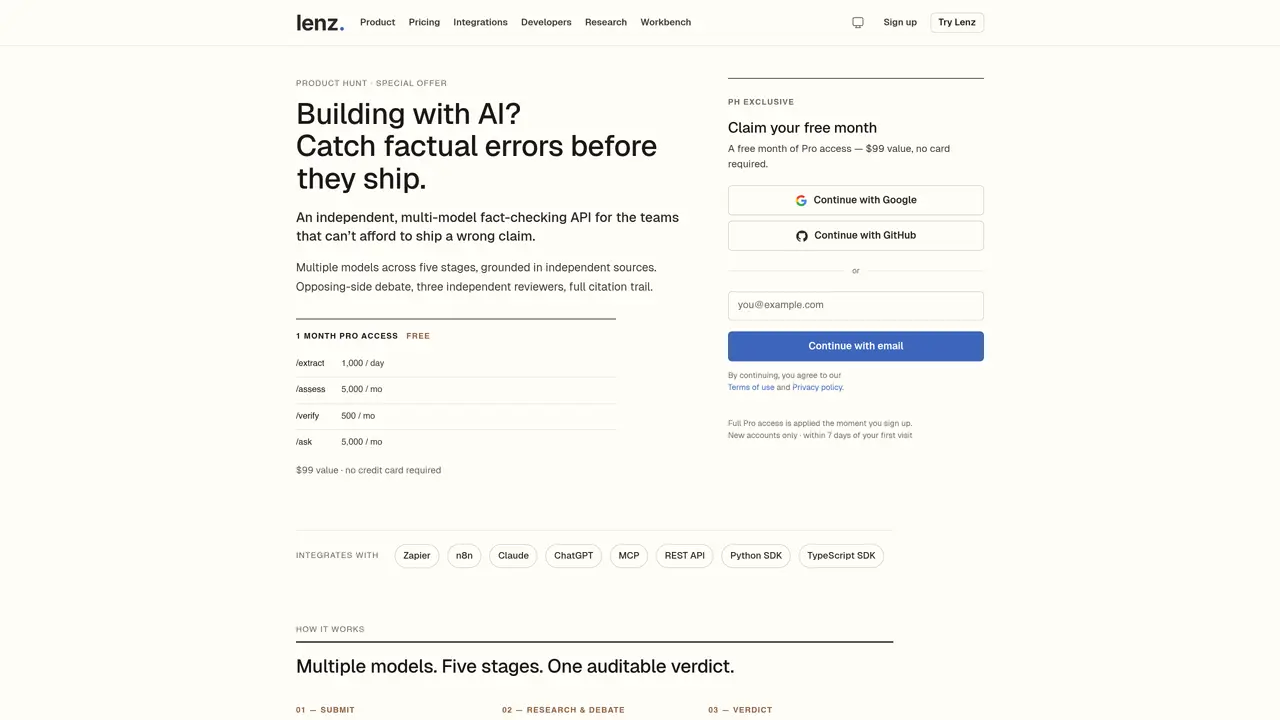
Lenz provides an independent, multi-model fact-checking API designed to verify AI-generated claims before they are published or integrated into workflows. The service structures verification into five stages: claim framing, research and debate, panel review, verdict issuance, and machine-readable output. It uses multiple models to argue opposing sides from authoritative sources, preserving disagreement rather than averaging it. The API returns structured verdicts with scores, citations, and reasoning traces, enabling automated workflow branching. It integrates with common AI tools and platforms via SDKs and APIs, supporting use cases such as content verification for newsletters, CRM data enrichment, regulated claims auditing, agent guardrails, and customer support responses. The system is designed for teams that cannot afford to publish incorrect information, offering a traceable audit trail for high-stakes content.
Key features
- Claim framing to remove ambiguity
- Opposing-side debate between models
- Three independent reviewers per claim
- Structured verdicts with scores and citations
- API endpoints for /extract, /assess, /verify, /ask
- Python and TypeScript SDKs
- Zapier and n8n integrations
- Monthly credit-based pricing model
Use cases
- Verifying AI-generated content in newsletters and blog posts
- Auditing enriched CRM records for factual accuracy
- Regulated claims verification in health, finance, and legal documents
Pros
- Multi-model verification pipeline with opposing-side debate
- Independent sourcing and full citation trail
- Machine-readable verdicts for automated workflows
- Integrates with Zapier, n8n, Claude, ChatGPT, MCP, REST API, Python SDK, TypeScript SDK
- Free tier available with 100 credits per month
Cons
- Limited to factual claim verification use cases
- Requires structured, falsifiable claims as input
- No offline or desktop application
Frequently asked questions about Lenz
What does Lenz do?
Lenz is an independent, multi-model fact-checking API that verifies AI-generated claims before publication or integration into workflows. It structures verification into five stages—claim framing, research and debate, panel review, verdict issuance, and machine-readable output—using multiple models to argue opposing sides from authoritative sources.
Who is Lenz designed for?
Lenz is designed for teams that cannot afford to publish incorrect information, such as newsletters, CRM data enrichment, regulated claims auditing, agent guardrails, and customer support responses. It is particularly useful for organizations handling high-stakes content where an audit trail is critical.
How does Lenz integrate with existing tools?
Lenz integrates with common AI tools and platforms via SDKs and APIs, including Zapier, n8n, Claude, ChatGPT, MCP, REST API, Python SDK, and TypeScript SDK. It supports workflows like AI Draft to Publish, Data Enrichment to CRM, and Agent Guardrails.
What are the key stages of Lenz's verification process?
Lenz's verification process includes five stages: claim framing to remove ambiguity, research and debate where two models argue opposing sides, panel review, verdict issuance with a score and citations, and machine-readable output for automated workflow branching.
Does Lenz offer a free trial?
Yes, Lenz offers a free month of Pro access for new accounts within 7 days of the first visit, with no credit card required. The free access is applied immediately upon email verification.
How does Lenz handle disagreements between models?
Lenz preserves disagreement between models rather than averaging it away. It returns a verdict grounded in independent sources, not model consensus, ensuring a traceable audit trail for high-stakes content.