
Open-source platform combining product analytics, session replay, A/B testing, and feature flags in one toolkit for product engineers.

Triall
$15Starting price
3.2KMonthly visits
8Popularity
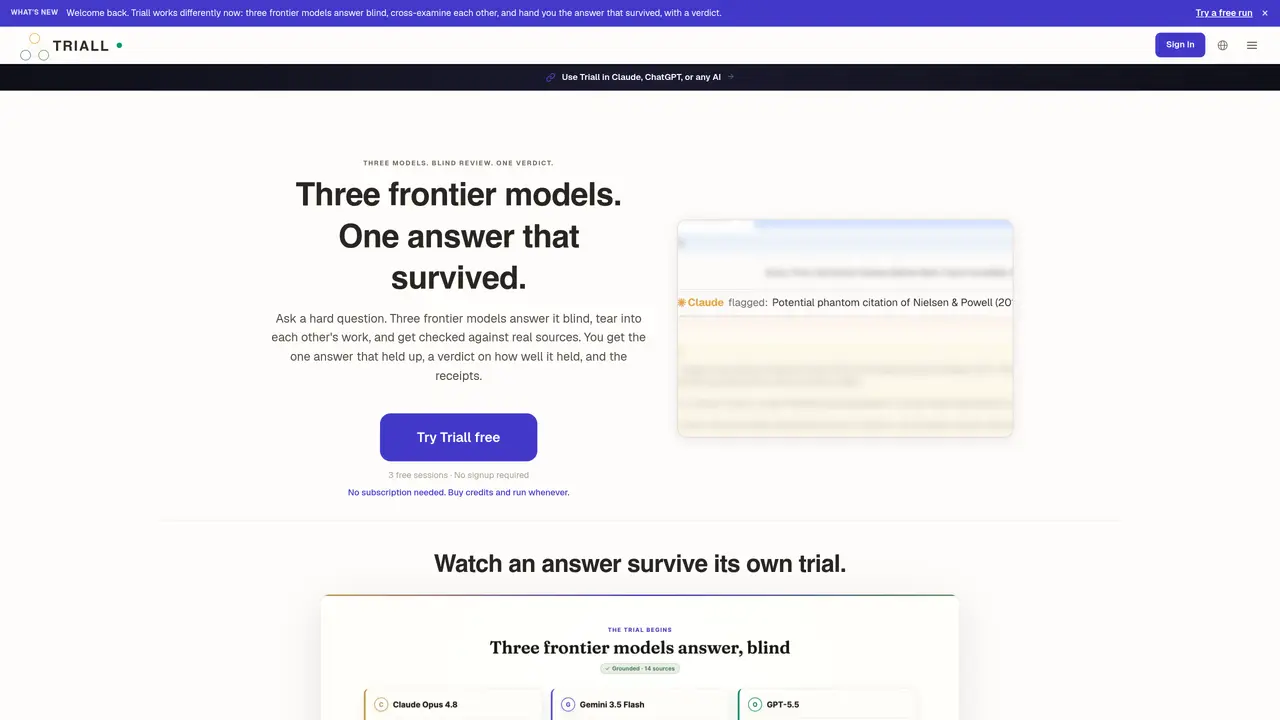
About Triall
Triall is an AI verification platform that subjects hard questions to a multi-model trial, where three frontier large language models answer independently, blindly review and critique each other’s work, and converge on the strongest response. Before any model answers, Triall retrieves real-time web sources to ground reasoning in evidence rather than memory alone. Each model writes its response in isolation to prevent anchoring, and the tribunal phase strips authorship to ensure unbiased evaluation. The models then attack and rank one another’s outputs, with the highest-ranked answer undergoing adversarial refinement to address potential weaknesses. Factual claims are verified against external sources, and the final verdict—Survives, Weakened, or Refuted—is delivered with confidence and risk scores. Designed for users who need auditable, high-confidence AI outputs, Triall is particularly suited for legal, technical, strategic, or research contexts where flawed answers carry significant consequences. It integrates directly into chat interfaces like Claude and ChatGPT or via API, enabling seamless deployment without leaving the user’s workflow. The platform emphasizes transparency, providing a full reasoning trail and receipts for every claim, which is critical for compliance reviews, policy analysis, or high-stakes decision-making.
Key features
- Runs three independent large language models in parallel
- Blind peer-review and stress-testing of answers
- Convergence analysis to identify consensus
- Adversarial refinement and devil's-advocate checks
- Web-based claim verification
- Evidence-tagged verdicts with confidence scoring
- Over-compliance risk scoring
- Transparent reasoning trail for auditing
- Multi-model iterative workflow
Use cases
- Verifying AI-generated legal or policy analysis for compliance
- Stress-testing technical or research answers for accuracy
- Auditing AI outputs in high-stakes strategic decision-making
Pros
- Runs three frontier large language models in parallel for independent reasoning
- Blind peer-review and adversarial cross-examination between models to reduce correlated errors
- Convergence analysis and iterative refinement to strengthen the most robust answer
- External web-based claim verification for factual grounding and traceability
- Provides a single evidence-tagged verdict with confidence and over-compliance risk scores
Cons
- Requires multiple model runs, which may increase latency compared to single-model outputs
- Limited to the models and web sources integrated by the platform
- No guarantee of absolute correctness, only improved reliability through multi-model consensus
Frequently asked questions about Triall
What does Triall do?
Triall runs three frontier AI models in parallel, has them blindly peer-review and stress-test each other’s answers, and produces a single evidence-tagged verdict with confidence and risk scores. It is designed to catch hallucinations and provide auditable, verifiable AI outputs.
Who is Triall for?
Triall suits users who require higher-confidence, auditable, and verifiable AI answers for legal, technical, strategic, or research queries, especially in contexts where accuracy and traceability are critical.
How does Triall pricing work?
Triall offers pay-as-you-go credits or monthly subscription plans with varying session allowances and features. Credits can be purchased without a subscription and never expire, while plans include different levels of iterations, context windows, and web search limits.
Can I integrate Triall with other tools?
Yes, Triall can be used inside chat interfaces like Claude and ChatGPT or via a REST API for integration into custom applications. It functions as a tool within these platforms, running the full multi-model pipeline in the background.
What happens if an answer is weakened or refuted?
If an answer is weakened, users can request a repair to address the issues flagged by the tribunal. A refuted answer indicates the models could not converge on a reliable response, and users are prompted to refine their query or seek alternative verification.
How does Triall ensure independence between models?
Triall enforces isolation by having each model answer independently without knowledge of the others’ responses. The tribunal phase strips authorship before cross-examination, preventing bias and ensuring models critique each other’s reasoning rather than conforming to a dominant view.
Triall Website Engagement
Last Update: 9 days ago
Total Monthly Visits
0
Bounce Rate
0%
Visit Duration (avg)
—
Pages Per Visit
0
Country Rank
0
United States
Global Rank
0