Build teams of AI agents that collaborate, automate workflows, and complete complex tasks together.

Claude Octopus
$0.07Starting price
0Popularity
About Claude Octopus
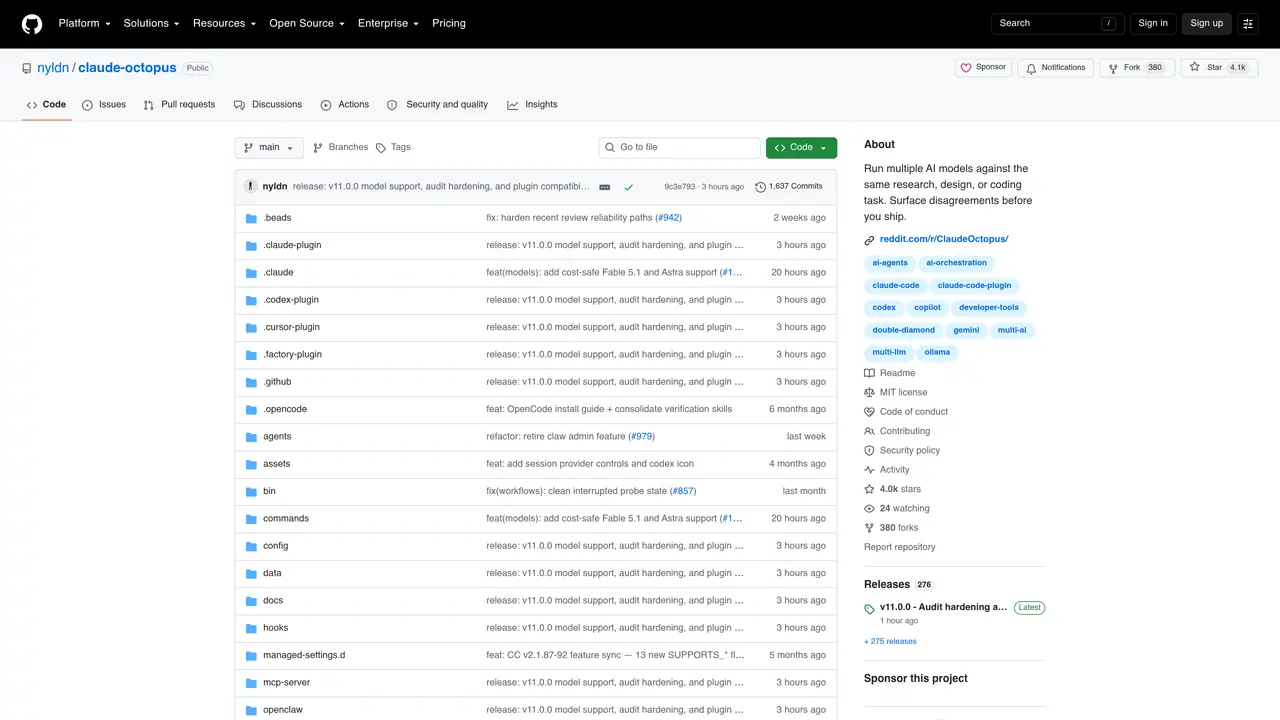
Claude Octopus is an open-source multi-LLM orchestration plugin for Claude Code designed to mitigate single-model blind spots by coordinating up to twelve AI providers—including Claude, Codex, Copilot, Ollama, Perplexity, and others—alongside the built-in Claude Code host. It operates in two modes: native Claude workflows for routine tasks and Octopus for escalated scenarios requiring adversarial review or multi-model validation. The tool enforces structured workflows with role-specific AI personas, reusable skills, and quality gates that flag disagreements before outputs reach production, typically at a 75% consensus threshold. It supports persistent memory integration with systems like claude-mem and agentmemory, ensuring context retention across sessions. Dark Factory mode enables autonomous spec-to-code pipelines, automating research, definition, development, and delivery phases while allowing users to review final outputs rather than intermediate steps. Octopus remains dormant until explicitly invoked, minimizing overhead for standard tasks while providing on-demand multi-model validation for complex engineering challenges.
GitHub, Inc.
San Francisco, California, US · Founded 2008
- Founders
- Tom Preston-Werner, Chris Wanstrath, PJ Hyett, Scott Chacon
- Founded
- 2008
- Headquarters
- San Francisco, California, US
- Legal status
- Subsidiary of Microsoft (NASDAQ: MSFT)
Key features
- Coordinates up to eight AI providers in parallel
- Enforces adversarial quality gates with consensus thresholds
- Activates role-specific AI personas and reusable skills
- Supports structured workflows (Discover→Define→Develop→Deliver)
- Automates natural-language intent routing to workflows
- Includes Dark Factory mode for spec-to-code pipelines
- Provides multi-AI validation, testing, and PR/CI monitoring
- Reduces single-model blind spots through cross-checking
Use cases
- Automating complex engineering tasks with multi-model validation
- Running spec-to-code pipelines in Dark Factory mode
- Performing multi-AI testing and CI monitoring without manual provider switching
Pros
- Coordinates up to twelve AI providers, including local and API-based models, for cross-model validation
- Supports structured workflows (Discover→Define→Develop→Deliver) with role-specific AI personas and reusable skills
- Enforces adversarial quality gates with a default 75% consensus threshold to surface disagreements before deployment
- Integrates with persistent memory systems like claude-mem and agentmemory for context retention across sessions
- Offers Dark Factory mode for autonomous spec-to-code pipelines, reducing manual oversight
Cons
- Requires explicit activation via /octo:* commands, adding a step to workflow initiation
- Some external providers (e.g., Qwen) now require API-key or Coding-Plan auth, limiting free-tier access
- Complexity increases with multi-model orchestration, potentially requiring setup for multiple integrations
Frequently asked questions about Claude Octopus
What does Claude Octopus do?
Claude Octopus coordinates multiple AI models to validate outputs, enforce quality gates, and automate structured workflows like research, development, and delivery. It surfaces disagreements between models before deployment to reduce blind spots.
Who is Claude Octopus for?
It suits developers and teams working on complex engineering tasks who need multi-model validation, adversarial review, or autonomous spec-to-code pipelines without manually managing multiple AI services.
How does the consensus gate work?
The default 75% consensus threshold requires multiple AI models to agree on outputs before proceeding, flagging disagreements for review. This ensures higher reliability by cross-checking results across providers.
What integrations does it support?
It supports twelve providers, including local models like Ollama and API-based services such as Codex, Copilot, Perplexity, and OpenRouter. Some require existing subscriptions or API keys, while others run locally for free.
How do I get started with Claude Octopus?
Install the plugin via Claude Code, then use /octo:* commands to activate Octopus workflows. No external providers are required to start; add them incrementally as needed for specific tasks.
Can I use it without external AI providers?
Yes. Octopus works with just the built-in Claude Code host and can be extended with additional providers later. External models are optional and only used within explicit workflows.