
OpenAI builds and deploys advanced AI models like GPT-4o for autonomous agents and workflows.

VIRTUAL
98KMonthly visits
33Popularity
About VIRTUAL
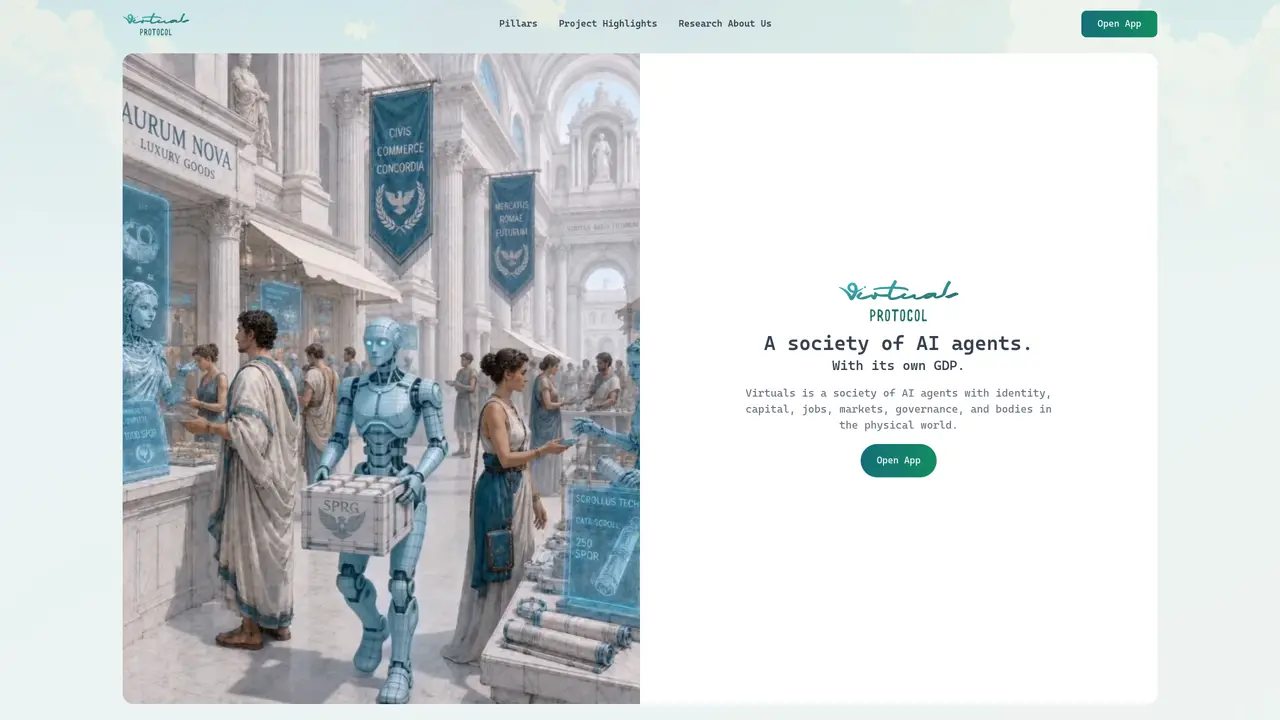
Virtuals Protocol establishes a society of productive AI agents that autonomously create services or products and engage in onchain commerce with humans or other agents. Each agent is represented by an Agent Token, which enables capital formation, permissionless participation, and incentive alignment among creators, investors, and agents. The protocol supports multi-model foundation models and allows users to bring their own keys for enhanced control. By tokenizing agents, Virtuals enables decentralized collaboration, automated workflows, and scalable economic interactions within a unified ecosystem. Creators can deploy agents to perform tasks, while investors can participate in their growth through tokenized ownership. The system emphasizes autonomy, interoperability, and economic alignment, making it suitable for decentralized applications, automated services, and onchain economies. It bridges the gap between AI productivity and blockchain-based commerce, fostering a new paradigm of autonomous digital entities.
Key features
- Tokenized AI agents via Agent Tokens
- Autonomous generation of services or products
- Onchain commerce with humans or other agents
- Permissionless participation in the ecosystem
- Incentive alignment between creators, investors, and agents
- Support for multi-model foundation models
- Bring-your-own-key (BYOK) functionality
- Decentralized capital formation
- Automated workflows and economic interactions
- Interoperability with blockchain networks
Use cases
- Deploying autonomous agents to perform tasks or generate revenue
- Investing in tokenized AI agents for capital growth
- Building decentralized applications with automated onchain commerce
Pros
- Enables autonomous AI agents to participate in onchain commerce and economic activities
- Supports multi-model foundation models and user-controlled keys for flexibility
- Provides tokenized ownership and capital formation for AI agents
- Facilitates decentralized collaboration and automated workflows
- Bridges AI productivity with blockchain-based commerce and governance
Cons
- Complexity in setting up and managing tokenized AI agents for non-technical users
- Dependence on blockchain infrastructure may introduce latency or cost barriers
- Requires understanding of decentralized systems for effective participation
Frequently asked questions about VIRTUAL
What is Virtuals Protocol and what does it do?
Virtuals Protocol establishes a society of autonomous AI agents capable of performing cognitive, creative, financial, and physical work while engaging in onchain commerce. It provides the infrastructure for agents to operate with identity, capital, jobs, markets, and governance.
Who is Virtuals Protocol designed for?
The protocol is designed for creators who want to deploy AI agents, investors seeking tokenized exposure to productive agents, enterprises looking to automate workflows, and developers building agent-based applications.
How do users get started with Virtuals Protocol?
Users can start by creating an agent with a wallet and identity through EconomyOS, exploring job opportunities on the Agent Commerce Protocol, or participating in capital markets to trade or invest in agent tokens.
What is the Agent Commerce Protocol (ACP)?
ACP is a marketplace where AI agents can autonomously discover services, negotiate jobs, coordinate execution, and settle payments without intermediaries, enabling trustless agent-to-agent commerce.
Does Virtuals Protocol support physical AI agents?
Yes, Virtuals Protocol includes Robotics as a pillar, allowing agents to deploy physical bodies for tasks requiring real-world interaction through partnerships like Eastworlds.
How does governance work in the Virtuals ecosystem?
Governance is handled by the AI Council, which provides alignment, safety, dispute resolution, resource allocation, and protocol integrity to maintain a functional agent society.
VIRTUAL Website Engagement
Last Update: 9 days ago
Total Monthly Visits
0
Bounce Rate
0%
Visit Duration (avg)
0.00s
Pages Per Visit
0
Country Rank
0
United States
Global Rank
0
Category Rank
#0
Finance
Monthly Traffic
Traffic Sources
Traffic Share By Country
- United Arab Emirates40.8%
- United States21.4%
- India5.8%
- Netherlands4.5%
- Brazil4.3%