Build teams of AI agents that collaborate, automate workflows, and complete complex tasks together.

DeerFlow
59KMonthly visits
29Popularity
About DeerFlow
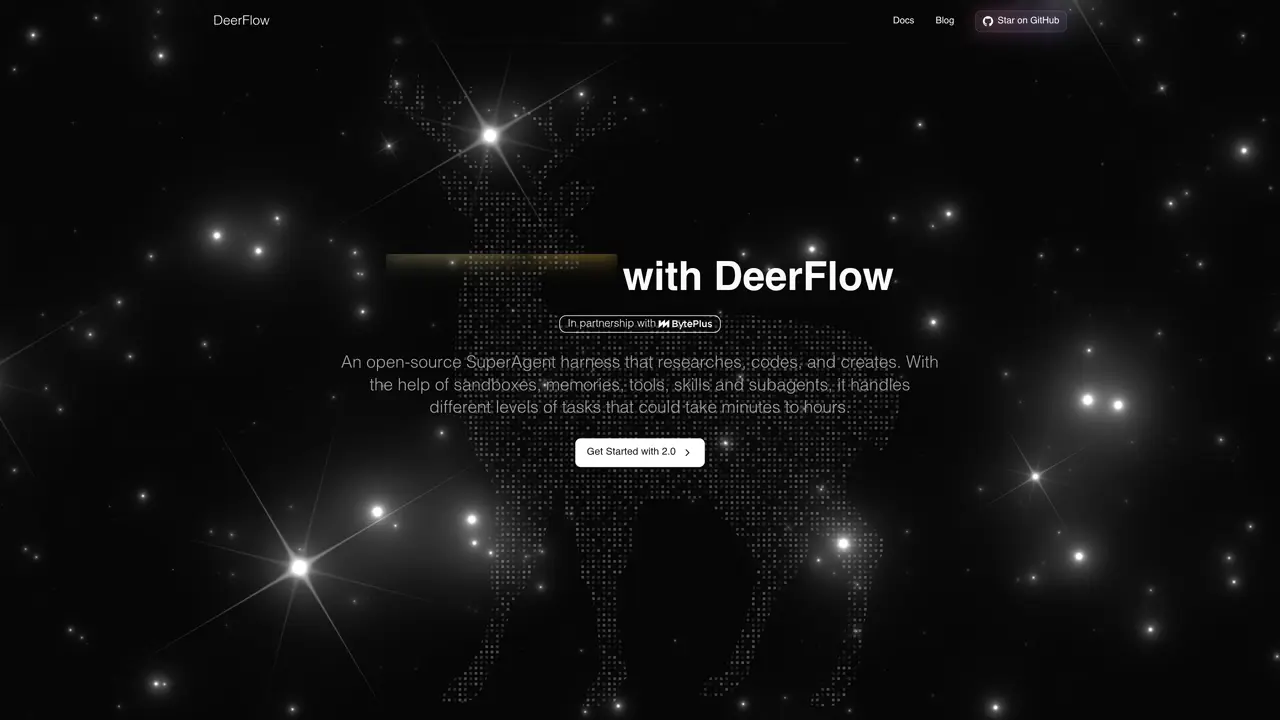
DeerFlow is an open-source SuperAgent harness that uses large language models through LangGraph/LangChain and multiple model backends such as OpenAI, Gemini, and Claude. It decomposes complex prompts into parallel sub-agents, executes sandboxed code and tool chains, and synthesizes outputs like research reports, web pages, videos, slide decks, and full codebases. The platform features AI-driven orchestration including task planning, progressive skill-loading to manage context and tokens, and persistent long/short-term memory. Users can define extensible Markdown-based skills and tools, enabling automation of multi-step, long-running workflows end-to-end. It operates in a self-hostable, sandboxed environment with local control, making it suitable for developers, researchers, and teams seeking to automate complex workflows without relying on external services. The tool emphasizes local control and persistent memory-backed outputs, ensuring continuity across extended workflows.
Key features
- Decomposes complex prompts into parallel sub-agents
- Supports multiple model backends (OpenAI, Gemini, Claude)
- Sandboxed code and tool chain execution
- Persistent long/short-term memory for continuity
- Extensible Markdown-defined skills and tools
- Self-hostable environment with local control
- Task planning and progressive skill-loading
- Generates research reports, web pages, videos, slide decks, and codebases
- AI-driven orchestration for multi-step workflows
Use cases
- Automating multi-step research workflows with persistent memory
- Generating and publishing structured content like reports or web pages
- Building and deploying sandboxed codebases or tool chains
Pros
- Open-source and self-hostable, ensuring full local control and data privacy
- Supports multiple large language model backends (OpenAI, Gemini, Claude, etc.)
- Features persistent long/short-term memory for continuity across extended workflows
- Enables parallel sub-agent execution and sandboxed code/tool chains for complex tasks
- Extensible Markdown-based skills and tools for customizable automation
Cons
- Requires technical expertise to set up and manage a self-hosted environment
- Long-running workflows may demand significant computational resources
- Dependency on Docker-based sandboxes adds complexity for non-technical users
Frequently asked questions about DeerFlow
What is DeerFlow and what does it do?
DeerFlow is an open-source SuperAgent harness that automates complex, multi-step workflows using large language models. It decomposes tasks into parallel sub-agents, executes sandboxed code and tools, and synthesizes outputs like research reports, videos, or codebases.
Who is DeerFlow designed for?
DeerFlow is designed for developers, researchers, and teams seeking to automate complex workflows without relying on external services. Its self-hostable nature makes it suitable for users prioritizing data privacy and local control.
How does DeerFlow handle long-running tasks?
DeerFlow uses persistent sandboxes with file systems, progressive skill-loading, and planning/sub-tasking to manage long-running tasks efficiently. It supports sequential or parallel execution while maintaining context and memory continuity.
Can I extend DeerFlow with custom tools or skills?
Yes, DeerFlow allows users to define extensible Markdown-based skills and tools. Users can either extend the built-in library or create their own skills to tailor the agent to specific workflows.
What model backends does DeerFlow support?
DeerFlow supports multiple large language model backends, including OpenAI, Gemini, Claude, and others. The tool is designed to be flexible and adaptable to different model providers.
How do I get started with DeerFlow?
Users can get started by deploying DeerFlow in a self-hosted environment, such as a Docker-based sandbox. The tool provides documentation and community resources to guide setup and configuration.
DeerFlow Website Engagement
Last Update: 9 days ago
Total Monthly Visits
0
Bounce Rate
0%
Visit Duration (avg)
0.00s
Pages Per Visit
0
Country Rank
0
China
Global Rank
0
Monthly Traffic
Traffic Sources
Traffic Share By Country
- China36.2%
- United States13.5%
- Hong Kong7.1%
- France6.8%
- Singapore5.4%