
OpenAI builds and deploys advanced AI models like GPT-4o for autonomous agents and workflows.

OpenHarness
$0.07Starting price
0Popularity
About OpenHarness
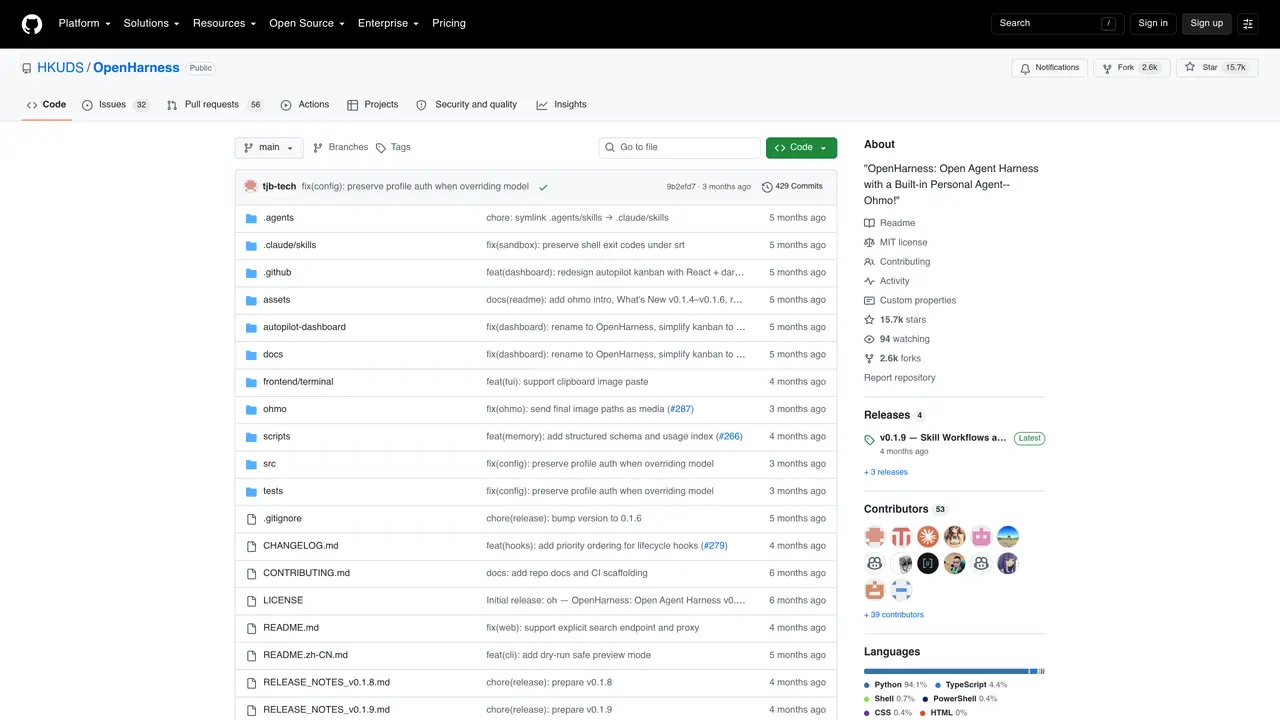
OpenHarness is an open-source AI agent framework focused on providing the core infrastructure to build, run, and orchestrate intelligent agent systems. It separates the intelligence layer from the execution infrastructure, allowing developers to customize how agents act, remember, and execute tasks. The framework is designed for building advanced AI workflows, experimenting with multi-agent architectures, and creating custom agent systems beyond simple chat-based interactions. Developers can integrate tools, manage persistent memory, and coordinate multiple agents working together on complex tasks. OpenHarness also supports extending functionality through plugins, skills, and custom tools, while offering control over agent behavior via permissions, rules, and governance layers. It is particularly suited for developers, AI engineers, researchers, and builders who need full control over their AI agent systems and workflows.
GitHub, Inc.
San Francisco, California, US · Founded 2008
- Founders
- Tom Preston-Werner, Chris Wanstrath, PJ Hyett, Scott Chacon
- Founded
- 2008
- Headquarters
- San Francisco, California, US
- Legal status
- Subsidiary of Microsoft (NASDAQ: MSFT)
Key features
- Build custom AI agents with tools, memory, and execution loops
- Coordinate multiple agents working together on complex tasks
- Persistent memory and context management for long-running workflows
- Extend functionality with plugins, skills, and custom tools
- Control agent behavior with permissions, rules, and governance layers
- Rich tool ecosystem integrating file systems, shell commands, web tools, and external services
- Multi-agent orchestration for scalable and flexible agent systems
- Open-source framework with full customization capabilities
- CLI and agent runtime for launching and managing workflows
- Integration into custom applications and workflows
Use cases
- Build multi-agent systems for complex workflows and automation
- Develop custom AI coding assistants and developer tools
- Run autonomous agents for scripting and DevOps tasks
Pros
- Separates intelligence from execution, allowing customization of agent behavior and infrastructure
- Supports multi-agent coordination with subagent spawning and team management
- Includes persistent memory and context compression for long-running sessions
- Provides a plugin ecosystem for extending functionality with skills, hooks, and tools
- Offers governance features like permissions, rules, and interactive approval dialogs
Cons
- Requires Python environment setup and technical expertise to fully utilize
- Limited official documentation compared to commercial alternatives
- Community-driven development may result in slower updates for niche use cases
- Integration with external tools depends on plugin availability and maintenance
Frequently asked questions about OpenHarness
What is OpenHarness and what does it do?
OpenHarness is an open-source Python framework that provides the core infrastructure to build, run, and orchestrate AI agents. It separates the intelligence layer from execution, enabling developers to customize agent behavior, memory, and tool use while supporting multi-agent coordination.
Who should use OpenHarness?
OpenHarness is designed for developers, AI engineers, researchers, and builders who need full control over their AI agent systems. It suits those experimenting with multi-agent architectures or building custom agent workflows beyond simple chat interactions.
How does OpenHarness handle agent memory and context?
OpenHarness includes persistent memory via MEMORY.md files and context compression through CLAUDE.md discovery and injection. It supports session resume and history tracking to maintain agent state across long-running tasks.
Does OpenHarness require additional API keys?
No, OpenHarness can run on existing subscriptions like Claude Code or Codex. The personal agent 'ohmo' operates without requiring extra API keys beyond those already configured for the underlying LLM service.
What governance features does OpenHarness provide?
OpenHarness offers multi-level permission modes, path-level and command rules, and pre/post tool-use hooks. It also includes interactive approval dialogs to control agent behavior and enforce safety boundaries during execution.
How can I get started with OpenHarness?
Start by cloning the OpenHarness repository and installing dependencies via the provided scripts. Use the 'oh' command to launch the framework and explore built-in tools, skills, and plugins. The documentation and community resources offer guidance for setup and customization.