
Open-source desktop workspace for running multiple AI coding agents in parallel with isolated worktrees and shared integrations.

Solenta
0Popularity
About Solenta
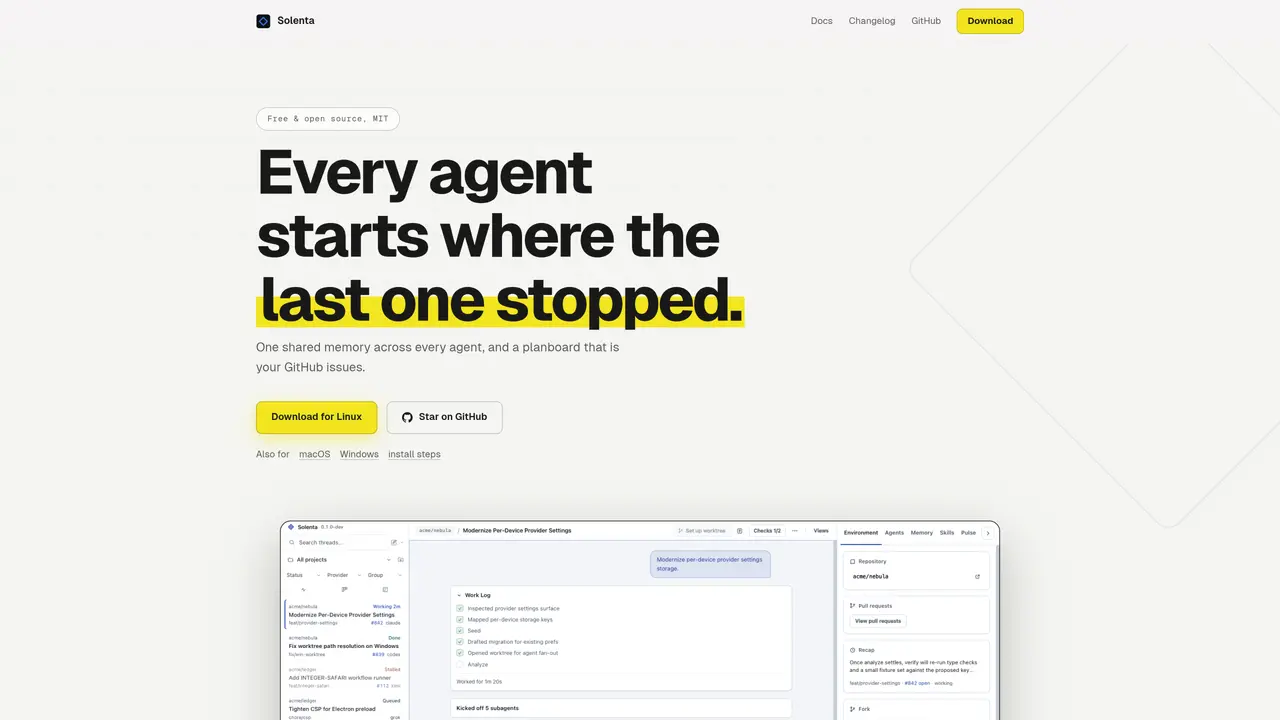
Solenta coordinates multiple AI agents across different providers, each working in isolated git worktrees. It injects a local memory server into every session so that knowledge persists across agents, reducing redundant work. The planboard is a GitHub issues board with labels, allowing teams to track progress without additional tools. Agents update the board using the GitHub CLI, and the interface remains accessible to all collaborators. The tool supports multi-phase workflows with fan-out agents per phase, each with its own provider and model settings. A shared per-repo code index is included in prompts, and workers communicate via a shared task list. Solenta enforces verification gates before threads settle, tracks spend caps, and provides fleet analytics from git and GitHub data. It offers both web and SSH modes for remote project access and supports recurring automations.
Key features
- Shared memory server across agents
- GitHub issues-based planboard
- One git worktree per thread
- Multi-phase build workflows
- Per-repo code index for context
- Spend caps and token burn tracking
- Web and SSH modes for remote access
- Recurring automation scheduling
Use cases
- Coordinating multiple agents on a single project
- Automating multi-stage development workflows
- Tracking progress via GitHub issues
Pros
- Shared memory persists across all agents and sessions
- Planboard integrates with existing GitHub issues
- Supports multiple AI providers and models
- Local execution with no vendor lock-in
- Verification gates ensure quality before completion
Cons
- Requires GitHub CLI for full functionality
- No cloud-hosted version available
- SSH mode requires remote host registration
Frequently asked questions about Solenta
What is Solenta and what does it do?
Solenta coordinates multiple AI agents across different providers, each working in isolated git worktrees. It injects a local memory server into every session so knowledge persists across agents, reducing redundant work. The tool uses a GitHub issues board as a planboard for tracking progress and supports multi-phase workflows with fan-out agents per phase.
Who is Solenta designed for?
Solenta is designed for developers and teams working with AI agents who need persistent memory across sessions, structured project tracking via GitHub issues, and multi-phase workflow automation. It suits users who prefer local control and integration with existing CLI tools.
How does Solenta handle memory and knowledge sharing between agents?
Solenta automatically injects a local memory server into every agent session, ensuring that decisions and insights persist across agents. The memory is stored locally in an SQLite file with full-text and vector search capabilities, allowing agents to build on previous work without re-learning.
Does Solenta require additional tools or subscriptions beyond existing AI agents?
No, Solenta leverages the AI agents and CLIs you already have installed. It does not impose additional subscriptions or dependencies, operating with your existing tools and GitHub setup.
How does Solenta integrate with GitHub?
Solenta uses a GitHub issues board as its planboard, where agents update progress using the GitHub CLI. This allows teams to track work without additional tools, as the board is accessible to all collaborators familiar with GitHub.
Can Solenta run agents on remote machines?
Yes, Solenta supports SSH mode, allowing agents to run on remote hosts. Projects can be registered on remote machines, and agents execute tasks there over SSH while maintaining local control of the UI.