
OpenAI builds and deploys advanced AI models like GPT-4o for autonomous agents and workflows.

Traycer
$10Starting price
108KMonthly visits
34Popularity
About Traycer
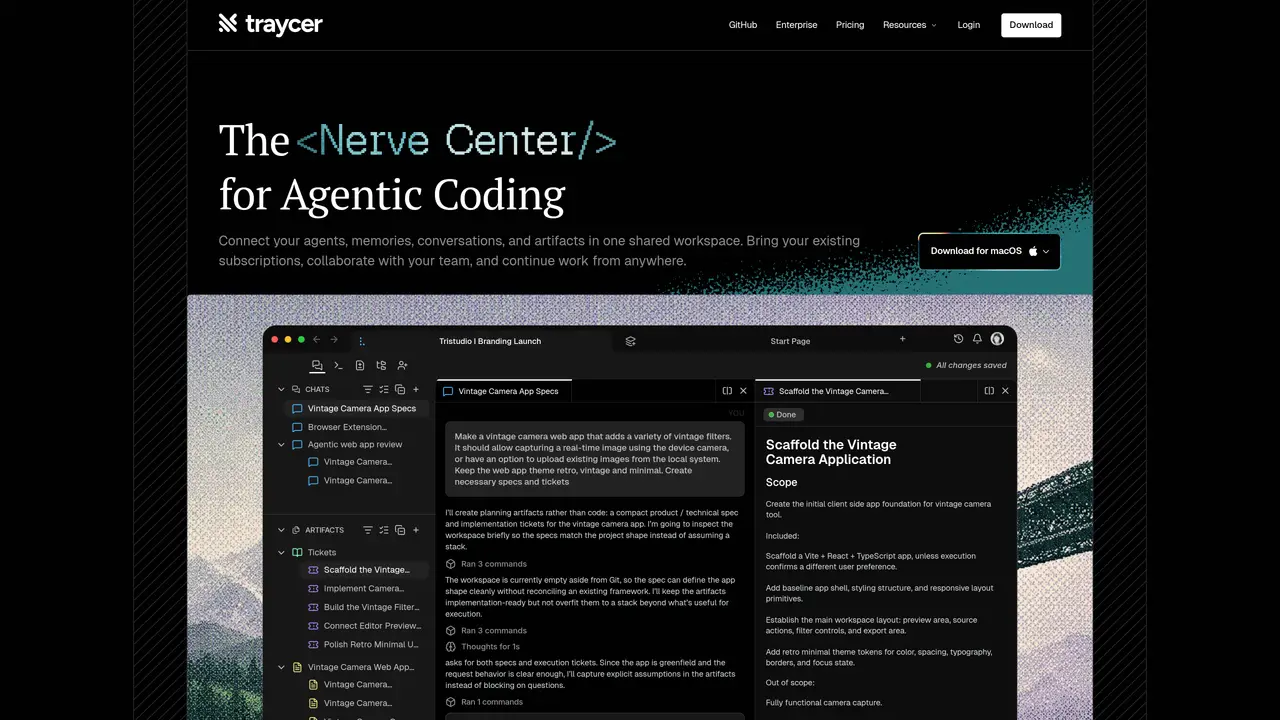
Traycer is a cutting-edge AI coding assistant designed to make coding on large codebases more efficient and effective. It is tailored for developers who need to streamline their workflow with intelligent planning and execution of coding tasks. Traycer simplifies complex tasks by providing detailed, actionable plans before diving into code, allowing developers to focus on ideas rather than getting lost in code diffs. Key Features: Spec-Driven Development: Traycer starts each task with a comprehensive, actionable plan, ensuring that developers can iterate on ideas rather than cryptic code. Parallel Agents: Allows multiple planning agents to work in the background, significantly speeding up task completion. One Click Hand-Off: Once a plan is complete, code can be generated with just a click using popular AI agents like Cursor and Claude Code. Verification and Guardrails: Traycer scans the codebase to verify AI-generated changes, implementing course corrections to prevent bad code from reaching production. It dramatically reduces feature development time, turning multi-day tasks into mere hours, and provides a structured approach to coding, which helps in maintaining codebase coherence. The intuitive design makes it easy for developers to understand and interact with the tool. Traycer is compatible with all major AI coding agents, allowing for flexible execution across platforms.
Key features
- Spec-Driven Development
- Parallel Agents
- One Click Hand-Off
- Verification and Guardrails
- Time Efficiency
- Enhanced Planning
- User-Friendly Interface
- Integration Flexibility
Use cases
- Software Development Teams: Enhancing their workflow by breaking down complex coding tasks.
- Startups: Using Traycer to quickly iterate and deploy new features.
- Freelance Developers: Benefiting from the time-saving features when working on multiple projects.
Pros
- Centralizes agentic coding workflows in a shared workspace for agents, memories, conversations, and artifacts
- Enables parallel planning agents to work simultaneously, accelerating task completion
- Supports one-click hand-off to popular AI coding agents like Cursor and Claude Code for code generation
- Provides structured planning artifacts (specs, tickets) before execution to reduce ambiguity and improve coherence
- Facilitates team collaboration with shared context and continuity across sessions
Cons
- Requires integration with existing AI coding agents, which may introduce setup complexity
- Limited to use cases where structured planning and artifact generation are beneficial, not a direct code editor
Traycer videos
Frequently asked questions about Traycer
What is Traycer and what does it do?
Traycer serves as a centralized workspace for agentic coding, connecting agents, memories, conversations, and artifacts in one shared environment. It enables developers to collaborate, bring their existing AI coding subscriptions, and continue work seamlessly across different platforms.
Who is Traycer designed for?
Traycer is designed for developers and engineering teams who work with AI coding agents and need a structured, collaborative environment to manage tasks, plans, and code execution efficiently.
How does Traycer integrate with existing AI coding agents?
Traycer supports integration with popular AI coding agents such as Claude Code, Codex, OpenCode, and Cursor, allowing users to run multiple agents side by side within a single workspace.
Can Traycer be used for both new and existing projects?
Yes, Traycer can be used for both greenfield projects and existing codebases. It adapts to the project's current state, whether empty or already established, to generate relevant planning artifacts and execution tickets.
What kind of artifacts can Traycer create?
Traycer can generate a variety of artifacts, including product and technical specifications, implementation tickets, execution notes, and review documents tailored to the project's requirements.
How do agents communicate within Traycer?
Agents in Traycer can communicate with each other through a protocol that mimics walkie-talkies, enabling them to ask questions, request reviews, and hand off work across separate chats.
Traycer Website Engagement
Last Update: 9 days ago
Total Monthly Visits
0
Bounce Rate
0%
Visit Duration (avg)
0.00s
Pages Per Visit
0
Country Rank
0
Brazil
Global Rank
0
Category Rank
#0
Programming & Developer Software
Monthly Traffic
Traffic Sources
Traffic Share By Country
- Brazil40.4%
- United States21.4%
- Indonesia7.1%
- India6.5%
- Uzbekistan3.6%