
OpenAI builds and deploys advanced AI models like GPT-4o for autonomous agents and workflows.

Nikxius
0Popularity
About Nikxius
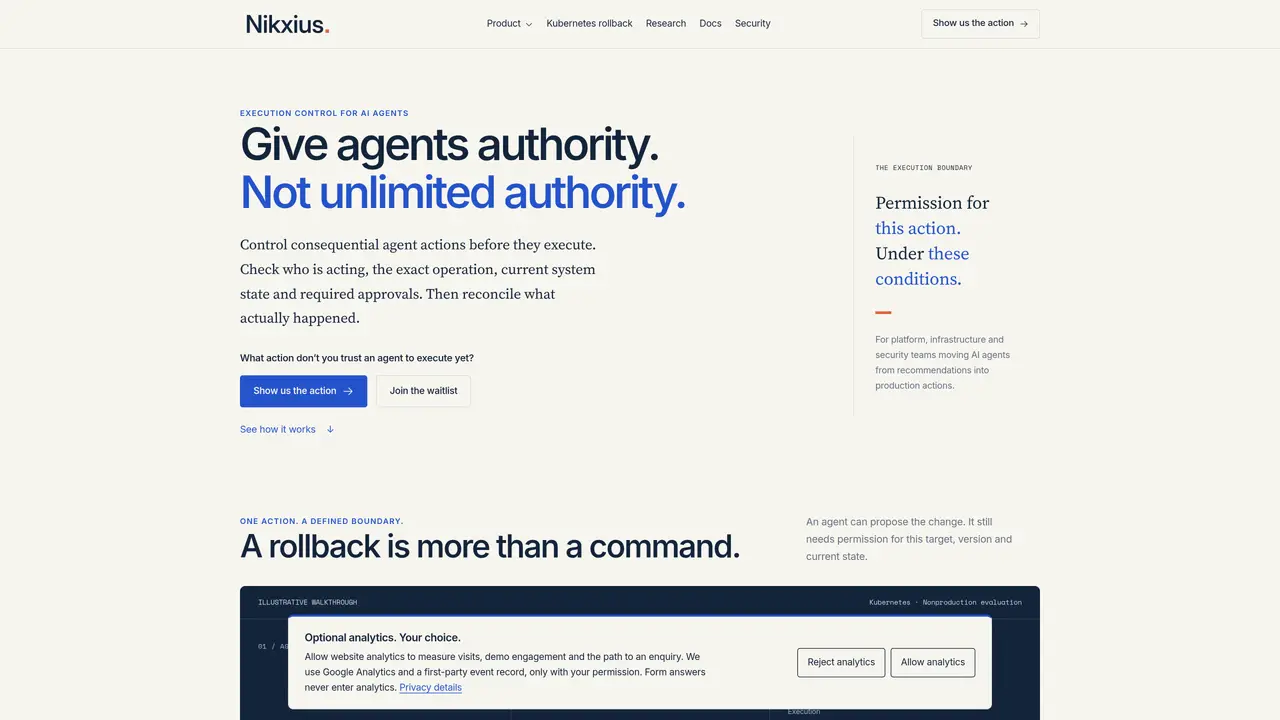
Nikxius provides an execution control boundary for AI agents that propose consequential actions such as Kubernetes rollbacks or internal API changes. It evaluates proposed operations against identity, current system state, policy conditions, and required approvals before dispatching them through a scoped writer. The system records dispatch identity and reconciles observed outcomes against permitted actions, preserving UNKNOWN when evidence is incomplete. It is designed for platform, infrastructure, and security teams moving AI agents from recommendation to production execution. The tool complements existing identity, policy, and observability infrastructure by binding permission directly to the operation rather than relying solely on actor identity or logging. Evaluations begin with a supported Kubernetes Deployment rollback in a nonproduction environment, using product semantics rather than live infrastructure connections.
Key features
- Operation-bound authorization checks
- Pre-dispatch policy evaluation
- Dispatch identity recording
- Outcome reconciliation with UNKNOWN handling
- Kubernetes Deployment rollback support
- Nonproduction environment evaluation
- Policy condition testing
- Evidence preservation for audits
Use cases
- Controlling AI agent rollbacks in nonproduction Kubernetes environments
- Validating agent permissions for internal API changes
- Enforcing approval workflows for consequential operations
Pros
- Binds permission to the exact operation, target, and version
- Evaluates identity, state, policy, and approvals before dispatch
- Records dispatch identity and reconciles observed outcomes
- Supports Kubernetes rollbacks and internal API changes
- Designed for platform and security teams moving agents to production
Cons
- Waitlist-only access
- Limited to Kubernetes Deployment rollback in initial scope
- No customer traction or live deployment examples provided
- Requires integration with existing execution control infrastructure
Frequently asked questions about Nikxius
What does Nikxius do?
Nikxius provides an execution control boundary for AI agents, evaluating proposed operations against identity, system state, policy conditions, and required approvals before dispatching them through a scoped writer. It records dispatch identity and reconciles observed outcomes against permitted actions.
Who is Nikxius designed for?
The tool is designed for platform, infrastructure, and security teams moving AI agents from recommendation to production execution, particularly when consequential actions like Kubernetes rollbacks or internal API changes are involved.
How does Nikxius evaluate and approve actions?
Nikxius checks agent identity, the exact operation scope, current deployment state, policy conditions, environment, and required approvals before dispatching the action. It binds permission directly to the operation rather than relying solely on actor identity.
Does Nikxius require live infrastructure connections?
No, initial evaluations use product semantics rather than live infrastructure connections, such as a supported Kubernetes Deployment rollback in a nonproduction environment.
How does Nikxius handle evidence of executed actions?
It reconciles observed outcomes against permitted actions and preserves UNKNOWN when evidence is incomplete. The system records dispatch identity and inspects native observations to verify the outcome.
Can Nikxius integrate with existing identity and policy infrastructure?
Yes, Nikxius complements existing identity, policy, and observability infrastructure by binding permission directly to the operation rather than relying solely on actor identity or logging.