
OpenAI builds and deploys advanced AI models like GPT-4o for autonomous agents and workflows.
Turnal
FreeStarting price
0Popularity
About Turnal
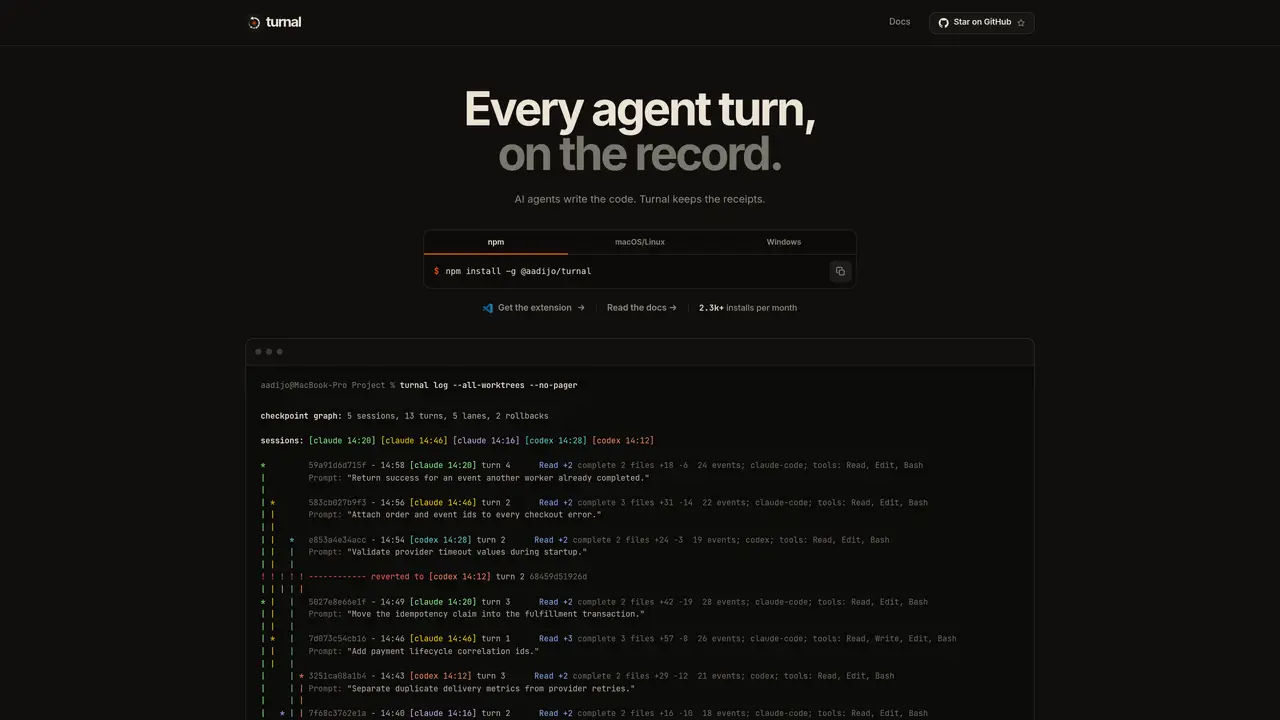
Turnal maintains an append-only event trail of AI coding agent sessions, capturing prompts, tool usage, file changes, and rollbacks. It stores these events and hidden Git checkpoints in a dedicated .turnal directory outside the main Git history, preserving the workspace state at each turn. The tool supports multiple AI agents such as Claude Code and Codex, allowing their sessions to be interleaved in a single timeline for unified review and recovery. Users can preview rollbacks and rehearse recovery by restoring to safety checkpoints before reverting changes. Turnal provides byte-exact file captures, per-turn diffs, and intent-aware attribution to clarify what each agent did and why. It is designed for developers who need to debug, audit, or replay AI-driven code modifications without losing context.
Key features
- Append-only event trail for agent sessions
- Hidden Git checkpoints for workspace state
- Per-turn diffs and byte-exact file captures
- Safety-first rollback with preview
- Intent-aware attribution for changes
- Multi-agent timeline interleaving
- Prompt and response capture
- Rollback and reset capabilities
Use cases
- Debugging AI-generated code changes with full context
- Auditing agent behavior across multiple sessions
- Rehearsing rollbacks before applying changes
Pros
- Records prompts, tool usage, and file changes per agent turn
- Preserves workspace state with byte-exact file captures
- Supports interleaved sessions from multiple AI agents
- Enables preview and rehearsal of rollbacks with safety checkpoints
- Stores history outside Git to avoid polluting repositories
Cons
- No free tier or open-source release mentioned
- Requires installation via npm or shell scripts
- Limited to local use; no cloud or remote storage option
- Depends on agent integrations exposing tool activity
Frequently asked questions about Turnal
What does Turnal do?
Turnal maintains an append-only event trail of AI coding agent sessions, capturing prompts, tool usage, file changes, and rollbacks. It stores these events and hidden Git checkpoints in a dedicated .turnal directory outside the main Git history, preserving the workspace state at each turn.
Who is Turnal designed for?
Turnal is designed for developers who need to debug, audit, or replay AI-driven code modifications without losing context. It supports multiple AI agents such as Claude Code and Codex, allowing their sessions to be interleaved in a single timeline.
How does Turnal work with Git?
Turnal stores hidden Git checkpoints in a dedicated .turnal directory outside the main Git history. It preserves the workspace state at each agent turn while keeping the Git commit history separate for clarity.
Can Turnal handle multiple AI agents working simultaneously?
Yes, Turnal supports interleaving sessions from multiple AI agents such as Claude Code and Codex in a single timeline, enabling unified review and recovery across different agents.
Does Turnal provide a way to preview or rehearse rollbacks?
Yes, Turnal allows users to preview rollbacks and rehearse recovery by restoring to safety checkpoints before reverting changes, ensuring changes can be undone without losing context.
How do I get started with Turnal?
Turnal can be installed via npm globally or through a provided shell script for macOS/Linux and Windows. After installation, it automatically captures agent sessions and maintains the event trail in the .turnal directory.