
OpenAI builds and deploys advanced AI models like GPT-4o for autonomous agents and workflows.

ai-memory
$0.07Starting price
0Popularity
About ai-memory
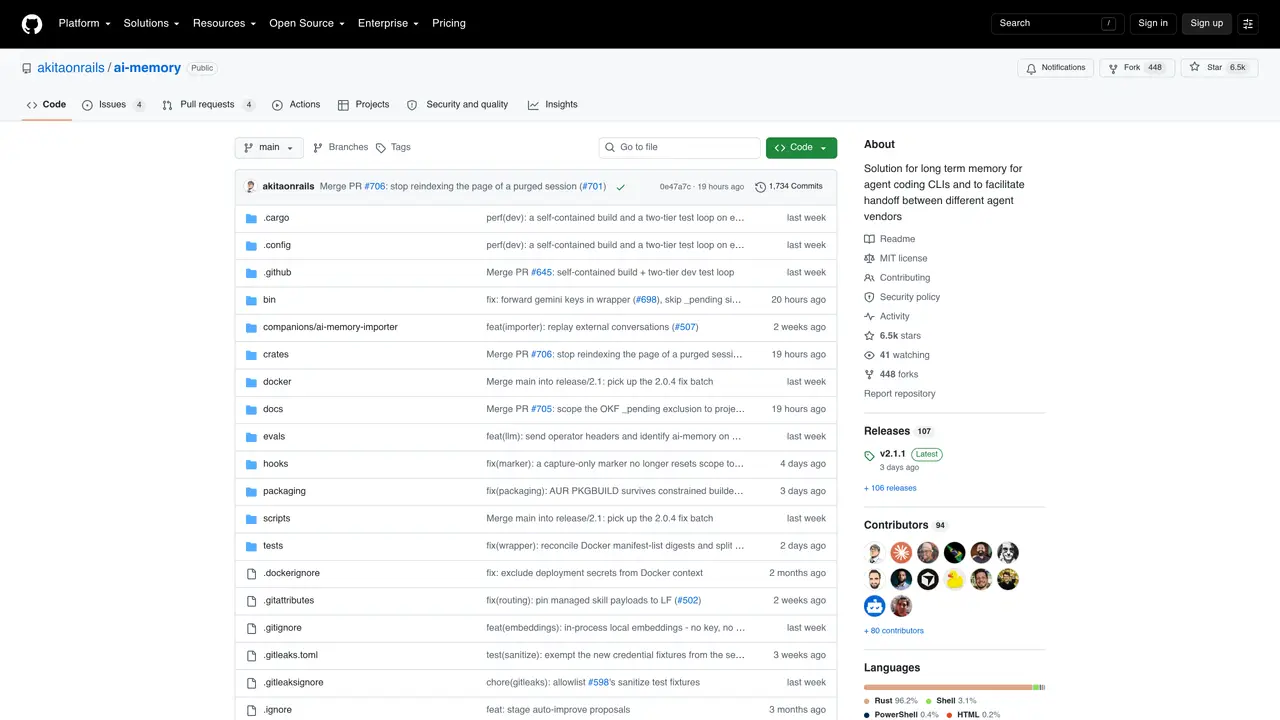
AI Memory is an open-source, Rust-based memory layer designed for coding agents. It records prompts, tool lifecycle events, and session boundaries, then consolidates them into concise briefs and durable notes stored as a git-versioned Markdown wiki. The system hands off context automatically to the next agent, ensuring developers can resume work seamlessly across tools like Claude, Codex, Cursor, and Kiro without repeating prior context. It supports CLI-first users, VS Code/Cursor practitioners, and research engineers who prioritize auditable reasoning, speed, privacy, and tool choice. AI Memory enforces capture policies to minimize data leakage while preserving enough signal for accurate consolidation, making it suitable for teams standardizing decisions, boutique consultancies managing multiple clients, or solo developers needing reliable recall after context switches. The tool runs locally or on homelab servers with simple bearer authentication, offering a project-scoped wiki for browsing folders, search results, and consolidated briefs. A built-in MCP server exposes memory tools, activity metrics, and a read-only web UI, while native hook installers capture events across agents with minimal overhead. Developers can traverse Markdown pages and handoffs directly from their editor, ensuring a cohesive workflow without disrupting existing processes.
GitHub, Inc.
San Francisco, California, US · Founded 2008
- Founders
- Tom Preston-Werner, Chris Wanstrath, PJ Hyett, Scott Chacon
- Founded
- 2008
- Headquarters
- San Francisco, California, US
- Legal status
- Subsidiary of Microsoft (NASDAQ: MSFT)
Key features
- Captures prompts, tool runs, and session boundaries across coding agents
- Consolidates events into git-versioned Markdown wikis for auditable context
- Automatic context handoffs to resume work seamlessly across tools
- Searchable memory with FTS5, entity matches, graph neighbors, and optional embeddings
- Enforces capture policies to minimize data leakage while preserving signal
- Built-in MCP server for memory tools, activity metrics, and a read-only web UI
- Native hook installers for popular coding agents with minimal overhead
- Supports local or homelab server deployment with bearer authentication
- Project-scoped wiki for browsing folders, search results, and consolidated briefs
- Managed workstreams that preserve native sessions and portable event ledgers
Use cases
- Resume coding tasks across different agents without repeating prior context
- Standardize decisions and procedures for teams using multiple coding tools
- Maintain auditable project memory for solo developers or boutique consultancies
Pros
- Enables seamless handoffs between multiple AI coding agents (e.g., Claude, Codex, Cursor) without repeating prior context
- Stores memory as a git-versioned Markdown wiki, ensuring auditability and version control
- Runs locally or on homelab servers with simple bearer authentication, prioritizing privacy and control
- Supports CLI-first users, VS Code/Cursor practitioners, and research engineers with minimal overhead
- Captures lifecycle events (prompts, tool calls) and consolidates them into concise briefs automatically
Cons
- Requires local or homelab server setup, which may not suit users seeking fully cloud-based solutions
- Capturing policies must be carefully configured to balance signal preservation with data privacy
- Limited to users comfortable with CLI tools or technical workflows
Frequently asked questions about ai-memory
What is AI Memory and what does it do?
AI Memory is a long-term memory solution for AI coding agents that records prompts, tool lifecycle events, and session boundaries. It consolidates this data into concise briefs and durable notes stored as a git-versioned Markdown wiki, enabling seamless handoffs between different agents.
Who is AI Memory designed for?
It is designed for CLI-first users, VS Code/Cursor practitioners, research engineers, teams standardizing decisions, boutique consultancies managing multiple clients, and solo developers needing reliable recall after context switches.
How does AI Memory handle privacy and data control?
Memory is stored locally or on a homelab server with simple bearer authentication, ensuring data remains under user control. Capture policies sanitize data at a privacy boundary before storage, and the system avoids vector stores or proprietary binary formats.
Does AI Memory require an LLM API key to function?
No, the default path uses zero LLM calls for capture, search, and handoffs, making it operational without an API key.
Can AI Memory be used across different machines or by a team?
Yes, memory lives on a server you control, allowing the same project knowledge to be resumed on different machines. Teams can point agents at a shared server, with per-project knowledge sharing and built-in multi-user authentication.
How do I get started with AI Memory?
Start by installing the tool locally or on a homelab server. Configure lifecycle hooks in your preferred agent to emit observations, then use the built-in CLI or MCP server to capture, consolidate, and recall memory as you work.