AI assistant for safe, reliable productivity with code, collaboration, and integrations.

Memory MCP
$0.07Starting price
0Popularity
About Memory MCP
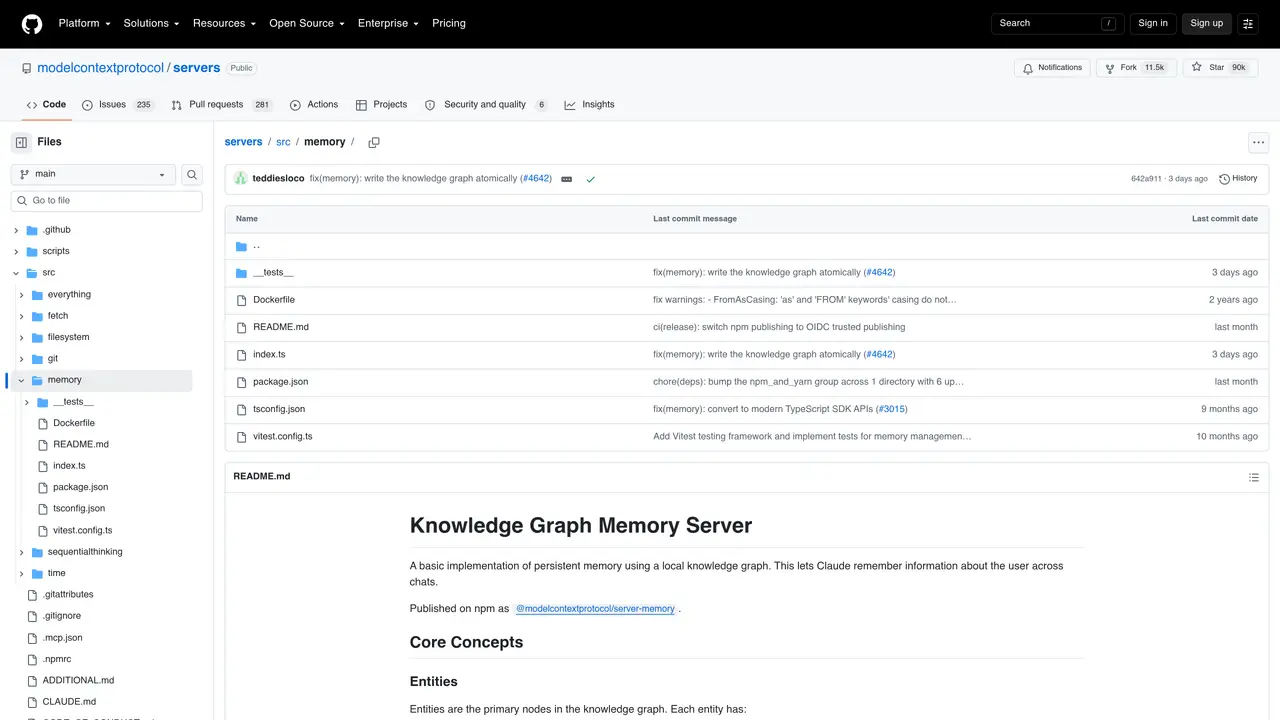
Memory MCP server is an open-source MCP server that enables persistent memory storage and retrieval for AI coding assistants. It connects Memory to Cursor, Claude Desktop and Windsurf, allowing these tools to maintain long-term context across sessions without losing track of prior conversations or project details. The server acts as a bridge, storing relevant information such as code snippets, project goals, and user preferences so that AI assistants can reference them in future interactions. This is particularly useful for ongoing development projects where continuity and context retention are critical. By leveraging Memory MCP, developers can reduce repetitive setup steps and ensure that AI tools have access to the full history of a project, improving efficiency and reducing errors. The server is designed to be lightweight and integrates seamlessly with supported editors and IDEs through the MCP protocol.
GitHub, Inc.
San Francisco, California, US · Founded 2008
- Founders
- Tom Preston-Werner, Chris Wanstrath, PJ Hyett, Scott Chacon
- Founded
- 2008
- Headquarters
- San Francisco, California, US
- Legal status
- Subsidiary of Microsoft (NASDAQ: MSFT)
Key features
- Persistent memory storage across sessions
- Integration with Cursor, Claude Desktop, and Windsurf
- Context retention for ongoing projects
- Lightweight MCP server architecture
- Seamless editor and IDE compatibility
- Open-source foundation
- Long-term context tracking
- Reduces repetitive setup steps
Use cases
- Maintaining project context in AI-assisted coding
- Tracking user preferences and project goals
- Reducing onboarding time for new team members
Pros
- Enables persistent memory storage and retrieval for AI coding assistants
- Supports long-term context retention across sessions without losing prior conversations
- Lightweight and integrates seamlessly with supported editors and IDEs via the MCP protocol
- Uses a local knowledge graph for efficient storage and retrieval of project details
- Open-source implementation published on npm as @modelcontextprotocol/server-memory
Cons
- Requires setup and configuration to integrate with specific AI assistants and editors
- Limited to entities, relations, and observations for structured memory storage
- May not support all possible use cases for memory-intensive applications
Frequently asked questions about Memory MCP
What is Memory MCP and what does it do?
Memory MCP is an open-source server that provides persistent memory storage for AI coding assistants. It maintains long-term context across sessions by storing entities, relations, and observations in a local knowledge graph, allowing AI tools to reference prior conversations and project details.
Which AI assistants or tools are compatible with Memory MCP?
Memory MCP is designed to integrate with AI coding assistants that support the Model Context Protocol (MCP), such as Cursor, Claude Desktop, and Windsurf. It acts as a bridge to provide these tools with persistent memory capabilities.
How does Memory MCP store and manage memory?
Memory MCP stores memory as a knowledge graph with entities (nodes), relations (connections), and observations (facts). Entities can represent people, organizations, or events, while relations define how they interact. Observations are discrete facts attached to entities.
Can I customize or extend Memory MCP for my specific needs?
As an open-source tool, Memory MCP can be customized or extended by modifying its codebase. The API provides functions for creating, updating, and deleting entities, relations, and observations, allowing for tailored memory management.
Is Memory MCP suitable for non-development use cases?
While Memory MCP is primarily designed for AI coding assistants, its knowledge graph structure could potentially support other use cases requiring persistent memory. However, its features are optimized for development workflows.
How do I get started with Memory MCP?
To get started, install the server from npm as @modelcontextprotocol/server-memory, configure it to connect with your supported AI assistant or editor, and define the entities, relations, and observations you want to track. The README provides detailed setup instructions.