
Meta AI enhances machine learning, NLP, and computer vision capabilities.

Qdrant MCP
$0.07Starting price
0Popularity
About Qdrant MCP
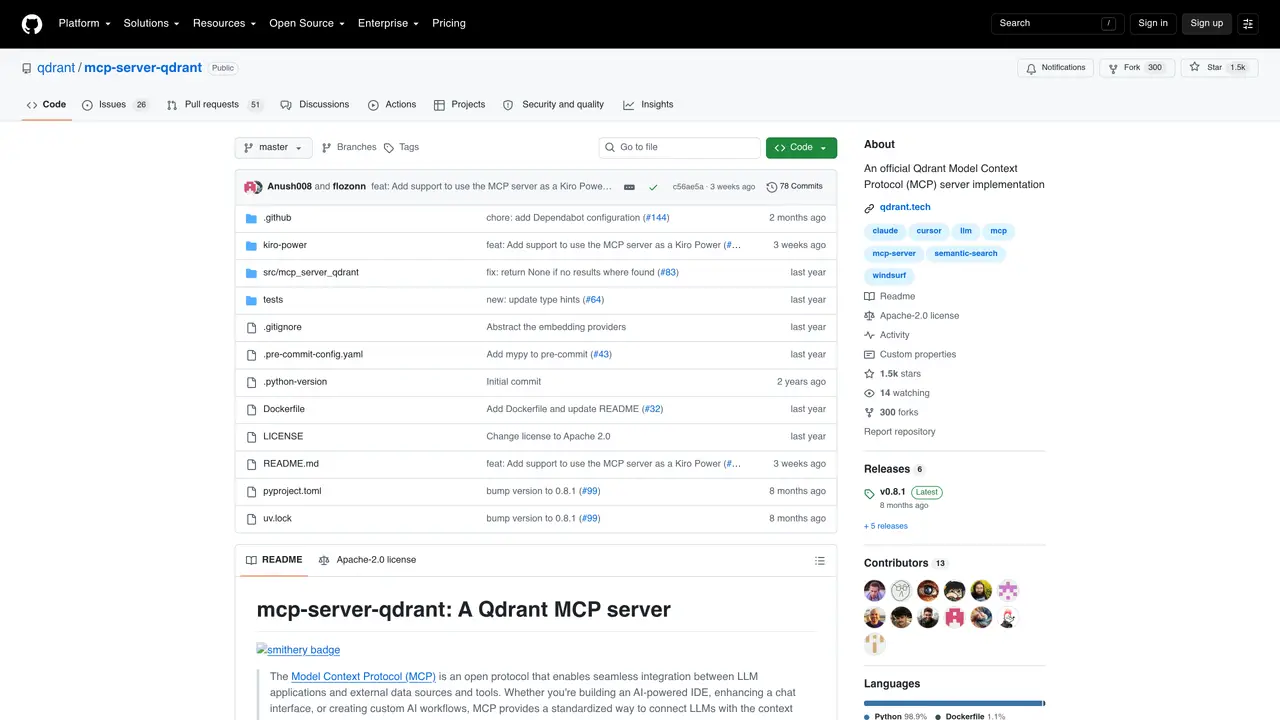
Qdrant MCP server is an open-source implementation that exposes Qdrant’s vector search capabilities through the Model Context Protocol (MCP). It enables direct integration with popular AI coding assistants such as Cursor, Claude Desktop, and Windsurf, allowing these tools to query and retrieve relevant context from Qdrant collections without leaving their native interfaces. The server acts as a bridge, translating MCP requests into Qdrant operations like similarity search, filtering, and payload retrieval. Developers can use it to enhance AI-powered coding workflows by providing real-time, context-aware vector search results. It is particularly useful for applications requiring semantic search over large codebases, documentation, or unstructured data. The server is designed to be lightweight and easy to deploy alongside existing Qdrant instances. It supports standard Qdrant features such as collections, vectors, and payload filtering while maintaining compatibility with the MCP ecosystem.
GitHub, Inc.
San Francisco, California, US · Founded 2008
- Founders
- Tom Preston-Werner, Chris Wanstrath, PJ Hyett, Scott Chacon
- Founded
- 2008
- Headquarters
- San Francisco, California, US
- Legal status
- Subsidiary of Microsoft (NASDAQ: MSFT)
Key features
- Exposes Qdrant vector search via MCP protocol
- Supports similarity search and filtering operations
- Integrates with Cursor, Claude Desktop, and Windsurf
- Lightweight and open-source implementation
- Maintains compatibility with standard Qdrant features
- Enables real-time context retrieval for AI coding assistants
- Supports payload-based filtering and retrieval
- Designed for seamless deployment alongside Qdrant
Use cases
- Enhancing AI coding assistants with semantic search over codebases
- Retrieving relevant documentation or context during development
- Building AI-powered tools that require vector-based context lookup
Pros
- Enables seamless integration between Qdrant vector search and AI coding assistants via the Model Context Protocol (MCP).
- Acts as a lightweight bridge, translating MCP requests into Qdrant operations like similarity search and payload retrieval.
- Supports standard Qdrant features including collections, vectors, and payload filtering.
- Designed for easy deployment alongside existing Qdrant instances with minimal setup overhead.
- Compatible with popular AI-powered coding workflows and tools that support MCP.
Cons
- Requires familiarity with Qdrant and MCP to configure and deploy effectively.
- Limited to read-only mode when configured, which may restrict certain write operations.
- Currently supports only the FastEmbed embedding provider, limiting flexibility in embedding choices.
Frequently asked questions about Qdrant MCP
What is Qdrant MCP server used for?
Qdrant MCP server exposes Qdrant’s vector search capabilities through the Model Context Protocol, enabling AI coding assistants to query and retrieve context from Qdrant collections directly within their interfaces.
Who should use Qdrant MCP server?
Developers and teams building AI-powered coding workflows or applications requiring semantic search over large codebases, documentation, or unstructured data will benefit from using this server.
How does Qdrant MCP server integrate with other tools?
It integrates via the Model Context Protocol, allowing AI coding assistants like Cursor, Claude Desktop, and Windsurf to access Qdrant’s vector search capabilities without leaving their native environments.
What are the configuration requirements for Qdrant MCP server?
Configuration is done via environment variables, including QDRANT_URL or QDRANT_LOCAL_PATH, API keys, default collection names, and embedding settings. The server supports FastMCP environment variables for additional customization.
Can Qdrant MCP server perform write operations?
The server can store information in Qdrant when configured, but it also supports a read-only mode that disables write operations via the qdrant-store tool.
How do I get started with Qdrant MCP server?
Clone the repository, configure the necessary environment variables, and deploy the server alongside your Qdrant instance. Refer to the README for detailed setup instructions and supported transport protocols.