
OpenAI builds and deploys advanced AI models like GPT-4o for autonomous agents and workflows.

PMB
$1Starting price
2.3KMonthly visits
6Popularity
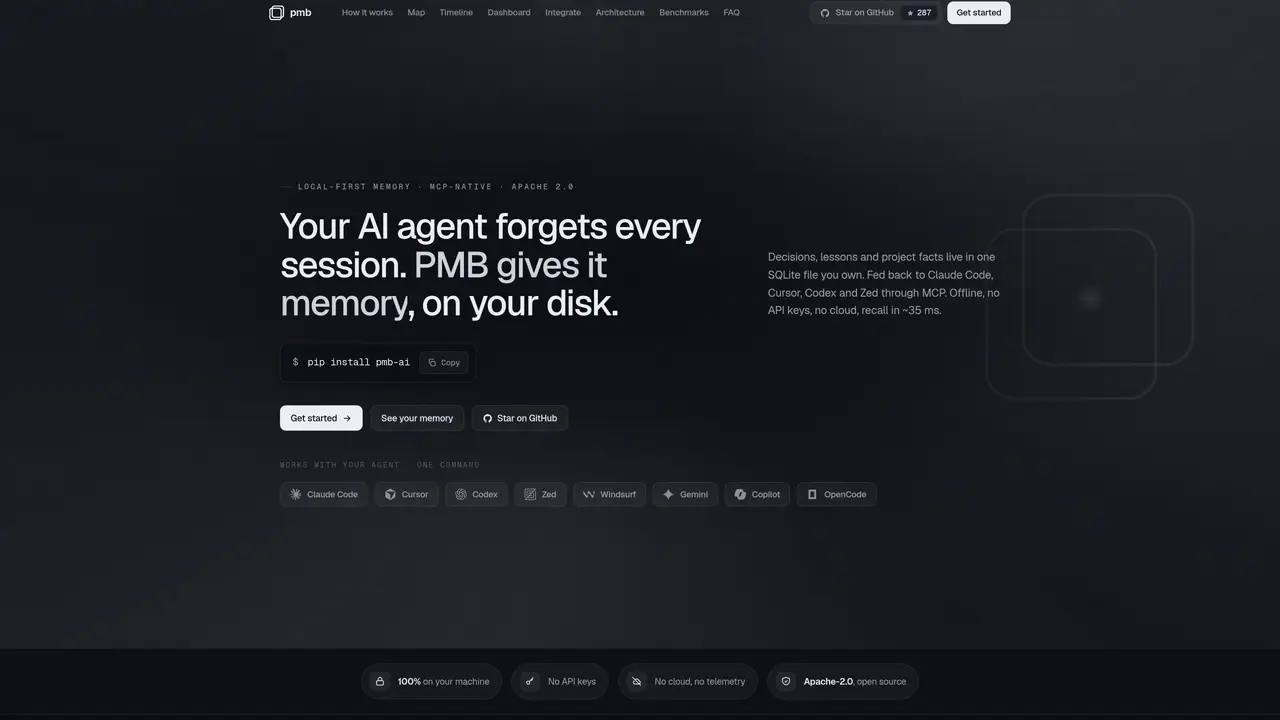
About PMB
PMB is a local-first memory layer for AI coding agents that keeps decisions, lessons, and project facts in a single SQLite file on a developer’s machine. It plugs into MCP-aware tools like Claude Code, Cursor, Codex, Zed, and Windsurf so each agent shares the same long-term context across sessions. By recalling relevant snippets in roughly 35 milliseconds and writing updates asynchronously, it gives AI assistants persistent project awareness without any cloud, telemetry, or API keys. Key Features: Local-first persistent memory: Stores all events in SQLite with vectors in LanceDB on disk, so agents read and write project memory without data leaving the machine. Automatic hybrid recall: Classifies every message in under a millisecond, then uses BM25, dense vectors, and an entity graph with reciprocal-rank fusion to fetch useful context before the model answers, with reported recall@10 of 94.6 percent on the LoCoMo dataset. Low-latency reads and async writes: Recall typically lands in tens of milliseconds, while writes return in under 1 millisecond as embeddings and vector inserts run on a background thread. Map and Timeline dashboard: A local web app shows a live entity graph and git-style timeline of decisions, lessons, commits, and facts so developers can inspect and clean up memory. Honest lesson scoring: Tracks whether the agent actually follows each rule, starring helpful lessons and flagging ignored ones as dead so teams avoid bloated or misleading memory. MCP-native integration and BYO model: Runs as a Model Context Protocol server over stdio, wired with commands like pmb connect claude-code, and can use hosted models or a fully local Ollama instance for summaries and graph extraction.
Key features
- Local-first persistent memory
- Automatic hybrid recall
- Low-latency reads and async writes
- Map and Timeline dashboard
- Honest lesson scoring
- MCP-native integration and BYO model
Use cases
- Backend and full-stack engineers use it to give coding agents durable knowledge of APIs, edge cases, and architectural decisions.
- Tooling and platform teams standardize a shared memory layer across Claude Code, Cursor, Codex, Zed, and similar tools for internal repos.
- Data scientists tie experiment notes and findings to MCP-aware notebook agents.
Pros
- Local-first memory storage with no cloud dependency or telemetry
- Sub-40 millisecond recall and sub-millisecond async writes for seamless agent interaction
- Supports hybrid recall using BM25, dense vectors, and entity graphs with high accuracy
- Open-source under Apache 2.0 license with full offline operation
- Integrates natively with MCP-aware tools like Claude Code, Cursor, Codex, and Zed
Cons
- Requires local setup and configuration for MCP integration
- Limited to SQLite-based storage, which may not scale for extremely large projects
- Dependent on user-provided models for summarization and graph extraction if not using hosted options
Frequently asked questions about PMB
What is PMB and what does it do?
PMB is a local-first memory layer for AI coding agents that stores decisions, lessons, and project facts in a SQLite file on a developer’s machine. It integrates with MCP-aware tools like Claude Code, Cursor, and Zed to provide persistent project awareness across sessions without relying on cloud services or API keys.
Who is PMB designed for?
PMB is designed for developers and teams using AI coding agents who need persistent, long-term context across sessions. It suits those who prefer local-first solutions and want to avoid cloud dependencies or telemetry.
How does PMB integrate with AI coding agents?
PMB integrates with MCP-aware tools via a Model Context Protocol server over stdio. Users can connect agents like Claude Code or Cursor with a single command, such as 'pmb connect claude-code', enabling shared memory across tools.
Can PMB work offline or with local models?
Yes, PMB operates entirely offline with no cloud or API keys required. It supports local models like Ollama for tasks such as summarization and graph extraction, ensuring all processing stays on the user’s machine.
What kind of memory does PMB store and how is it recalled?
PMB stores decisions, lessons, project facts, and file references in a SQLite database with vectors in LanceDB. It uses hybrid recall combining BM25, dense vectors, and an entity graph to fetch relevant context before the agent answers, typically in under 35 milliseconds.
How can I inspect or manage the memory stored by PMB?
PMB includes a local web dashboard that displays a live entity graph and a git-style timeline of decisions, lessons, and commits. Users can explore, inspect, and clean up memory directly from the dashboard or via terminal commands.
PMB Website Engagement
Last Update: 1 month ago
Total Monthly Visits
0
Bounce Rate
—
Visit Duration (avg)
0.00s
Pages Per Visit
0
Country Rank
0
India
Global Rank
0