
OpenAI builds and deploys advanced AI models like GPT-4o for autonomous agents and workflows.

Fetch MCP
$0.07Starting price
0Popularity
About Fetch MCP
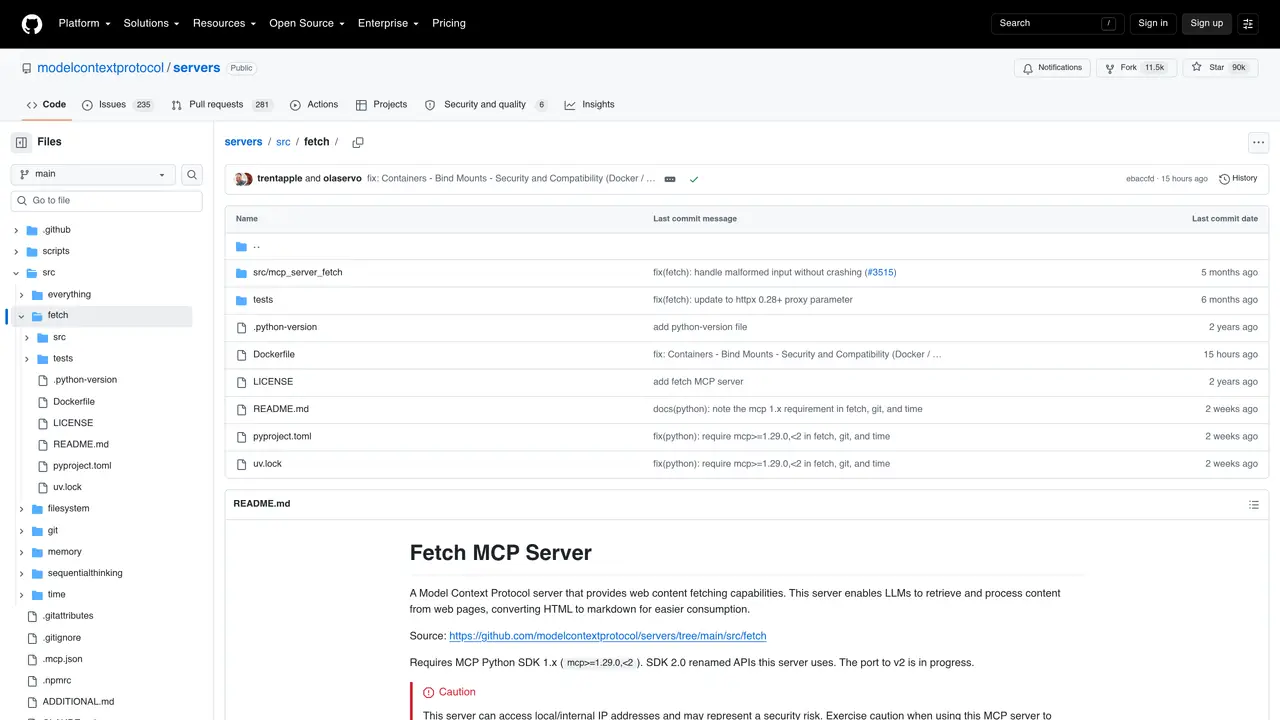
The Fetch MCP server enables integration between Fetch and major AI coding assistants such as Cursor, Claude Desktop, and Windsurf. It acts as a bridge that allows these tools to interact with Fetch’s web and scraping capabilities directly through the Model Context Protocol (MCP). By exposing Fetch’s functionality as an MCP server, it simplifies the process of fetching web content, scraping data, or performing HTTP requests within AI-assisted development workflows. This integration is particularly useful for developers who rely on AI coding tools to automate web-based tasks without leaving their preferred environment. The server supports standard HTTP methods and can handle requests for retrieving, parsing, and processing web resources efficiently. It is designed to be lightweight and easy to deploy, making it accessible for both individual developers and teams working on AI-driven projects that require real-time web data access.
GitHub, Inc.
San Francisco, California, US · Founded 2008
- Founders
- Tom Preston-Werner, Chris Wanstrath, PJ Hyett, Scott Chacon
- Founded
- 2008
- Headquarters
- San Francisco, California, US
- Legal status
- Subsidiary of Microsoft (NASDAQ: MSFT)
Key features
- Exposes Fetch as an MCP server for AI coding assistants
- Supports standard HTTP methods (GET, POST, etc.)
- Enables web scraping and content retrieval via MCP
- Integrates with Cursor, Claude Desktop, and Windsurf
- Lightweight and easy to deploy
- Handles real-time web data access requests
- Works with Model Context Protocol (MCP) for seamless integration
- Designed for AI-assisted development workflows
Use cases
- Fetching web content for AI-assisted code generation
- Scraping structured data from websites within AI tools
- Automating HTTP requests in AI coding environments
Pros
- Enables LLMs to retrieve and process web content directly within AI coding assistants via the Model Context Protocol
- Converts HTML to markdown for easier consumption by language models
- Supports chunked reading of webpages using start_index to handle large responses
- Lightweight and easy to deploy, with multiple installation methods (uv, pip, Docker)
- Integrates seamlessly with popular AI coding tools like Cursor, Claude Desktop, and Windsurf
Cons
- May pose a security risk by accessing local or internal IP addresses; requires careful configuration
- Currently requires MCP Python SDK 1.x; migration to SDK 2.0 is in progress
- Response truncation occurs by default, necessitating manual adjustment for full content retrieval
Frequently asked questions about Fetch MCP
What is Fetch MCP and what does it do?
Fetch MCP is a Model Context Protocol server that provides web content fetching capabilities, allowing LLMs to retrieve and process web pages by converting HTML to markdown for easier consumption.
Who is Fetch MCP designed for?
It is designed for developers and teams using AI coding assistants like Cursor, Claude Desktop, or Windsurf who need to automate web-based tasks without leaving their preferred environment.
How does Fetch MCP handle large webpages?
Fetch MCP supports chunked reading of webpages using the start_index argument, allowing models to read content in segments until they find the required information.
What installation methods are available for Fetch MCP?
Fetch MCP can be installed via uv (recommended), pip, or Docker, with configuration options provided for tools like Claude.app and VS Code.
Does Fetch MCP respect websites' robots.txt rules?
Yes, by default, Fetch MCP will obey a website's robots.txt file if the request can be made.
What are the security considerations for using Fetch MCP?
Fetch MCP can access local or internal IP addresses, which may pose a security risk; users should exercise caution and ensure proper configuration to avoid exposing sensitive data.