
OpenAI builds and deploys advanced AI models like GPT-4o for autonomous agents and workflows.

Vicoa
FreeStarting price
11KMonthly visits
17Popularity
About Vicoa
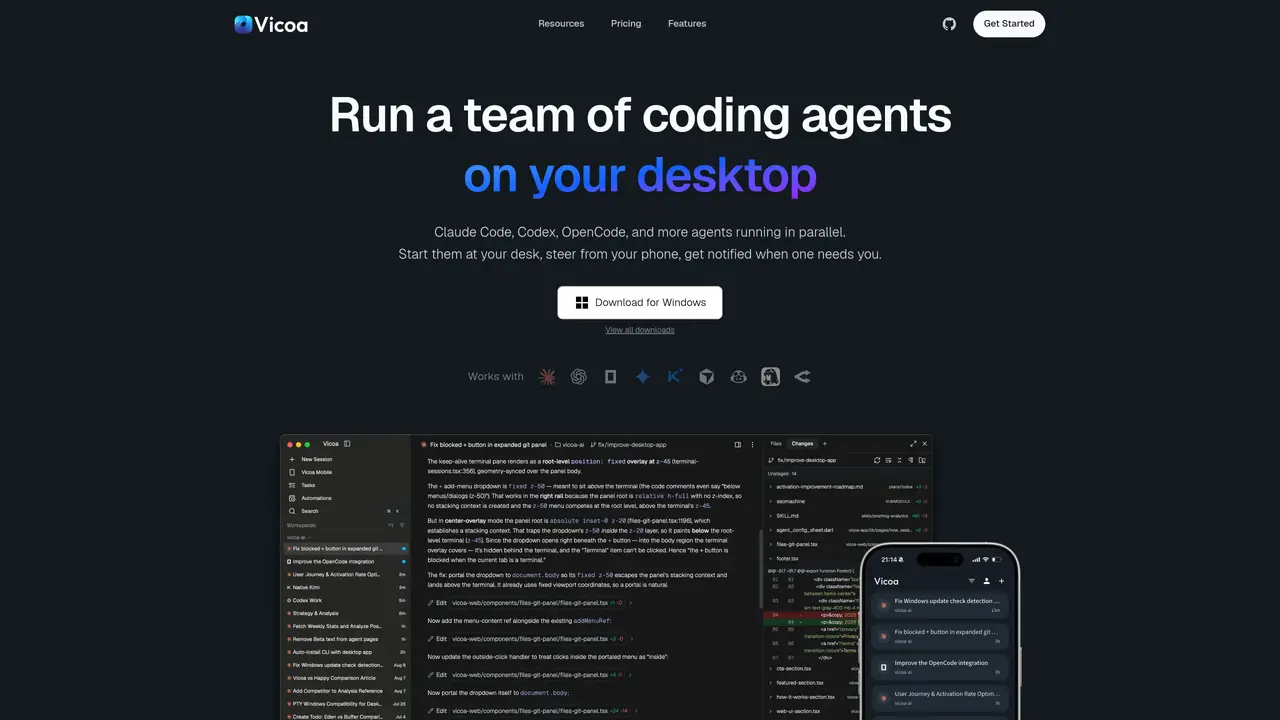
Vicoa is a cross-platform companion for developers that centralizes the management of AI coding agents across multiple devices. It allows users to run agents such as Claude Code, Codex, OpenCode, and others in parallel, each isolated on its own git worktree within a single workspace. The tool provides a unified dashboard to monitor live session statuses, review changes via inline git diffs, and interact with agents through a chat interface paired with a file explorer and live terminal. Users can start tasks on a laptop, then seamlessly continue steering or approving them from a phone or web browser without losing context. Vicoa supports OAuth authentication with Supabase, Google, and GitHub, and enables scheduling recurring agent tasks for automation. It is designed for developers who need to maintain productivity while managing AI-driven workflows remotely, avoiding the need to babysit long-running tasks or switch between isolated terminal sessions.
Key features
- Runs AI coding agents remotely (Claude Code, Codex, and others)
- Cross-device session synchronization
- Searchable history of coding sessions
- Real-time push notifications for updates
- One-tap code diffs and approvals
- Secure connections for remote agent management
- Simple CLI installation (pip install vicoa)
- Clean, user-friendly interface
- Seamless continuation of tasks across devices
- AI agents handle code writing, reviewing, and interaction
Use cases
- Developing code on a laptop and continuing on a mobile device without context loss
- Running long coding tasks in the background while staying updated via notifications
- Managing AI coding agents securely across multiple devices
Pros
- Enables running multiple AI coding agents in parallel on isolated git worktrees
- Supports cross-device session management with real-time synchronization across phone, web, and desktop
- Provides a unified workspace to review agent work, approve changes, and steer tasks from any device
- Includes a built-in file explorer and live terminal for direct interaction with agent environments
- Offers OAuth login integration with Supabase, Google, and GitHub for secure authentication
Cons
- Requires installation of the CLI and desktop/mobile apps to function
- Dependent on the availability and configuration of supported AI coding agents
Frequently asked questions about Vicoa
What is Vicoa and what does it do?
Vicoa is a tool that lets developers run and manage multiple AI coding agents from any device. It provides a unified workspace to start, monitor, and steer agents such as Claude Code or Codex, with real-time synchronization across desktop, web, and mobile.
Who is Vicoa designed for?
Vicoa is designed for developers who want to run AI coding agents remotely, maintain productivity on the go, and avoid babysitting long tasks. It suits individuals or teams managing multiple AI-driven workflows across different machines.
How does Vicoa handle authentication and security?
Vicoa supports OAuth login flows with Supabase, Google, and GitHub for secure authentication. It ensures code and agents remain on the user's own machines while enabling remote control from any device.
Can Vicoa run agents on different types of machines?
Yes, Vicoa can connect to Mac, Windows, Linux, or remote servers, allowing users to drive agents running on any of these systems through a single interface.
Does Vicoa support automation for routine tasks?
Vicoa allows users to schedule recurring agent tasks, such as running tests or generating reports, which execute automatically even when the user is not actively monitoring them.
How do I get started with Vicoa?
Users can install the Vicoa CLI or desktop app, sign in, and start running coding agents in parallel. The mobile app enables steering sessions from a phone, completing setup in a few simple steps.
Vicoa Website Engagement
Last Update: 9 days ago
Total Monthly Visits
0
Bounce Rate
0%
Visit Duration (avg)
0.00s
Pages Per Visit
0
Country Rank
0
United States
Global Rank
0
Monthly Traffic
Traffic Sources
Traffic Share By Country
- United States33.4%
- Nigeria29.9%
- India20.9%
- South Korea8.6%
- Pakistan3.8%