OpenAI builds and deploys advanced AI models like GPT-4o for autonomous agents and workflows.

DevRecall
0Popularity
About DevRecall
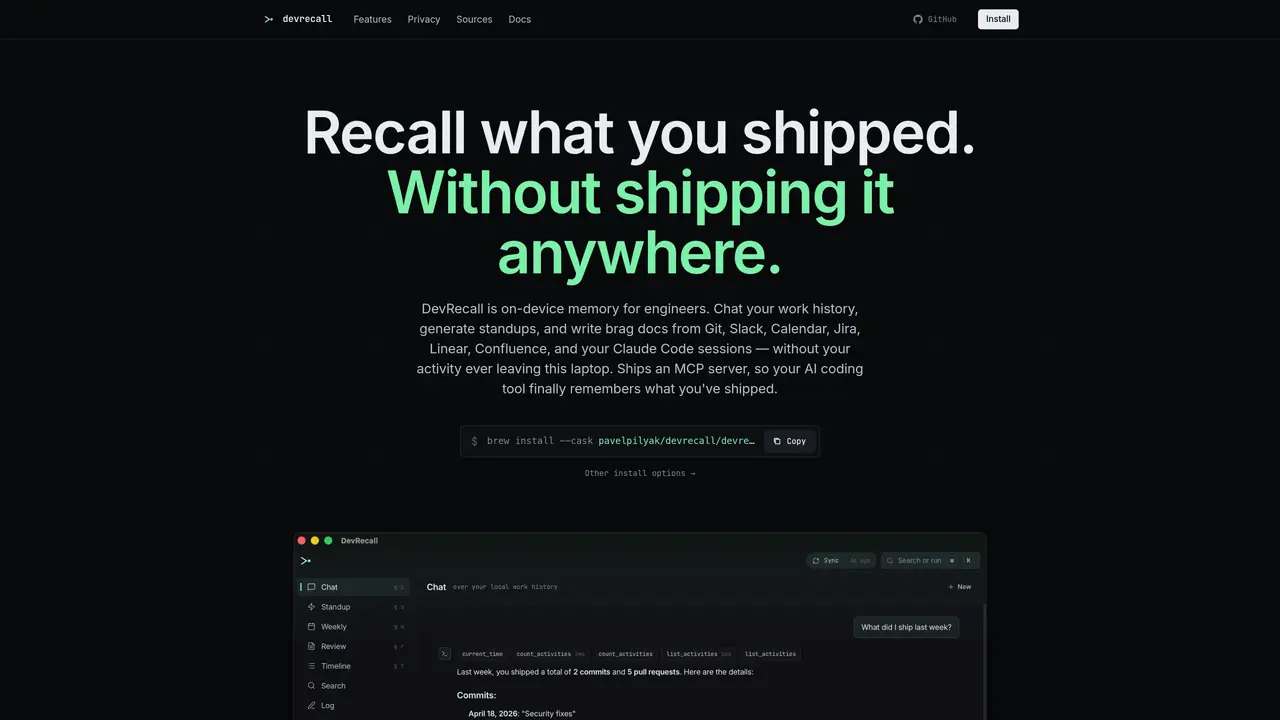
DevRecall builds an on-device index of a developer’s work history from Git, Slack, Calendar, Jira, Linear, Confluence, and Claude Code sessions. The index is stored locally in a SQLite database and supports both keyword and vector search, allowing users to ask questions about past work such as identifying specific bugs or changes. An MCP server is provided so that MCP-compatible coding tools like Claude Code or Cursor can query the index directly within the editor, returning cited commits, PRs, and tickets inline. The tool also generates routine documentation such as standups, weeklies, and brag docs from the indexed data without relying on memory. Identity merging consolidates multiple accounts (git email, GitHub handle, Slack ID, Jira account) into a single user profile across organizations. Embeddings are generated on-device using ONNX, and users can choose between a default local model or their own LLM. The entire system operates offline once sources are synced, with no backend storing raw activity data.
Key features
- On-device SQLite index of work history
- Hybrid search (FTS5 keyword and vector search)
- MCP server for MCP-compatible coding tools
- Identity merging across git, GitHub, Slack, Jira, and Linear
- On-device embeddings via ONNX
- Standup, weekly, and brag doc generation
- Local Ollama model or BYOK LLM support
- CLI and native desktop app for macOS and Linux
Use cases
- Recovering details of past bugs or changes from work history
- Generating standups and weekly reports from real activity data
- Providing in-editor recall and citations for coding agents
Pros
- Local-first architecture with no backend for activity data
- Supports hybrid search (keyword and vector) with date and source filters
- MCP server integration for in-editor recall and citations
- Identity merging across multiple accounts and organizations
- Offline operation after initial sync with on-device embeddings
Cons
- No Windows support for binaries
- No free tier or cloud version available
- Requires local model setup for optimal performance
- Limited to macOS and Linux platforms
Frequently asked questions about DevRecall
What is DevRecall and what does it do?
DevRecall is an on-device memory tool for engineers that indexes a developer’s work history from Git, Slack, Calendar, Jira, Linear, Confluence, and Claude Code sessions. It stores data locally in a SQLite database and supports both keyword and vector search, enabling users to query past work such as identifying specific bugs or changes.
Who is DevRecall designed for?
DevRecall is designed for software engineers, developers, and technical teams who need to recall past work, generate routine documentation like standups or brag docs, and provide memory for AI coding tools. It is particularly useful for those who value privacy and prefer keeping their work data local.
How does DevRecall handle privacy and data storage?
DevRecall operates entirely offline once sources are synced, with no backend storing raw activity data. All data is stored locally in a SQLite database at ~/.devrecall/devrecall.db, and OAuth tokens are kept in ~/.devrecall/tokens/. Raw activity never leaves the user's machine.
Can DevRecall integrate with AI coding tools like Claude Code or Cursor?
Yes, DevRecall ships an MCP server that allows MCP-compatible coding tools such as Claude Code, Cursor, or Continue to query the local index directly within the editor. This provides cited commits, PRs, and tickets inline, enhancing the coding workflow with contextual memory.
What integrations does DevRecall support?
DevRecall supports integrations with Git local repositories, GitHub, GitLab, Slack, Calendar (Google and iCal), Linear, Jira, Confluence, Bitbucket, and Claude Code sessions. Users authorize these tools via OAuth, and the data is indexed locally.
How do I get started with DevRecall?
To get started, install DevRecall via Homebrew on macOS or download the CLI for Linux. After installation, connect your sources (e.g., GitHub, Slack) via OAuth, sync your data, and begin querying your work history or generating documentation like standups or brag docs.