AI assistant for safe, reliable productivity with code, collaboration, and integrations.

OpenHistory
0Popularity
About OpenHistory
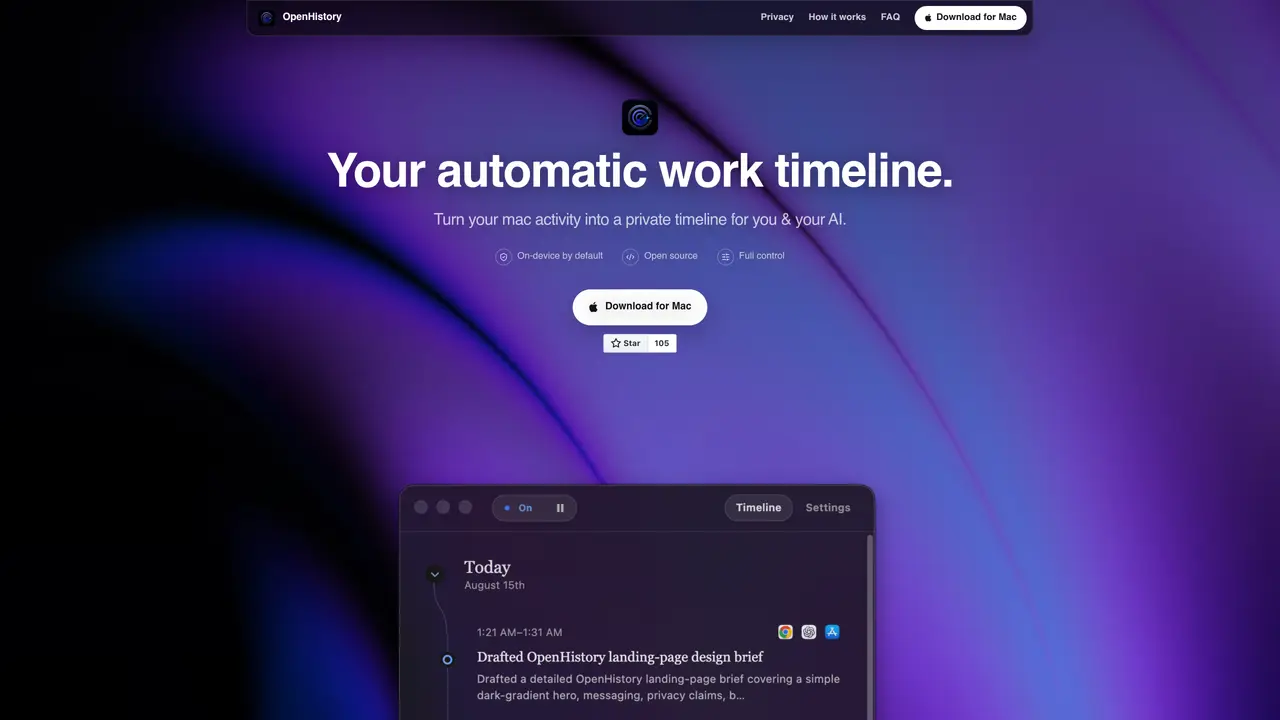
OpenHistory is an open-source macOS application that passively records foreground app activity and permitted accessibility context to construct a private, on-device work timeline. It automatically generates concise daily summaries of completed tasks, decisions, and unfinished work using either on-device processing or user-selected cloud inference. The tool includes a local MCP server that enables AI agents like ChatGPT Desktop and Claude Cowork to query your activity history using natural language, facilitating seamless integration with existing workflows. OpenHistory avoids capturing sensitive data such as screenshots, keystrokes, or microphone input, ensuring user privacy is maintained throughout. All recorded data remains stored locally on your Mac by default, with optional cloud inference for summary generation. The application is designed for professionals who need a lightweight, privacy-focused way to track and review their work without relying on external services or invasive monitoring tools.
Key features
- Passive foreground app activity recording
- Private, on-device work timeline storage
- Daily task and decision summaries
- Local MCP server for AI agent queries
- On-device or cloud-based inference options
- No screenshots, keystrokes, or microphone data captured
- Accessibility context integration
- Open-source macOS application
Use cases
- Tracking daily work progress and task completion
- Reviewing decisions and unfinished work via AI queries
- Privacy-focused activity logging for professionals
Pros
- Records only permitted activity context (e.g., window names, document context) without capturing screenshots, keystrokes, or microphone input
- Stores all data locally by default, with optional cloud inference for summaries under user control
- Supports natural-language queries via a local MCP server for integration with AI agents like ChatGPT Desktop and Claude Cowork
- Open-source software allowing inspection of privacy boundaries and customization
- Provides granular control over data collection, including pausing, disabling categories, and excluding specific apps
Cons
- Requires granting macOS Accessibility permissions for richer activity context
- Cloud inference for summaries requires user-supplied API keys for external providers
Frequently asked questions about OpenHistory
What does OpenHistory record?
OpenHistory observes foreground apps and permitted macOS Accessibility context such as window names, document context, browser domains, clicks, and visible interface text. It does not capture screenshots, audio, camera or microphone input, passwords, private browser windows, or low-level keyboard events.
Where is my history stored?
Your activity, timelines, summaries, settings, and agent connections are stored in a permission-restricted directory on your Mac. The OpenHistory app does not send analytics or telemetry.
Does my data ever leave my Mac?
Not by default. You can use Apple’s on-device model, turn automatic summaries off, or explicitly connect a cloud provider. Nothing is sent to external services unless you choose that provider, supply an API key, and approve the transmission disclosure.
What are the system requirements?
OpenHistory requires macOS 14 or later. Apple On-Device summaries require a Mac that supports Apple Intelligence and macOS 26 or later. Richer activity context requires granting macOS Accessibility permission.
Can I control what OpenHistory sees?
Yes. You can pause collection at any time, disable individual capture categories, exclude specific apps, and independently control email and messaging activity.
Can I delete everything?
Yes. The 'Delete all local data' option permanently removes your recorded activity, summaries, settings, saved API keys, and agent connections from your Mac.