
OpenAI builds and deploys advanced AI models like GPT-4o for autonomous agents and workflows.

Headroom
$0.07Starting price
0Popularity
About Headroom
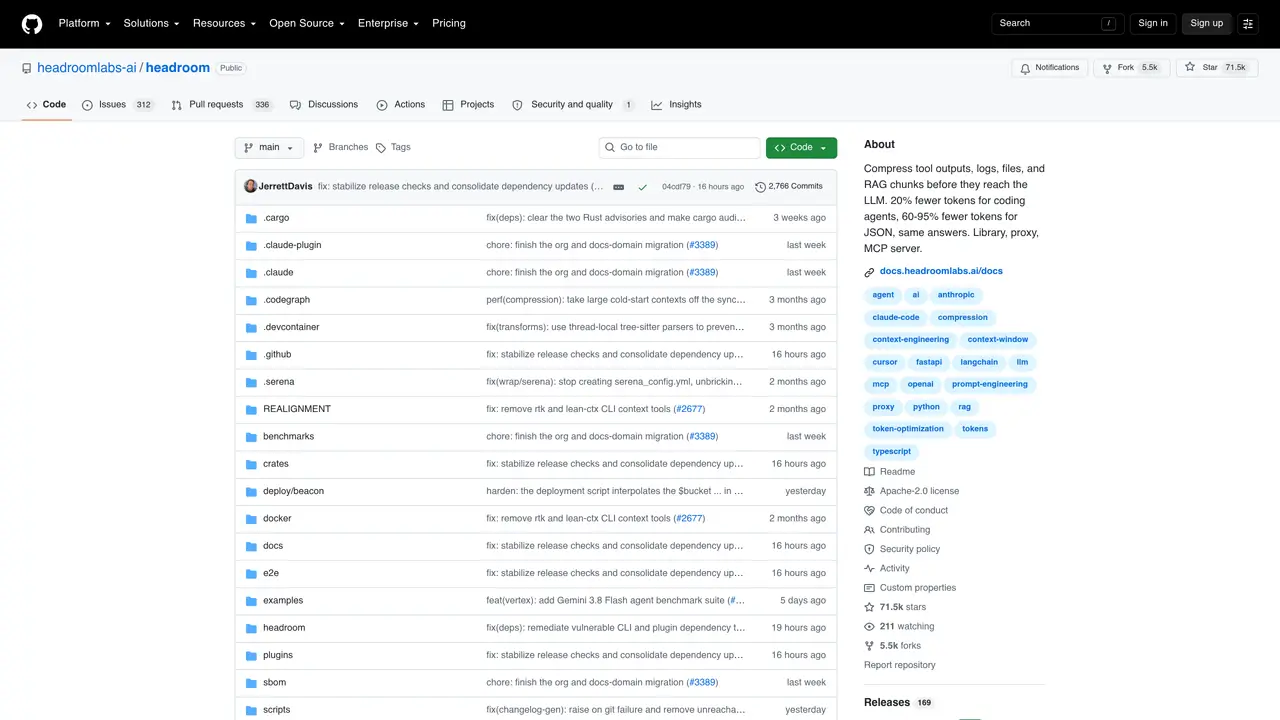
Headroom is an open-source context optimization layer designed to compress noisy AI agent context before it reaches the LLM provider. It reduces token usage from tool outputs, logs, files, database results, RAG chunks, and conversation history, helping developers build more efficient AI agents. The tool can be used as a library, transparent proxy, MCP server, or wrapper around existing agent tools, making it adaptable to various workflows. Headroom supports custom AI agent workflows built with Python, TypeScript, LangChain, LangGraph, Agno, and Strands, and integrates with coding agents such as Claude Code, Codex, Cursor, Aider, and OpenClaw. By compressing repetitive or boilerplate context, Headroom improves context efficiency and reduces model costs for AI applications. Developers can start with small projects, compare token usage before and after compression, and expand to RAG pipelines, tool-heavy agents, or file-heavy workflows as needed.
GitHub, Inc.
San Francisco, California, US · Founded 2008
- Founders
- Tom Preston-Werner, Chris Wanstrath, PJ Hyett, Scott Chacon
- Founded
- 2008
- Headquarters
- San Francisco, California, US
- Legal status
- Subsidiary of Microsoft (NASDAQ: MSFT)
Key features
- Compress noisy context from tool calls, file reads, logs, RAG chunks, and conversation history
- Flexible deployment as a library, transparent proxy, MCP server, or agent wrapper
- Support for coding agents including Claude Code, Codex, Cursor, Aider, and OpenClaw
- Integration with agent frameworks like LangChain, LangGraph, Agno, and Strands
- Reduction of token usage and model costs by removing boilerplate context
- Customizable workflows for Python and TypeScript applications
- Context compression for RAG pipelines, tool-heavy agents, and file-heavy workflows
- Transparent proxy mode for seamless integration into existing systems
Use cases
- Compress tool outputs and logs before they consume expensive LLM context
- Make coding agents and autonomous agents more token efficient
- Run context optimization through proxy, MCP server, library, or wrapper workflows
Pros
- Reduces token usage by up to 95% for structured data like JSON while maintaining answer accuracy
- Operates locally on the user's machine, ensuring no external transmission of prompt or file content
- Supports multiple deployment modes: library, transparent proxy, MCP server, or agent wrapper
- Compatible with popular coding agents such as Claude Code, Codex, Cursor, Aider, and OpenClaw
- Provides reversible compression (CCR) to retain original content for debugging or rollback
Cons
- Requires technical setup for integration, particularly for proxy or MCP server modes
- May introduce additional latency due to on-device compression processing
- Limited to use cases where context compression is beneficial, not universally applicable
Frequently asked questions about Headroom
What does Headroom do?
Headroom compresses tool outputs, logs, files, RAG chunks, and conversation history before they reach the LLM, reducing token usage while preserving answer accuracy.
Who is Headroom suitable for?
Headroom is designed for developers building AI agents, particularly those working with coding agents, RAG pipelines, or tool-heavy workflows where context efficiency is critical.
How does Headroom integrate with existing tools?
Headroom can be used as a library in Python or TypeScript, deployed as a transparent proxy, wrapped around existing agent tools, or run as an MCP server for broader compatibility.
Does Headroom require sending data to external servers?
No, compression runs entirely on the user's machine, ensuring no prompt or file content is transmitted externally.
Can Headroom be used with multiple AI agents simultaneously?
Yes, Headroom supports cross-agent memory, allowing shared context stores across different agents like Claude, Codex, and Grok.
How do I get started with Headroom?
Users can begin by installing Headroom as a library or proxy, then integrating it into their agent workflows or using the agent wrap feature for quick setup.