
OpenAI builds and deploys advanced AI models like GPT-4o for autonomous agents and workflows.

ShipSure
£19Starting price
0Popularity
About ShipSure
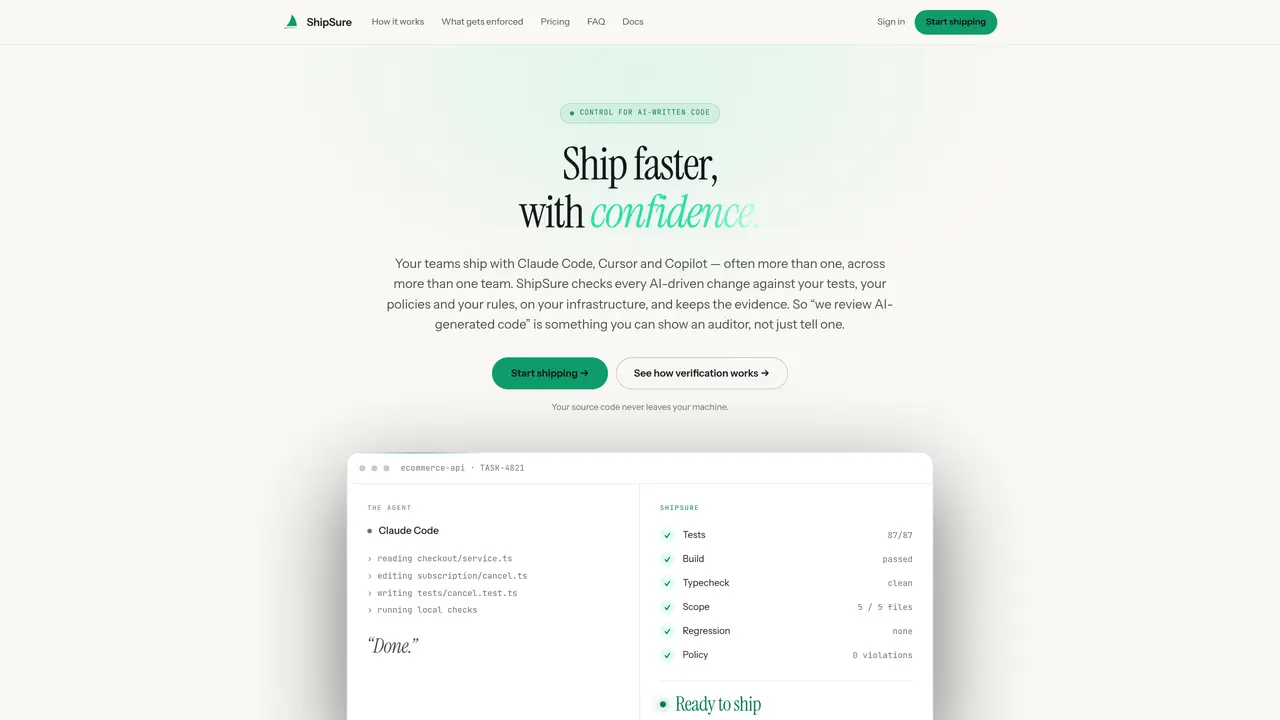
ShipSure serves as a verification layer designed to validate AI-generated code changes before they are merged into a project. It runs on the user’s own infrastructure—whether on laptops, CI runners, or private networks—ensuring that every change passes critical checks such as tests, builds, type checks, scope limits, and project-specific rules before being marked as complete. The tool captures detailed evidence for each verification run, including the checks performed, their outcomes, the commands executed, and the time taken, providing teams with auditable records instead of unverified claims. ShipSure integrates seamlessly into existing development workflows without requiring new editors or workflows, making it adaptable to current tools and processes. It supports multiple AI agents across teams while maintaining local control over source code, ensuring privacy and compliance with internal policies. Verification results are derived directly from the user’s repository, tests, and build systems, guaranteeing consistent and reproducible outcomes. By enforcing these checks, ShipSure helps teams maintain code quality and reliability in AI-assisted development environments.
Key features
- Verifies tests, builds, type checks and scope limits
- Checks against custom project rules and task contracts
- Records exact commands, durations and outcomes
- Supports private runners on user infrastructure
- Provides role-based access down to read-only
- Integrates with existing CI and development tools
- Delivers clear passed or failed verdicts
- Maintains full run history with evidence
Use cases
- Ensuring AI-generated code meets project requirements before merge
- Providing auditors with verifiable evidence of code review
- Enforcing consistent quality gates across multiple AI agents and teams
Pros
- Runs verification on user-controlled infrastructure
- Preserves source code locally and uploads only metadata
- Supports multiple AI agents and teams
- Provides full run history with per-check evidence
- Offers role-based access and audit-friendly records
Cons
- No free tier or trial period
- Single sign-on limited to GitHub OAuth
- Self-hosted distribution and custom retention not yet available
- Requires Node 20 or newer
Frequently asked questions about ShipSure
What is ShipSure and what does it do?
ShipSure is a verification layer for AI-driven code changes produced by agents such as Claude Code, Cursor, or Copilot. It executes checks on the user’s own infrastructure to confirm that every change passes tests, builds, type checks, scope limits, and project-specific rules before marking a task as complete.
Who is ShipSure designed for?
ShipSure is designed for development teams using AI coding agents who need to verify that AI-generated code meets project requirements before deployment. It is particularly useful for teams that require auditable records of verification processes.
How does ShipSure integrate with existing workflows?
ShipSure integrates with existing development workflows without requiring new editors or workflows. It supports multiple AI agents across teams and executes verification on infrastructure the user controls, such as laptops, CI runners, or private networks.
Does ShipSure require source code to leave the user's infrastructure?
No, ShipSure ensures that source code never leaves the user’s machine. Only metadata, such as file paths, test outcomes, and durations, is sent to ShipSure’s servers. The contents of files remain local to the user’s infrastructure.
What kind of checks does ShipSure perform?
ShipSure verifies changes against tests, builds, type checks, scope limits, and project-specific rules. It also checks adherence to pre-built requirement lists covering common project needs, such as authentication, permissions, billing, and edge cases.
How does ShipSure provide verifiable records for audits?
ShipSure records detailed evidence for each verification run, including which checks ran, their outcomes, commands executed, and durations. This allows teams to provide auditors with verifiable records rather than relying on claims about the verification process.