
Open-source platform combining product analytics, session replay, A/B testing, and feature flags in one toolkit for product engineers.

plumb
$4/mStarting price
0Popularity
About plumb
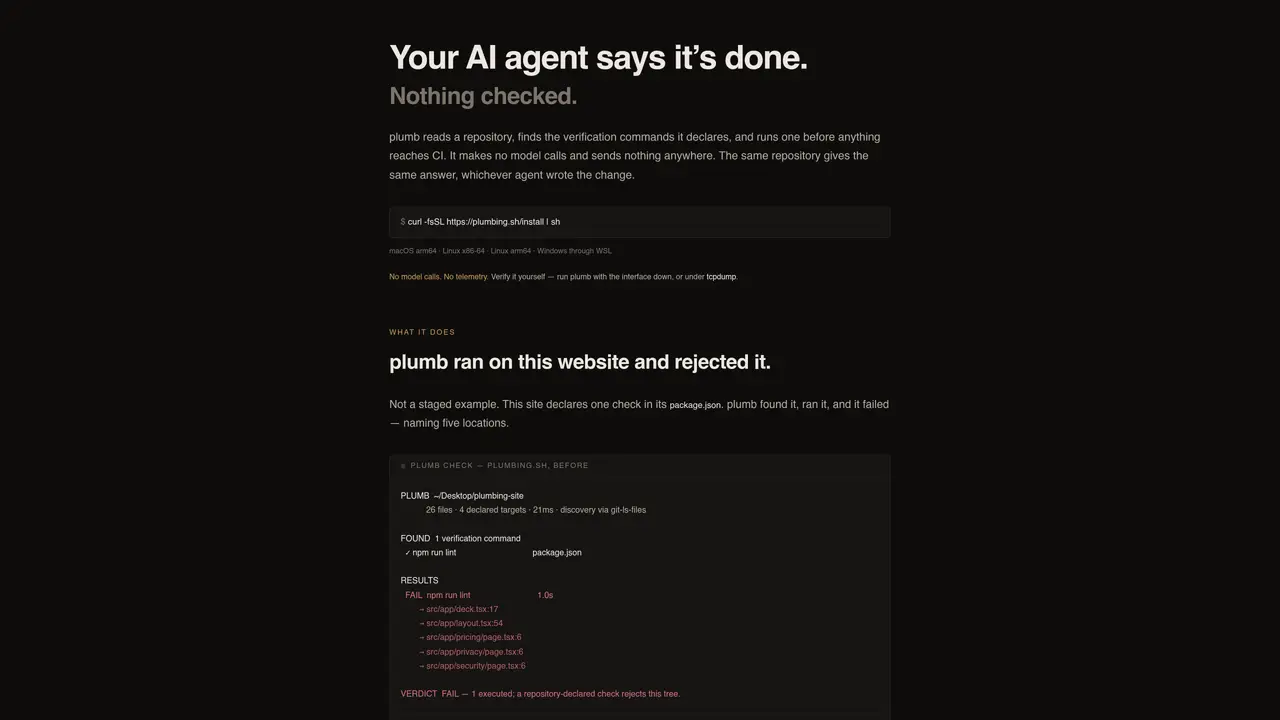
plumb reads a repository and runs the verification commands it declares before any change reaches CI. It executes no model calls and transmits no data, producing the same result regardless of which agent wrote the change. The tool discovers declared checks via repository files such as package.json or Makefiles, then runs them locally to produce a verdict of PASS, FAIL, BLOCKED, INCONCLUSIVE, or NOT-RUN. Each verdict includes file and line references where applicable, and BLOCKED indicates missing toolchain dependencies on the current machine. plumb also surfaces obligations stated in repository documents like CONTRIBUTING files, enabling contributors to see undocumented requirements. Typical use involves running plumb check before committing to catch defects early, avoiding the cost of CI round trips. The tool operates entirely offline except for an optional update check that requests permission before fetching a signed manifest.
Key features
- Repository analysis without model calls
- Local verification of declared checks
- Deterministic verdicts with file and line references
- Obligation extraction from CONTRIBUTING and AGENTS files
- Discovery via git-ls-files or repository manifests
- Hook installation for pre-commit verification
- Signed license verification on the local machine
- Air-gapped license compatibility
Use cases
- Pre-commit verification of agent-written changes
- Early defect detection before CI round trips
- Onboarding verification of repository requirements
Pros
- Runs only repository-declared verification commands
- Produces deterministic results independent of the agent that wrote the code
- Executes entirely locally with no model calls or telemetry
- Surfaces obligations from repository documentation
- Provides file and line references for failing checks
Cons
- Requires a paid license to run repository checks
- Limited to local execution; no cloud or remote verification
- Update check is the only network operation and must be explicitly allowed
Frequently asked questions about plumb
What does plumb do?
plumb reads a repository to discover verification commands declared in files like package.json or Makefiles, then runs those commands locally to produce a verdict of PASS, FAIL, BLOCKED, INCONCLUSIVE, or NOT-RUN before any change reaches CI.
Who is plumb designed for?
plumb is designed for developers and teams using AI agents to write code, ensuring changes are verified locally before committing or pushing to CI, reducing the cost of CI round trips.
Does plumb transmit any data or make model calls?
No, plumb executes no model calls and transmits no data, producing the same result regardless of which agent wrote the change. It operates entirely offline except for an optional update check that requests permission first.
How does plumb handle missing toolchain dependencies?
If a declared verification command cannot run due to missing dependencies on the current machine, plumb returns a BLOCKED verdict, clearly indicating the issue is with the machine, not the repository.
Can plumb surface undocumented requirements in a repository?
Yes, plumb can surface obligations stated in repository documents like CONTRIBUTING files, helping contributors see undocumented requirements before making changes.
How do I get started with plumb?
Install plumb via the provided command (e.g., curl -fsSL https://plumbing.sh/install | sh), then run plumb check in your repository to discover and execute declared verification commands locally.