
OpenAI builds and deploys advanced AI models like GPT-4o for autonomous agents and workflows.

Twigg
128Monthly visits
0Popularity
About Twigg
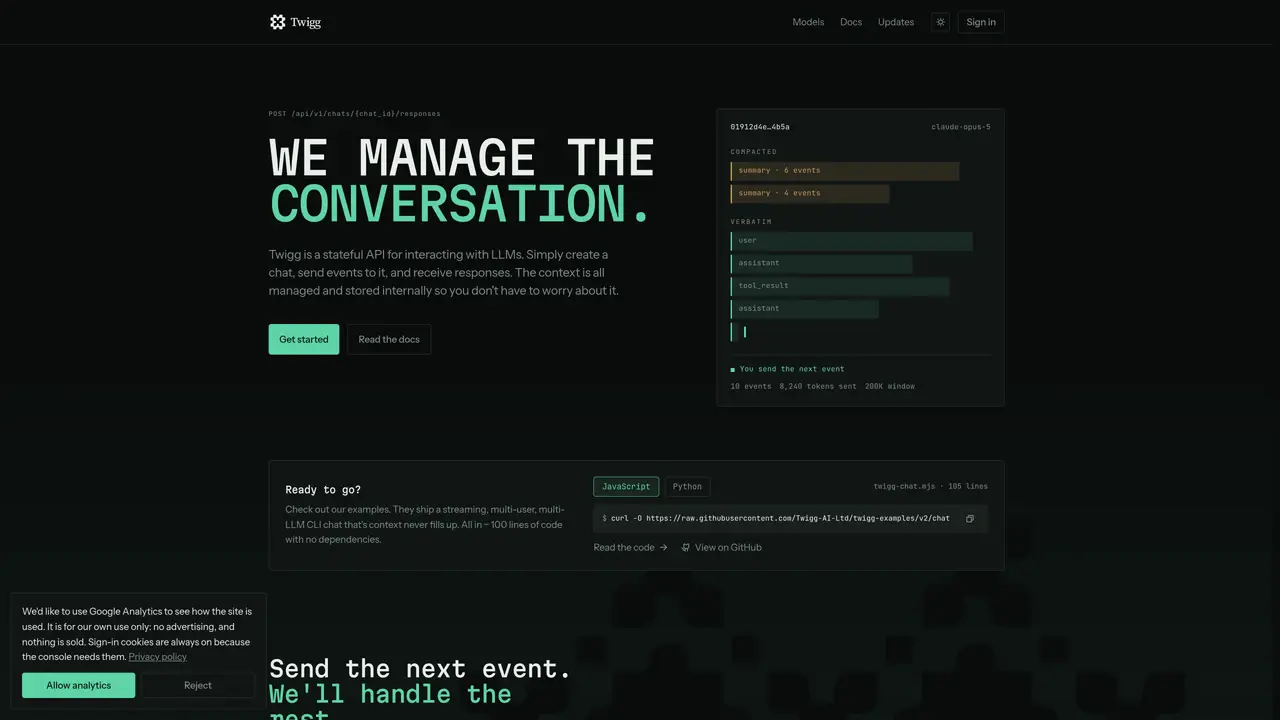
Twigg provides a stateful API for interacting with large language models. Users create a chat session and send events to it, receiving responses while the system manages the conversation context internally. The tool stores conversations outside LLM providers, allowing context to persist across model switches. It includes a hosted context store, an assembler to fit conversations to model context windows, and a model router that directs requests to providers such as Anthropic, OpenAI, Google, xAI, Fireworks, or OpenRouter. Twigg also reports the cost of each request. The API is designed for developers who need consistent, managed conversations without handling context themselves.
Key features
- Stateful chat sessions
- Context window management
- Model routing across providers
- Cost tracking per request
- External context storage
- Event-based interaction
- Mid-conversation model switching
- Conversation persistence
Use cases
- Multi-model chat applications
- Cost-efficient LLM usage tracking
- Stateful customer support bots
Pros
- Stateful conversation management
- No provider lock-in
- Supports multiple LLM providers
- Cost reporting per request
- Context stored externally from providers
Cons
- No free tier mentioned
- Requires API key authentication
- Documentation only in markdown format
- JavaScript app with limited page content
Frequently asked questions about Twigg
What is Twigg?
Twigg is a stateful API for interacting with large language models. It manages conversation context internally, stores conversations outside LLM providers, and allows users to create a chat session, send events to it, and receive responses without handling context themselves.
Who should use Twigg?
Twigg is designed for developers who need consistent, managed conversations with LLMs without managing context themselves. It suits applications requiring model switching, cost tracking, and external context storage.
How does Twigg handle model switching?
Twigg allows users to create a chat once and switch models mid-conversation. The system fits the conversation to each model's context window and routes requests to providers like Anthropic, OpenAI, Google, xAI, Fireworks, or OpenRouter.
Does Twigg report the cost of requests?
Yes, Twigg reports the cost of each request made through its API, providing transparency on expenses associated with LLM usage.
How do I get started with Twigg?
To get started, visit the Twigg documentation at https://twigg.ai/llms.txt or the quickstart guide at https://twigg.ai/docs/quickstart.md. The API base URL is https://api.twigg.ai, and authentication is done using an API key as a bearer token.
Where can I find the API documentation and OpenAPI spec?
The API documentation is available at https://twigg.ai/llms.txt, with a full reference at https://twigg.ai/llms-full.txt. The OpenAPI spec can be found at https://api.twigg.ai/openapi.json.
Twigg Website Engagement
Last Update: 20 hours ago
Total Monthly Visits
0
Bounce Rate
0%
Visit Duration (avg)
—
Pages Per Visit
0
Country Rank
—
Unknown
Global Rank
0