
OpenAI builds and deploys advanced AI models like GPT-4o for autonomous agents and workflows.

Where Is My Token
0Popularity
About Where Is My Token
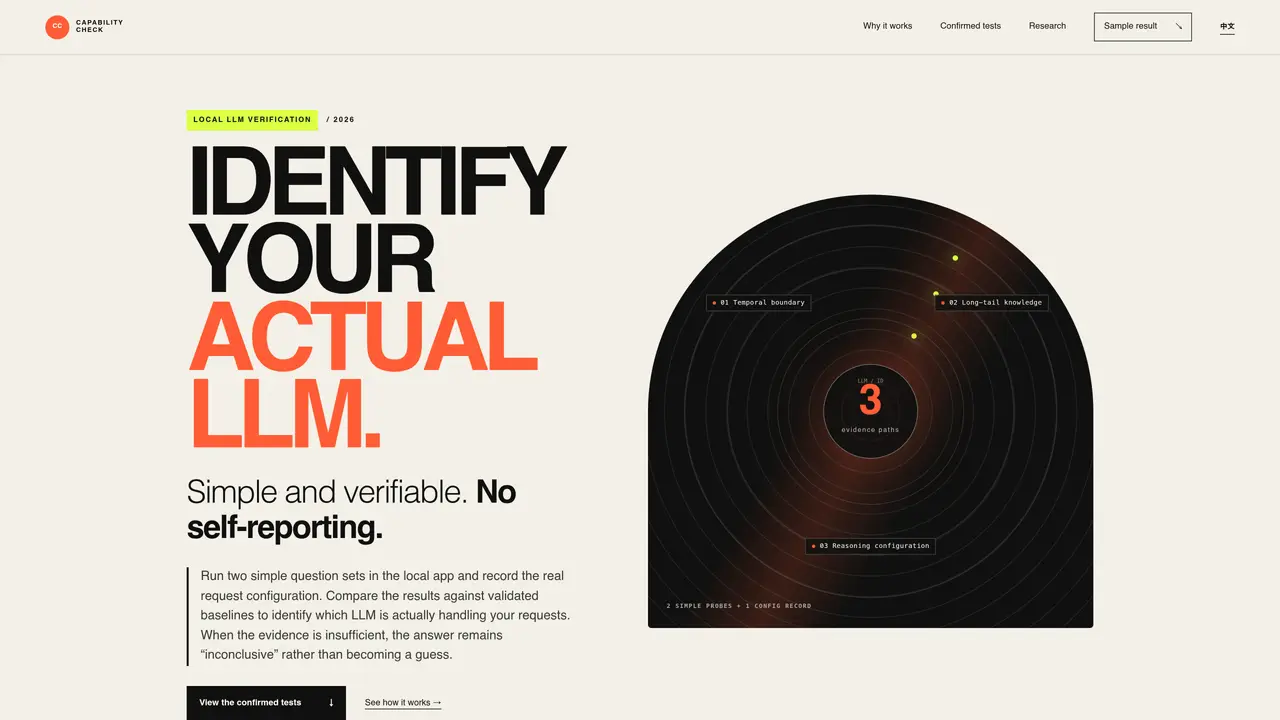
Where Is My Token is a desktop application that determines which large language model (LLM) is processing a user’s requests by running two sets of objective tests. The tool sends fixed temporal-boundary and long-tail knowledge prompts to the model and records the reasoning configuration, including provider, model name, access method, and settings. The results are compared against validated baselines collected under identical conditions to identify the actual LLM handling the request. If the evidence is insufficient or does not match any baseline, the system returns an inconclusive result rather than making an unconfirmed guess. All test data, answers, and configuration remain stored locally on the user’s device, ensuring privacy and reproducibility. The application is designed to verify whether the LLM label displayed by a platform matches the model’s actual behavior.
Key features
- Temporal-boundary testing to assess model knowledge cutoff dates
- Long-tail knowledge testing to evaluate rare factual recall
- Reasoning configuration recording (provider, model, access method, settings)
- Local storage of test results and configuration data
- Comparison against validated baselines for model identification
- Three possible outcomes: match, mismatch, or inconclusive
- Bilingual test set (English and Chinese)
- Fixed, non-adaptive prompts to ensure consistency
Use cases
- Verifying whether a platform’s claimed LLM matches its actual behavior
- Detecting mismatches between displayed model names and underlying LLMs
- Evaluating the consistency of LLM responses across different providers
Pros
- Compares model behavior against validated baselines for accuracy
- Uses fixed, objective prompts to avoid subjective grading
- Stores all data locally, ensuring privacy and reproducibility
- Returns inconclusive results when evidence is insufficient
- Records reasoning configuration without sending additional prompts
Cons
- Requires a local desktop application that is not yet publicly available
- Limited to tests included in the default local-app test set
- Results depend on the availability of validated baselines for comparison
Frequently asked questions about Where Is My Token
What does Where Is My Token do?
Where Is My Token is a desktop application that identifies the actual large language model (LLM) processing a user’s requests by running objective tests and comparing results against validated baselines.
Who is this tool designed for?
The tool is designed for users who want to verify whether the LLM label displayed by a platform matches the model’s actual behavior, ensuring transparency in AI interactions.
How does Where Is My Token verify the LLM?
It uses two sets of tests—temporal-boundary and long-tail knowledge prompts—and records the reasoning configuration, then compares the results against validated baselines to identify the actual LLM.
Does Where Is My Token store data online?
No, all test data, answers, and configuration remain stored locally on the user’s device, ensuring privacy and reproducibility.
What happens if the evidence is insufficient?
If the evidence does not match any baseline or is insufficient, the system returns an inconclusive result rather than making an unconfirmed guess.
Is Where Is My Token available now?
The companion local app is in development, and a download link will be provided upon release when the software is ready.