
AI platform for upscaling images, enhancing photos, and generating high-quality creative assets with contextual detail.

PixelCNN
$0.07Starting price
0Popularity
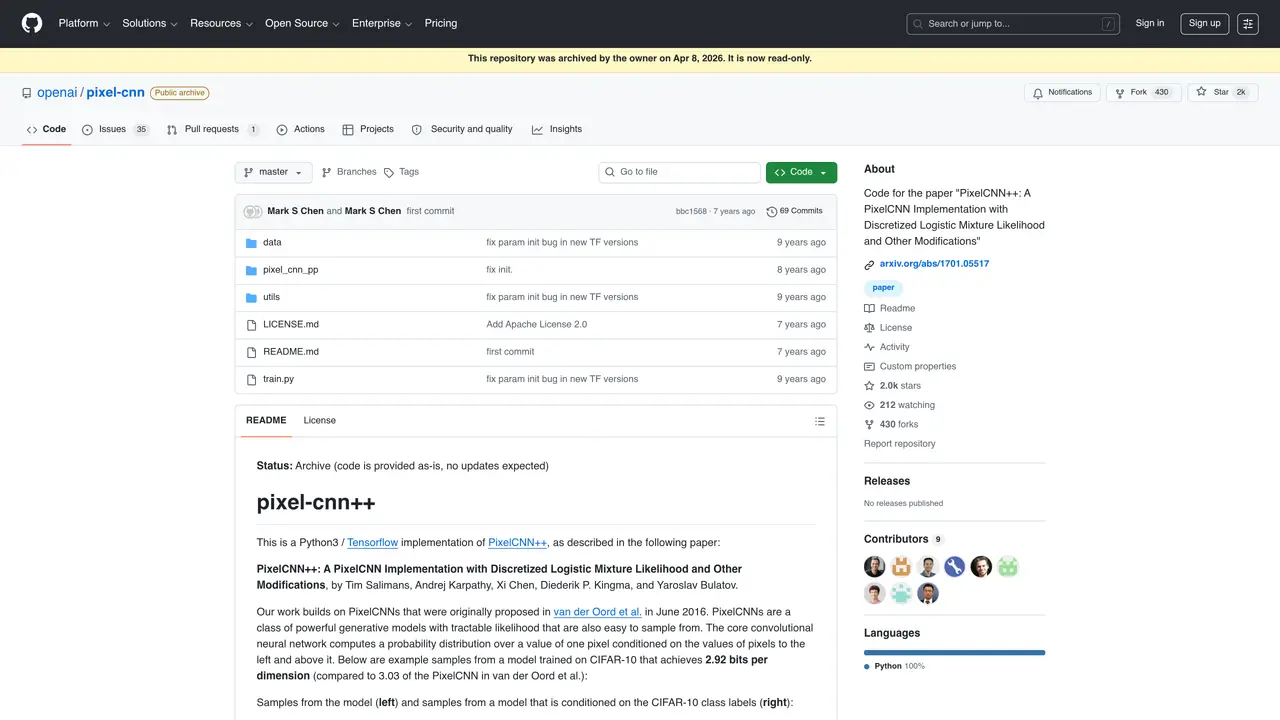
About PixelCNN
PixelCNN is an advanced deep learning model designed to generate high-quality images. With PixelCNN, developers can create stunning visuals with realistic detail and depth. This AI-powered solution offers a wide range of benefits, including improved image generation, enhanced visual accuracy, and faster processing times. It can be used to generate natural-looking images, allowing developers to quickly create visually-appealing images with no manual effort. Furthermore, PixelCNN can be used to generate high-resolution images with improved color accuracy, allowing developers to create visuals with greater detail and accuracy. With PixelCNN, developers can create stunning visuals that are sure to capture the attention of viewers.
GitHub, Inc.
San Francisco, California, US · Founded 2008
- Founders
- Tom Preston-Werner, Chris Wanstrath, PJ Hyett, Scott Chacon
- Founded
- 2008
- Headquarters
- San Francisco, California, US
- Legal status
- Subsidiary of Microsoft (NASDAQ: MSFT)
Key features
- Generate natural-looking images with no manual effort
- Create visually-appealing visuals with improved color accuracy
- Quickly produce high-resolution images with realistic detail and depth
Use cases
- Generating natural-looking images for various applications, such as art, design, or advertising
- Creating visually appealing product images for e-commerce websites
- Developing high-quality visuals for film, television, or video game production
Pros
- Implements PixelCNN++ with discretized logistic mixture likelihood for improved image generation
- Supports multi-GPU training for faster model convergence
- Provides tractable likelihood and straightforward sampling process
- Includes pretrained model checkpoints for immediate use on CIFAR-10
- Offers flexibility to adapt for custom datasets with minimal modifications
Cons
- Code is archived and no longer actively maintained or updated
- Requires significant computational resources, including multiple GPUs for optimal performance
- Training process is time-intensive, taking days to converge even on high-end hardware
- Implementation is TensorFlow-based, limiting compatibility with other frameworks
Frequently asked questions about PixelCNN
What is PixelCNN and what does it do?
PixelCNN is a class of generative models that compute a probability distribution over pixel values conditioned on the pixels to the left and above, enabling high-quality image generation. It is designed to model complex image distributions with tractable likelihood and supports sampling from the learned distribution.
Who should use PixelCNN?
PixelCNN is suitable for researchers, developers, and practitioners working on image generation, synthesis, or density estimation tasks. It is particularly useful for those interested in probabilistic generative models or experimenting with advanced neural network architectures.
How does PixelCNN work?
PixelCNN uses a convolutional neural network to model the conditional distribution of each pixel based on its context in an image. The model is trained to maximize the likelihood of the training data, allowing it to generate new images by sampling from this distribution.
What datasets can PixelCNN be trained on?
The provided implementation supports multi-GPU training on datasets like CIFAR-10 and Small ImageNet. The code is designed to be adaptable to additional datasets by modifying the data loading components.
Can I use PixelCNN for my own dataset?
Yes, the code can be adapted for custom datasets by implementing a data iterator object similar to those provided for CIFAR-10 and Small ImageNet. The repository includes guidance on how to structure the data loading process.
Is there a pretrained model available for PixelCNN?
Yes, a pretrained TensorFlow model achieving 2.92 bits per dimension on CIFAR-10 is available for download. This model can be used directly for inference or fine-tuning on related tasks.