AI job search copilot that matches roles to skills, optimizes resumes for ATS, generates cover letters, and autofills applications with real-time insights.

jobctl
FreeStarting price
0Popularity
About jobctl
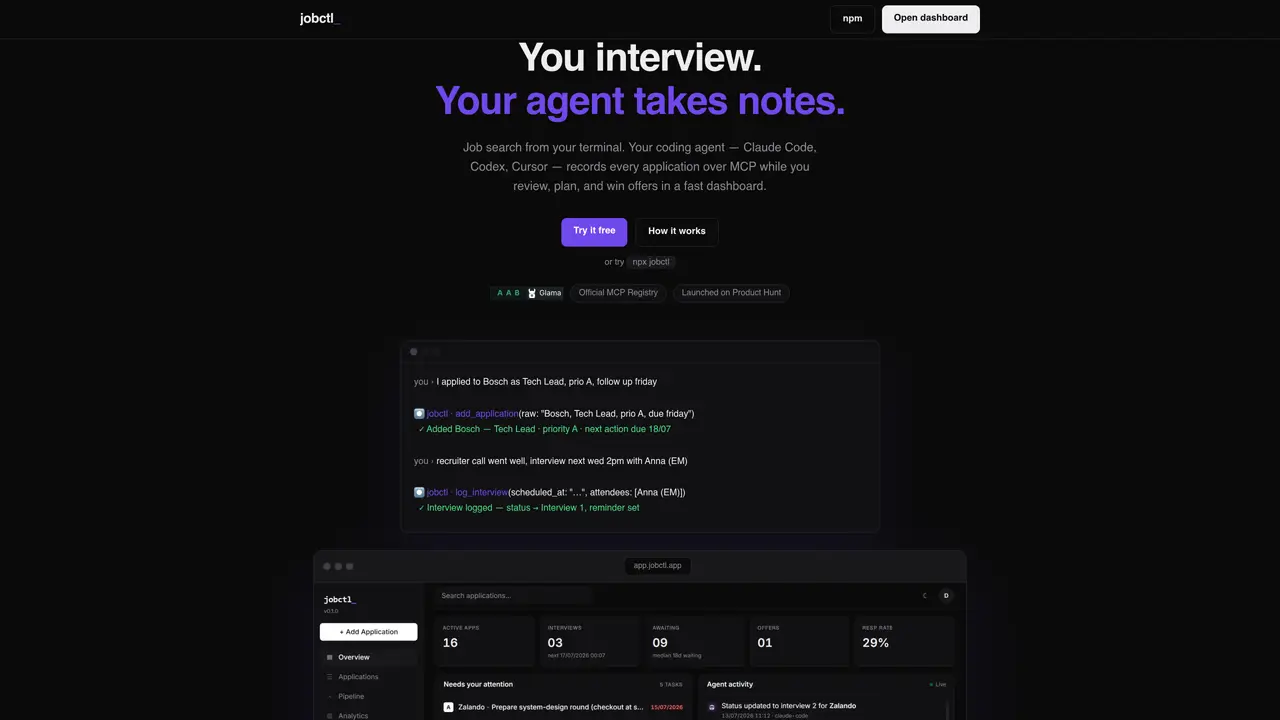
jobctl is a job application tracker designed for developers. It integrates with AI coding agents such as Claude Code, Codex, Cursor, or ChatGPT to automatically record job applications, interviews, notes, and status updates through an MCP server. Users interact with their agent in plain language, which the system parses into structured data including priorities, due dates, and follow-ups. The recorded information is then displayed in a web dashboard where users can review their pipeline, track upcoming interviews, and analyze response rates. The tool supports features like match assessment, company analysis, and interview preparation materials. It emphasizes data ownership with magic-link login, revocable API tokens, and full JSON export capabilities. jobctl is free for early users and does not use AI to write applications itself, relying instead on the user’s own agent for data generation.
Key features
- MCP server integration for agent-based data recording
- Plain-language input parsing for applications and interviews
- Kanban-style pipeline dashboard
- Match assessment and company analysis storage
- Interview prep materials and attendee tracking
- Response rate and salary analytics
- Magic-link login and revocable API tokens
- Full JSON export and GDPR-compliant data deletion
Use cases
- Tracking job applications and follow-ups during a developer job search
- Managing interview schedules and preparation materials
- Analyzing response rates and salary trends across applications
Pros
- Integrates with AI coding agents via MCP
- Automatically parses plain-language job application updates
- Provides a dashboard for pipeline tracking and analytics
- Supports structured data export and GDPR-compliant deletion
- Free for early users
Cons
- Requires an AI coding agent (Claude, ChatGPT, Codex, or Cursor)
- No mobile or desktop app beyond web dashboard
- Limited to developer-focused job tracking features
Frequently asked questions about jobctl
What is jobctl?
jobctl is a free job application tracker designed for developers. It uses an MCP server to let AI coding agents like Claude, ChatGPT, Codex, or Cursor automatically record job applications, interviews, notes, and status updates. Users interact with their agent in plain language, and the system parses this into structured data displayed in a web dashboard for review and planning.
How does jobctl work with AI coding agents such as Claude or ChatGPT?
jobctl provides a remote MCP server at app.jobctl.app/mcp. Users connect their agent via OAuth or an API token, enabling tools like add_application and log_interview. Users can then instruct their agent in plain language, such as 'I applied to Bosch as Tech Lead, priority A, follow up Friday,' and the tracker updates automatically.
Is jobctl free to use?
Yes, jobctl is free for early users. It was built by a developer during their own job hunt, and early access remains free. The tool emphasizes data ownership and does not use AI to write applications itself.
Does jobctl write job applications using AI?
No, jobctl itself is deterministic and does not make LLM calls. The AI layer is the user’s own agent, which handles research and writing. jobctl stores the results—such as match analysis, company research, and statuses—so nothing is lost in chat history.
Can I export my data or delete my account in jobctl?
Yes, jobctl allows full JSON export of applications, analyses, events, and interviews. It also offers one-click GDPR-compliant account deletion, ensuring users retain full ownership of their job search data.
What makes jobctl different from using a spreadsheet or Notion board?
jobctl automates bookkeeping by leveraging the agent users already interact with. It parses plain-language inputs into structured fields, logs status changes, and sets reminders, while the dashboard provides kanban views, response-rate analytics, and interview preparation tools in one place.