Craft captivating stories effortlessly using AI-powered GPT technology and an intuitive interface.

gpt-author
$0.07Starting price
0Popularity
About gpt-author
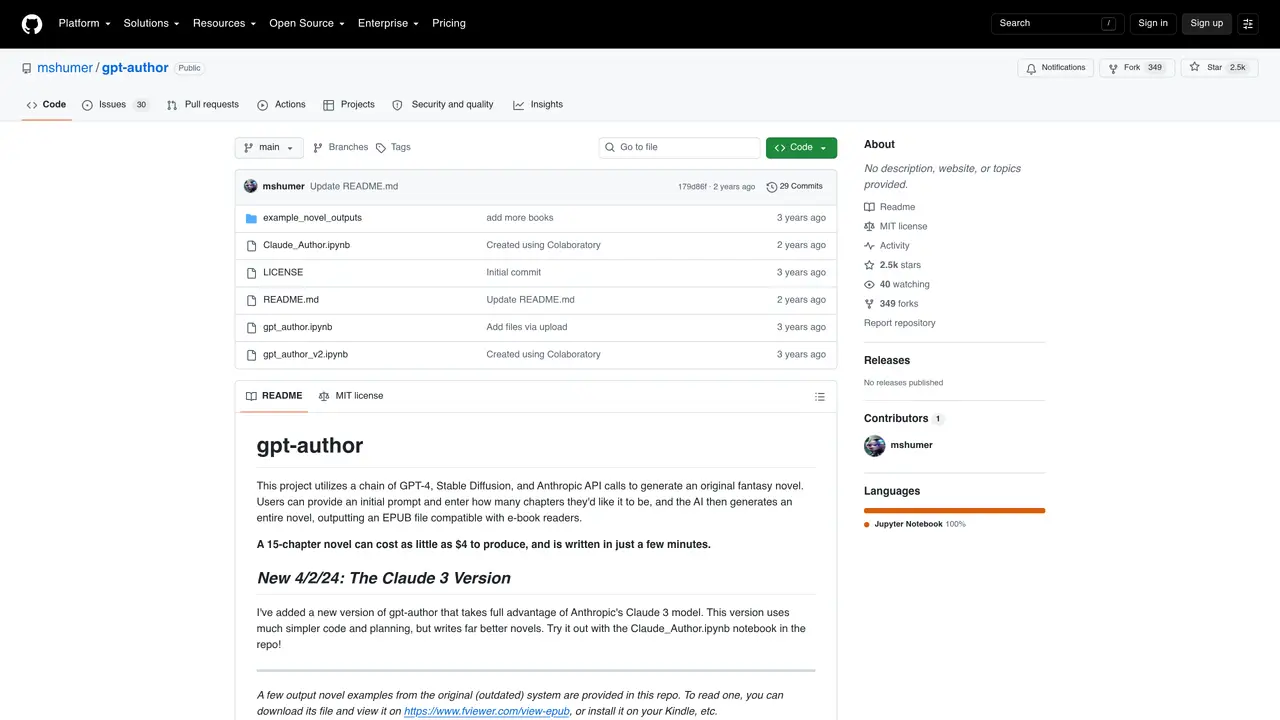
gpt-author is a creative writing project that uses GPT-4, Stable Diffusion, and the Anthropic API to automatically produce original fantasy novels based on user-provided prompts. Users can define the desired number of chapters, and the tool constructs the narrative, refines the plot, writes each chapter in sequence while maintaining continuity, and generates cover art. The final output is compiled into an EPUB file, making it ready for use on e-book readers. This project is designed for those interested in exploring AI’s potential in creative writing, particularly for generating long-form stories with minimal manual input. It appeals to writers seeking inspiration, hobbyists experimenting with AI-generated content, or anyone curious about automated storytelling workflows. The tool requires some technical setup, as it is provided as a GitHub repository rather than a plug-and-play application.
GitHub, Inc.
San Francisco, California, US · Founded 2008
- Founders
- Tom Preston-Werner, Chris Wanstrath, PJ Hyett, Scott Chacon
- Founded
- 2008
- Headquarters
- San Francisco, California, US
- Legal status
- Subsidiary of Microsoft (NASDAQ: MSFT)
Key features
- Generates full fantasy novels from user prompts
- Writes chapters sequentially with plot continuity
- Refines and improves narrative structure automatically
- Creates cover art using Stable Diffusion
- Compiles output into an EPUB file for e-readers
- Supports customization of chapter count
- Leverages GPT-4 for text generation
- Uses Anthropic API for additional capabilities
- Requires technical setup via GitHub repository
Use cases
- Quickly produce fantasy novels for personal enjoyment or sharing
- Explore AI's role in creative writing and long-form storytelling
- Generate draft content for further human editing or publishing
Pros
- Automates end-to-end novel generation from a single prompt
- Combines multiple AI models (GPT-4, Stable Diffusion, Anthropic) for plot, writing, and cover art
- Outputs a ready-to-use EPUB file compatible with e-readers
- Supports customization of chapter count and writing style
- Provides both Google Colab and local Jupyter notebook options for accessibility
Cons
- Requires technical setup and API key configuration
- Output quality depends heavily on the initial prompt and model performance
- Longer novels may exceed token limits or require additional optimization
- Generated content may need manual review for coherence and editing
Frequently asked questions about gpt-author
What is gpt-author and what does it do?
gpt-author is an open-source project that uses AI models like GPT-4 and Anthropic to automatically generate original fantasy novels based on user prompts. It handles plot development, chapter-by-chapter writing, and cover art creation, then compiles the result into an EPUB file.
Who is gpt-author designed for?
The tool is designed for writers seeking inspiration, hobbyists experimenting with AI-generated content, or anyone interested in automated storytelling workflows. It appeals to users comfortable with technical setup or willing to use Google Colab.
How does gpt-author work?
The AI first generates potential plots from a prompt, selects the most engaging one, and refines the storyline. It then writes each chapter sequentially while maintaining continuity, creates cover art, and compiles everything into an EPUB file.
What are the technical requirements to use gpt-author?
Users need API keys for GPT-4, Stable Diffusion, and Anthropic. The project can be run in Google Colab or a local Jupyter notebook, with dependencies installed via pip. Some technical knowledge is required for setup.
Can I customize the output of gpt-author?
Yes, users can specify the number of chapters, writing style, and other parameters in the notebook. The tool also allows adjustments to the prompt to influence the novel's tone and themes.
Is gpt-author free to use?
The project itself is open-source and free to use, but users will incur costs from the AI APIs (GPT-4, Stable Diffusion, Anthropic) based on their usage and model choices.