ChatGPT vs Claude vs Gemini: Which AI Assistant Is Right for You in 2026?
Something quietly remarkable happened to AI pricing this year: the three biggest assistants ended up charging almost exactly the same money for almost exactly the same tiers. ChatGPT, Claude and Google Gemini all now run a $20 mid-tier, a $100 power tier and a $200 top tier. All three give you a context window of […]
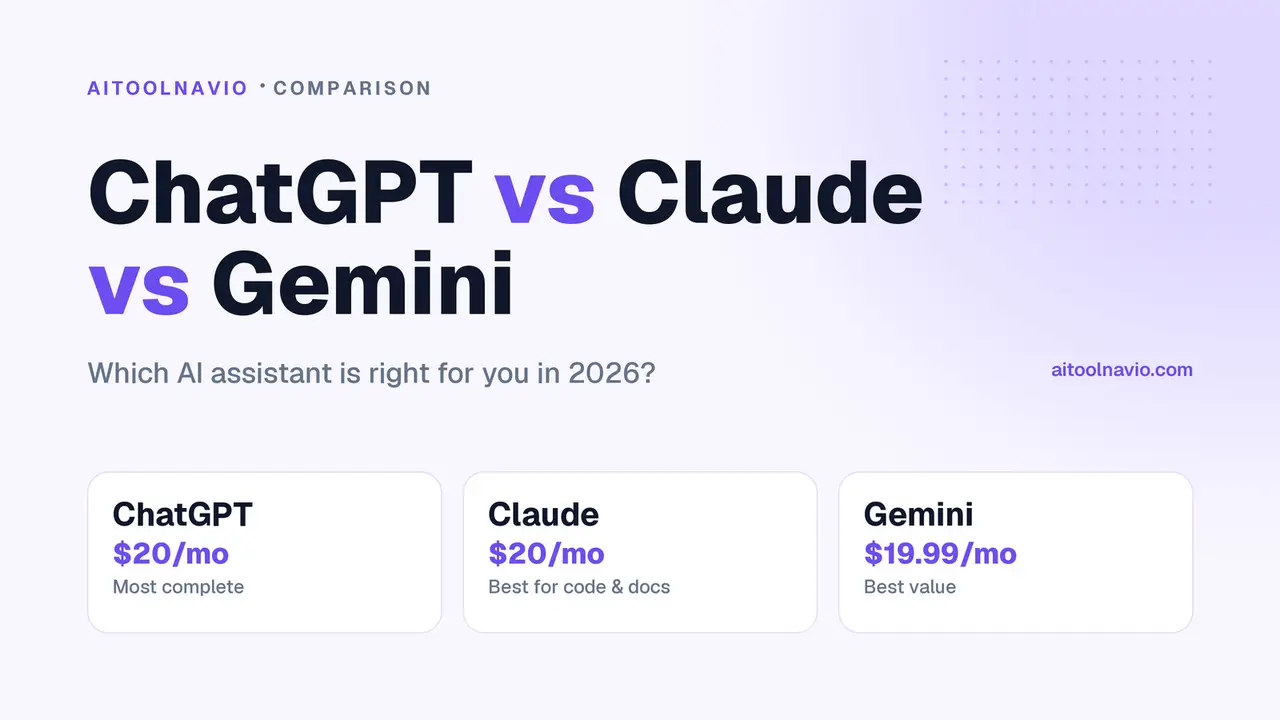
Something quietly remarkable happened to AI pricing this year: the three biggest assistants ended up charging almost exactly the same money for almost exactly the same tiers. ChatGPT, Claude and Google Gemini all now run a $20 mid-tier, a $100 power tier and a $200 top tier. All three give you a context window of a million tokens or more. All three read images, write code and search the web.
So the old way of choosing — find the one with the biggest numbers — no longer works. The numbers have converged. What separates them in 2026 is what surrounds the model: where it already lives in your working day, what it bundles, and which kind of task it was tuned to be good at.
Here is how to decide.
The short answer
If you want to skip the detail:
- Choose ChatGPT if you want the broadest single tool. It has the most features, the largest ecosystem, and the most generous free tier since OpenAI removed the text message cap in August.
- Choose Claude if your work is long documents or serious code. The million-token window plus Opus 5 makes it the strongest at holding a large, complex thing in its head without losing the thread.
- Choose Gemini if you live in Google. Workspace integration, plus bundled storage and YouTube Premium, makes it the best value on paper by a wide margin — and it has the cheapest paid entry point at $4.99.
Now the reasoning.
What each one actually costs
Prices are per month, individual plans, as of publication. Currency is USD.
| Tier | ChatGPT | Claude | Gemini |
|---|---|---|---|
| Free | $0 | $0 | $0 |
| Entry | Go — $8 | — | AI Plus — $4.99 |
| Standard | Plus — $20 | Pro — $20 ($17 annual) | AI Pro — $19.99 |
| Power | Pro — $100 (~5×) | Max 5× — $100 | AI Ultra — $99.99 (5×) |
| Top | Pro — $200 (~20×) | Max 20× — $200 | AI Ultra — $199.99 (20×) |
| Team | $25/seat monthly | $25/seat monthly | Workspace add-on |
The symmetry is not a coincidence — it is three companies converging on the same read of what people will pay. Two details break the pattern, and both matter:
Gemini is cheaper to start. AI Plus at $4.99 (cut from $7.99 in June 2026) is the cheapest way onto a frontier assistant. ChatGPT Go at $8 is the next cheapest. Claude has no entry tier at all — you go from free to $20.
Gemini bundles things worth real money. Google AI Pro includes YouTube Premium Lite, which Google values at $8.99/month, plus Health Premium and Home Premium. AI Ultra includes full YouTube Premium and up to 20TB of cloud storage. If you already pay for those separately, Gemini’s effective price is far below its sticker price. Neither OpenAI nor Anthropic bundles anything comparable.
Claude is cheapest if you commit. Pro on annual billing works out to $17/month, the lowest standard-tier price of the three.
What each one actually runs
| ChatGPT | Claude | Gemini | |
|---|---|---|---|
| Flagship | GPT-5.6 Sol | Claude Opus 5 | Gemini 3.5 Pro |
| Mid | GPT-5.6 Terra | Claude Sonnet 5 | Gemini 3.5 Flash |
| Fast | GPT-5.6 Luna | Claude Haiku 4.5 | Gemini 3.5 Flash |
| Context window | ~1.05M tokens | 1M tokens | ~2M tokens (reported) |
| Max output | 128K tokens | 128K tokens | Not published |
| Released | 9 July 2026 | Sonnet 5: 30 June; Opus 5: 24 July 2026 | Flash: 19 May; Pro: 17 July 2026 |
A few things worth understanding here.
The context race is basically over. A million tokens is roughly 750,000 words — several novels, or a mid-sized codebase. Gemini’s reported two million is double that, but you will hit practical limits of attention and cost long before you hit the ceiling on any of them. Treat context size as a solved problem rather than a deciding factor.
Gemini 3.5 Pro is the least documented. Google shipped it on 17 July 2026 but has not published official benchmarks, pricing or a model card. Most of what circulates about its performance comes from industry reporting rather than Google. We have flagged this rather than repeating unverified numbers, and you should be sceptical of any comparison that ranks it precisely.
Model defaults changed recently on all three. Claude Sonnet 5 became the default for Free and Pro users, with Opus 5 the default on Max. OpenAI extended GPT-5.6 Luna to Free and Go users on 6 August 2026. If you tried any of these earlier in the year, you were using different models.
Round 1: Writing
Claude wins on prose, ChatGPT wins on range.
Claude produces the most natural default prose of the three — less throat-clearing, fewer stock transitions, less of the tic where every answer opens by restating your question. For essays, editorial and anything with a voice, it needs the least editing.
ChatGPT covers more ground. Canvas gives you a proper editing surface, custom GPTs let you bake in a house style, and the sheer breadth of adjacent features — image generation, Sora video, voice — means one subscription handles a full content workflow.
Gemini is competent and rarely the best. Its advantage is location: drafting inside Gmail and Docs, where writing actually happens, beats a marginally better sentence in a separate tab.
Verdict: Claude for quality, ChatGPT for volume and variety.
Round 2: Coding
Claude, and it is not especially close.
Anthropic has aimed squarely at developers, and it shows. Opus 5 with a million-token window handles whole-repository reasoning well, and Claude Code has become a standard part of many developers’ workflows. Notably, Sonnet 5 ships inside third-party tools including Cursor and GitHub Copilot — competitors adopting your model is a meaningful signal.
ChatGPT is strong and improving, with Sol handling intricate generation well. If you want one tool for coding and everything else, it is the pragmatic pick.
Gemini’s coding story is really the Antigravity story — Google’s agent-first development platform, with priority access on Ultra tiers. Promising, but a different product with a different learning curve.
Verdict: Claude for code quality, ChatGPT if coding is one job among many.
Round 3: Research and long documents
Claude for depth, Gemini for breadth, ChatGPT for citations.
Drop a 300-page PDF into any of the three and all will manage. The differences show under pressure: Claude holds detail from the beginning of a long document most reliably when you ask about it at the end. Gemini’s larger window means it will swallow collections that others reject. ChatGPT’s Deep Research produces the most usable cited output.
If citation quality is the whole job, note that a dedicated tool may beat all three — Perplexity is built specifically for sourced answers.
Verdict: Claude for one big document, Gemini for many, ChatGPT for a written report.
Round 4: Everyday integration
Gemini, decisively — if you are a Google household.
This is Google’s structural advantage and it has widened in 2026. AI Inbox in Gmail triages your mail and drafts replies. Daily Brief assembles a morning digest from Gmail, Calendar and past chats. Gemini Spark, on Ultra tiers, is a persistent agent that acts across Google products. None of this requires you to visit a chatbot.
ChatGPT counters with connectors, custom GPTs and desktop apps, but it is integrating into your tools from outside rather than already being inside them. Microsoft users get a variant of Google’s advantage through Microsoft Copilot instead.
Claude barely competes here, by choice. It is a focused tool for thinking and building, not an ambient layer over your life.
Verdict: Gemini, unless you live in Microsoft 365.
One caveat worth knowing: several of Gemini’s best features — Gemini Spark, AI Inbox, Daily Brief — were US-only at launch. Check availability in your country before buying on that basis.
Round 5: The free tiers
ChatGPT, for now.
On 6 August 2026 OpenAI made GPT-5.6 Luna the default for free users and removed the text message cap. A free ChatGPT account is now genuinely useful for everyday work rather than a trial that runs out by lunchtime.
Claude’s free tier runs Sonnet 5 — the same model paying Pro users get — but with tight session limits. You get frontier quality in small amounts.
Gemini’s free tier is capable and, since May 2026, governed by a compute-based limit rather than a prompt count: complex requests consume more of your allowance, limits refresh every five hours against a weekly cap, and you get downgraded to smaller models rather than cut off.
Verdict: ChatGPT gives the most away. Claude gives the best model in the smallest quantity.
So which one should you pick?
You write for a living → Claude Pro. Best prose, least editing, and $17/month annually is the cheapest standard tier going.
You write code → Claude Pro, moving to Max if you use Claude Code daily. If coding is occasional, ChatGPT Plus is the better all-rounder.
You already pay for Google One and YouTube Premium → Google AI Pro. The bundle makes the assistant close to free in practice.
You want one tool that does everything → ChatGPT Plus. Widest feature set, best ecosystem, most third-party support.
You are on a tight budget → Google AI Plus at $4.99, or ChatGPT Go at $8. Both give real frontier access for less than a streaming subscription.
You are not sure yet → Use the free tiers for two weeks on your actual work. All three are good enough that the deciding factor will be a habit you cannot predict in advance.
You are a business buying seats → All three land near $25/seat monthly, so the decision is your existing stack, not price. Google if you are a Workspace shop, ChatGPT if you want breadth, Claude if your team is technical.
Do you need to choose at all?
At $20 a month each, running two is not extravagant if AI is central to your work — a common pairing is Claude for writing and code, ChatGPT for everything else. If you want multiple models without multiple subscriptions, aggregators like Poe bundle several behind one fee, at the cost of losing each app’s native features.
And these three are not the whole market. DeepSeek offers strong reasoning at a fraction of the price, Grok has live access to X, and Mistral Le Chat is the credible European option with data residency in the EU. See the full chatbots and assistants category for the rest.
The verdict
There is no winner, and any article claiming otherwise is guessing on your behalf. The honest summary:
- Claude is the best model for demanding work — long documents, real code, careful prose.
- Gemini is the best value, provided you already live in Google’s ecosystem.
- ChatGPT is the best product — the most complete, most polished, most useful to the most people.
Pick on which of those three words describes what you need. Then check the pricing yourself before you pay, because everything in this article moved at least once in the last six months and will move again.
Related reading
- The 100 Best AI Tools in 2026 — tested and categorised across ten categories
- Chatbots & Assistants — every assistant in the directory
- Compare tools side by side — specs and pricing head-to-head
- Top 100 AI tools by traffic — the popularity-ranked view
Official sites: chatgpt.com · claude.ai · gemini.google.com
Sources
Pricing and model details were compiled in August 2026 from the following. Where a figure came only from third-party reporting rather than the vendor, we have said so in the text.
- Everything new in our Google AI subscriptions, fresh from I/O 2026 — Google
- The Google AI Ultra plan now starts at $100 a month — Engadget
- GPT-5.6: Frontier intelligence that scales with your ambition — OpenAI
- Previewing GPT-5.6 Sol — OpenAI
- GPT-5.6 in ChatGPT — OpenAI Help Center
- The new GPT-5.6 family: Luna, Terra, Sol — Simon Willison
- OpenAI GPT-5.6 Sol, Terra, and Luna now support 1M token context windows — AWS
- What’s new in Claude Sonnet 5 — Claude Platform Docs
- Context windows — Claude Platform Docs
- Claude Sonnet 5 Launch Analysis — Caylent
- Claude pricing in 2026 — CloudZero
- ChatGPT Pricing 2026: Complete Breakdown of All Plans — Techjack Solutions
- Gemini Pricing in 2026 for Individuals, Orgs & Developers — Finout
- Gemini 3.5 Pro: What’s Confirmed, Benchmarks & Pricing — AIToolsReview