
Generate speech with customizable voices in any language, and create captivating stories using natural-sounding voices.
ConceptNet
0Popularity
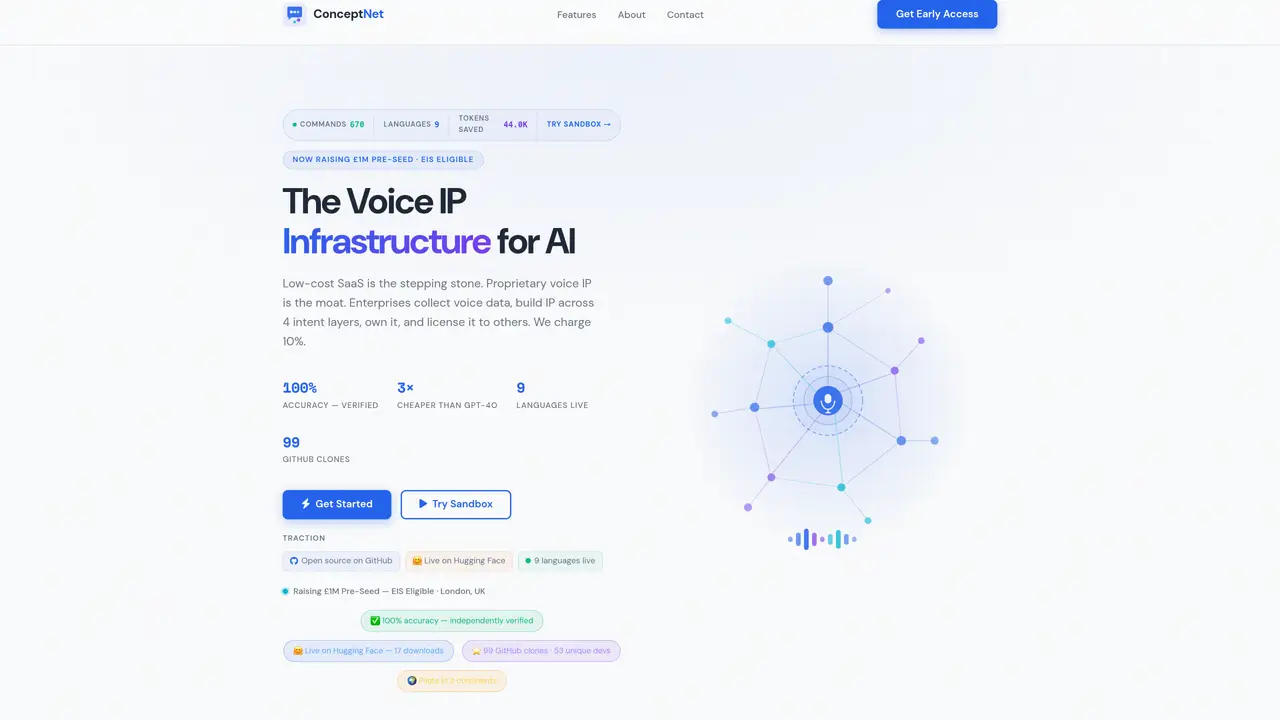
About ConceptNet
ConceptNet provides a voice-first infrastructure layer for enterprises to convert spoken commands into actionable tasks across existing systems. It operates as a proprietary voice IP platform where companies upload voice data and instructions, which are then encrypted, isolated, and stacked into four escalating intent layers. The resulting voice IP can be licensed to other organizations, with ConceptNet taking a 10% transaction fee. The system is designed to be multilingual by default, supporting 200 languages via SONAR embeddings, and claims 100% accuracy verified through independent testing. It positions itself as a cost-effective alternative to major LLM providers, with pricing starting at $0.015 per query compared to competitors charging up to $0.20. The platform emphasizes data ownership, allowing enterprises to retain control of their voice IP rather than sharing it publicly. It is marketed as a long-term moat, with proprietary IP intended to last a decade compared to the shorter lifespan of typical AI features.
Key features
- Voice-first command processing with natural intent understanding
- Agent execution engine for task automation across enterprise tools
- Four-layer intent stacking (Basic, Context-Aware, Predictive, Autonomous)
- Multilingual support for 200 languages by default
- Proprietary voice IP ownership and licensing mechanism
- Encrypted and isolated data storage for enterprise voice data
- 10% transaction fee on licensed voice IP revenue
- Independent accuracy verification through adversarial testing
Use cases
- Enterprise voice automation for customer service and internal workflows
- Cross-cultural voice AI deployment in global organizations
- Licensing proprietary voice IP to third-party developers or companies
Pros
- Supports 200 languages via SONAR multilingual embeddings
- 100% accuracy verified through independent adversarial testing
- Costs 3–5× less than major LLM providers per query
- Enables enterprises to own and license proprietary voice IP
- Open-source components available on GitHub and Hugging Face
Cons
- Waitlist-only access with no public availability
- Requires enterprise voice data upload for full functionality
- Limited to voice IP infrastructure, not a standalone application
Frequently asked questions about ConceptNet
What is ConceptNet and what does it do?
ConceptNet is a voice-first infrastructure platform that converts spoken commands into actionable tasks across existing enterprise systems. It enables companies to collect voice data, build proprietary voice IP through four escalating intent layers, and license that IP to others while retaining ownership.
Who is ConceptNet designed for?
The platform is designed for enterprises seeking to leverage voice AI at scale while maintaining data ownership and long-term competitive advantage. It suits organizations looking to build proprietary voice IP rather than relying on generic AI features.
How does ConceptNet ensure accuracy in voice command processing?
ConceptNet claims 100% accuracy, verified through independent testing by an ML researcher from the Hugging Face community. Adversarial holdout tests confirmed 99.3% accuracy, demonstrating genuine intent learning rather than surface pattern memorization.
Does ConceptNet support multiple languages?
Yes, ConceptNet supports 200 languages natively through SONAR multilingual embeddings, making it a global-first voice AI platform. This contrasts with competitors that typically support far fewer languages.
How does ConceptNet handle data ownership and privacy?
ConceptNet encrypts and isolates uploaded voice data, ensuring enterprises retain full ownership of their voice IP. Unlike other platforms, the data is not shared publicly or with third parties, providing a long-term competitive moat.
What is the pricing model for ConceptNet?
ConceptNet operates on a per-query pricing model, with costs significantly lower than major LLM providers. The platform emphasizes token-free architecture, making it more cost-effective for enterprise-scale voice AI deployments.