
OpenAI builds and deploys advanced AI models like GPT-4o for autonomous agents and workflows.

Astron Agent
$0.07Starting price
0Popularity
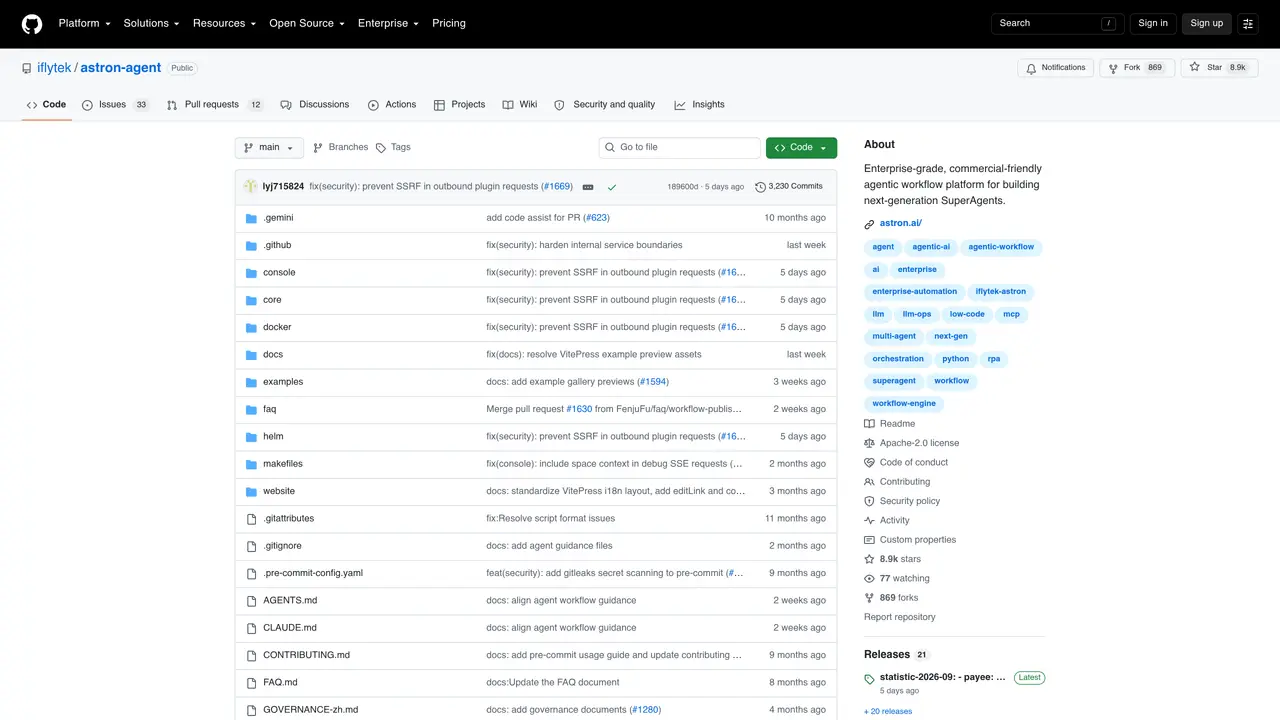
About Astron Agent
Astron Agent is an enterprise-grade, commercial-friendly platform designed for building and deploying AI-driven agentic workflows at scale. It provides a robust framework for orchestrating multi-step processes, managing AI models, and integrating with LLMs, MCP tools, and RPA systems. The platform enables organizations to turn decisions into automated actions while supporting high availability, extensibility, and production readiness. Astron Agent simplifies model lifecycle management and tool integration, allowing developers and businesses to rapidly compose, run, monitor, and scale AI agents across systems. It is built on technology used in iFLYTEK’s commercial Astron Agent Platform, ensuring enterprise-grade stability and reliability. The tool is released under the Apache 2.0 license, permitting unrestricted commercial use without licensing restrictions. It is particularly suited for automating complex cross-system processes and establishing a foundation for next-generation intelligent agent applications in enterprise environments.
GitHub, Inc.
San Francisco, California, US · Founded 2008
- Founders
- Tom Preston-Werner, Chris Wanstrath, PJ Hyett, Scott Chacon
- Founded
- 2008
- Headquarters
- San Francisco, California, US
- Legal status
- Subsidiary of Microsoft (NASDAQ: MSFT)
Key features
- Build AI-driven agentic workflows
- Orchestrate multi-step processes
- Manage and deploy models
- Integrate with LLMs, MCP tools, and RPA systems
- Turn decisions into automated actions
- Support high availability and production readiness
- Monitor and scale AI agents
- Simplify model lifecycle management
- Commercial-friendly Apache 2.0 license
Use cases
- Automating cross-system business processes
- Deploying AI agents for enterprise workflows
- Integrating LLMs and RPA tools into automated pipelines
Pros
- Enterprise-grade reliability with high-availability deployment options
- Open-source under Apache 2.0 license, enabling unrestricted commercial use
- Native integration with intelligent RPA and cross-system enterprise tools
- Flexible large model support with multiple access methods and on-premises deployment
- Ready-to-use tool ecosystem with plug-and-play integration of AI capabilities
Cons
- Requires technical expertise for deployment and configuration
- Limited documentation clarity for non-technical users
- High availability version may demand significant infrastructure resources
Frequently asked questions about Astron Agent
What is Astron Agent and what does it do?
Astron Agent is an enterprise-grade platform for building and deploying AI-driven agentic workflows. It orchestrates multi-step processes, manages AI models, and integrates with LLMs, MCP tools, and RPA systems to automate decisions into actions at scale.
Who is Astron Agent designed for?
The platform is designed for developers and businesses seeking to automate complex cross-system processes and deploy production-ready AI agents. It suits enterprises requiring high availability, scalability, and commercial-friendly licensing.
How does Astron Agent integrate with other tools and systems?
Astron Agent natively integrates with intelligent RPA systems and enterprise tools, enabling seamless interaction between agents and internal or external systems. It also supports plug-and-play integration with a ready-to-use tool ecosystem.
What deployment options are available for Astron Agent?
The platform offers two deployment methods, including Docker-based deployment for flexibility. It supports one-click deployment and on-premises clusters for enterprise-level Model as a Service (MaaS) needs.
Is Astron Agent suitable for commercial use?
Yes, Astron Agent is released under the Apache 2.0 license, which allows for unrestricted commercial use without licensing restrictions.
How can I get started with Astron Agent?
Users can start by exploring the GitHub repository, which provides documentation, examples, and deployment guides. The platform offers Docker-based deployment for quick setup and supports multiple access methods for large model integration.