
OpenAI builds and deploys advanced AI models like GPT-4o for autonomous agents and workflows.

Bahama
0Popularity
About Bahama
Bahama AI enables businesses to build customized AI-powered assistants that connect with internal documents and third-party platforms such as CRM and project management systems. These assistants support workflows across customer service, sales, finance, and more by delivering personalized, actionable insights. Employees can quickly access relevant information, draft reports, and retrieve data across the organization without manual searches. The platform is designed for intuitive setup, allowing managers to create and deploy assistants in minutes. By automating routine tasks and surfacing key insights, Bahama aims to enhance team efficiency and support informed decision-making. Currently available in private beta, the tool offers early access to businesses interested in testing its capabilities.
Key features
- Custom AI assistant creation for business workflows
- Integration with CRM and project management tools
- Connection to internal company documents and applications
- Personalized, actionable insights generation
- Intuitive setup for quick deployment
- Support for customer service, sales, finance, and other workflows
- Automated report drafting and data retrieval
- Early access through private beta
Use cases
- Building an AI assistant for customer service teams to retrieve order details and respond to inquiries
- Creating a sales assistant that pulls CRM data to generate follow-up emails and track leads
- Developing a finance assistant to summarize expense reports and flag anomalies
Pros
- Enables AI coding agents to deploy full-stack apps, databases, and hosting with minimal manual setup
- Supports integration with existing workflows and tools like Vercel, Neon, Supabase, and Fly.io
- Provides an open ecosystem with interchangeable blocks for hosts, databases, and environments
- Offers end-to-end secret management and live post-deployment verification
- Designed for agentic workflows, allowing AI assistants to autonomously plan and deploy projects
Cons
- Requires familiarity with coding agents and cloud infrastructure concepts
- Limited to use cases where AI-generated code and deployment are feasible
- Dependent on third-party providers for hosting and database services
Frequently asked questions about Bahama
What is Bahama and what does it do?
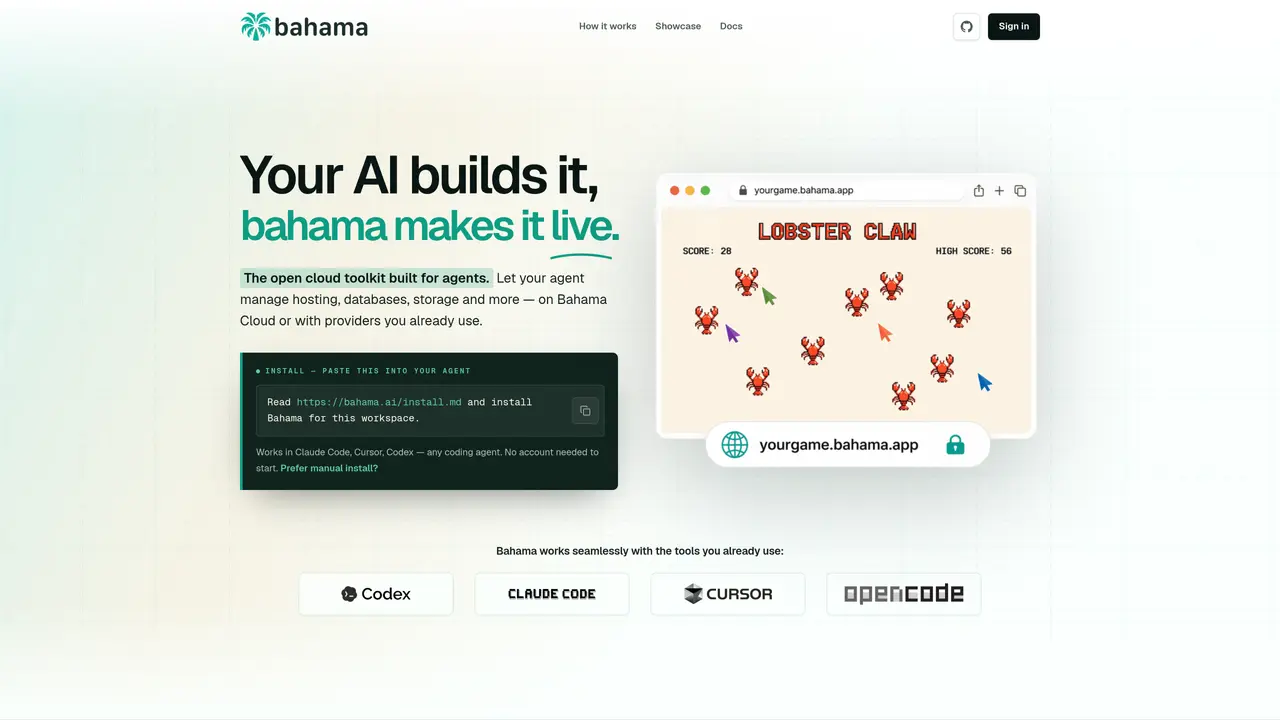
Bahama is an open cloud toolkit that enables AI coding agents to deploy applications, databases, and hosting infrastructure with minimal manual intervention. It standardizes deployment workflows across providers like Vercel, Neon, and Bahama Cloud.
Who should use Bahama?
Bahama is designed for developers and teams using AI coding agents such as Claude Code, Cursor, or Codex who want to automate the deployment of full-stack apps, databases, and static sites without managing cloud accounts manually.
How does Bahama integrate with existing tools?
Bahama plugs into tools you already use, such as Vercel for hosting or Neon for databases, by declaring compatible blocks in a bahama.yaml file. It orchestrates deployments through an approval flow while keeping your accounts and code under your control.
What types of applications can be built and deployed with Bahama?
Bahama supports building and deploying full-stack apps, landing pages, business dashboards, personal projects, and APIs. It handles hosting, databases, and storage, and can deploy interactive apps with shared cloud state.
Does Bahama require an account to start?
No account is needed to begin using Bahama. You can install it directly into your coding agent and start deploying projects immediately. An account is required only when deploying to Bahama Cloud or managing providers.
How does Bahama ensure security and control?
Bahama authenticates your cloud accounts, requires approval for consequential changes, and verifies deployments against live provider state. Secrets are sealed end-to-end and exposed only at runtime, never stored in chat logs or repositories.