
Generate captions, optimize content, and enhance with custom images for maximum engagement.
46M visits/mo-10%#3 Image & Design

Enterprise headless commerce platform unifying products, pricing, and checkout with governed AI orchestration for B2C, B2B, and B2X operations.
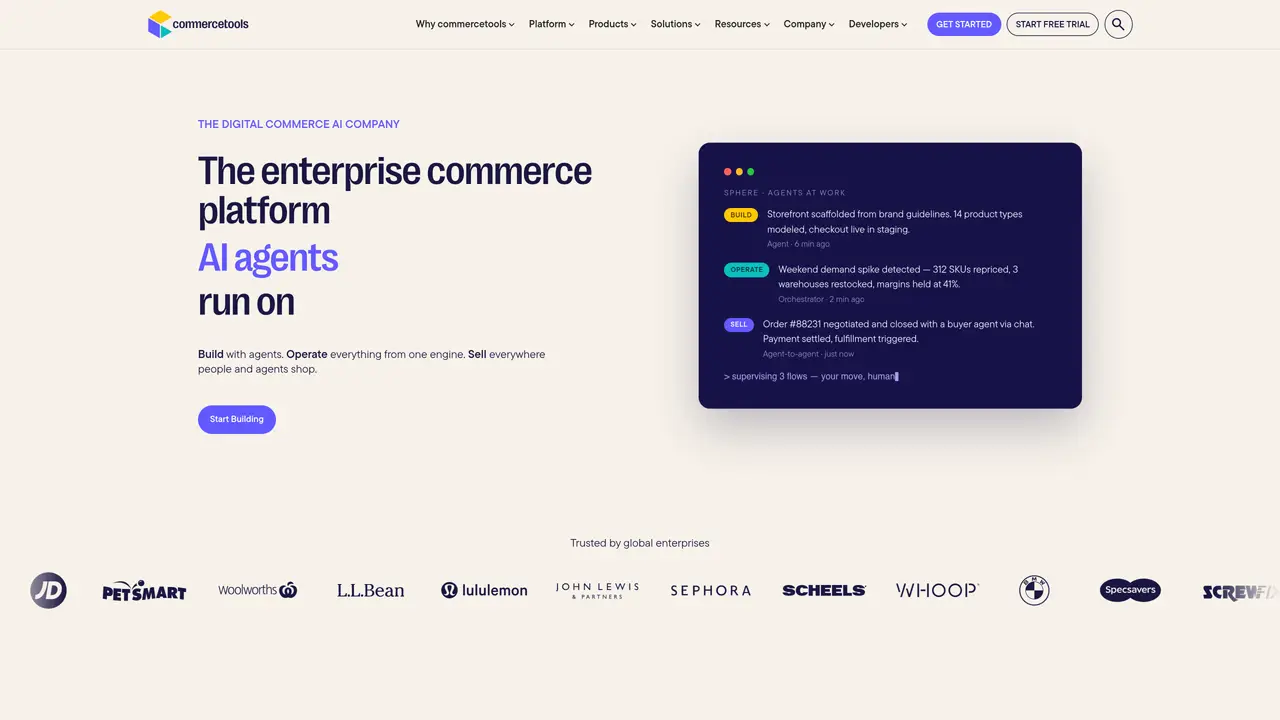
commercetools is an enterprise-grade headless commerce platform designed to unify product catalogs, pricing, promotions, carts, and checkout into a single, channel-agnostic foundation called Sphere. It enables businesses to model and deploy commerce logic once and expose it across any channel—web, app, or in-store—without duplicating effort or creating platform silos. The platform introduces MosAIc, a governed AI orchestration layer that allows teams to define policies, scopes, and approvals for AI agents, ensuring safe automation while maintaining human oversight. Through Merchant Center, users can model catalogs, manage price lists, configure workflows, and monitor operations with built-in audit trails and compliance controls. commercetools is ideal for enterprises modernizing from monolithic systems or adopting composable commerce patterns, serving industries like retail, CPG, manufacturing, healthcare, and wholesale. Teams can choose automation levels from exception handling to end-to-end processes, scaling globally while retaining control over performance, cost, and regulatory requirements. The platform supports rapid scaffolding of storefronts, checkout flows, and integrations with partner services such as Google Cloud, AWS, or MongoDB, while providing documentation, tutorials, and premium support for enterprise rollouts.
commercetools is an enterprise-grade headless commerce platform that unifies product catalogs, pricing, promotions, carts, and checkout into a single, channel-agnostic foundation called Sphere. It enables businesses to model and deploy commerce logic once and expose it across any channel—web, app, or in-store—without duplicating effort.
commercetools is designed for enterprises modernizing from monolithic systems or adopting composable commerce patterns, serving industries like retail, CPG, manufacturing, healthcare, and wholesale. It is ideal for businesses seeking scalable, AI-driven commerce operations with governance and compliance controls.
commercetools includes MosAIc, a governed AI orchestration layer that allows teams to define policies, scopes, and approvals for AI agents. This ensures safe automation while maintaining human oversight, enabling businesses to choose automation levels from exception handling to end-to-end processes.
commercetools offers ready-to-go integrations with best-in-class software vendors such as Google Cloud, AWS, and MongoDB. It also supports rapid scaffolding of storefronts, checkout flows, and connections to partner services through its API-first architecture.
commercetools offers a cloud-native, API-first platform with pricing tailored to enterprise needs. Specific pricing details are not publicly listed, as they vary based on usage, scale, and required features. Prospective users are encouraged to contact the sales team for a customized quote.
commercetools provides a free trial and developer resources to help users get started. Users can begin building with AI-driven tools, access documentation and tutorials, and engage with premium support or expert services for enterprise rollouts. The platform is designed to be flexible and scalable from initial setup to full deployment.
commercetools.com · third-party estimates from Similarweb
Last 4 months · grows by one month every month
Share of visits · estimated visits
Other countries: 44%
How people reach this site from other AI tools
590 a month · 0.3% of all visits
Automation & Agents · Sep 2026
Traffic figures are third-party estimates, good for scale and trends; they can differ from a company's own numbers. Updated monthly.
We use essential cookies to run aitoolnavio™, and optional cookies to analyze traffic and measure our marketing. You choose what we use — optional cookies stay off unless you turn them on. See our Privacy Policy.
One short email a week: fresh tools worth trying, honest takes and the updates that actually matter. No spam, unsubscribe any time.
Generate captions, optimize content, and enhance with custom images for maximum engagement.
Build conversational forms, capture rich responses, and automate follow-ups with AI-powered surveys and workflows.
Automate code, research, and documents using agents.
AI-powered IDE for autonomous coding tasks and agentic development workflows
Source, match, and manage talent with predictive analytics for effortless recruiting.
Automate workflow, optimize operations, and detect potential issues with this efficient AI-driven solution.
Transforms thoughts into actions, enhancing productivity and efficiency.
AI Recruitment engine to hire top global talent
All-in-one team productivity platform combining chat, docs, video meetings, workflows, and AI tools in one place.
Personal assistant that coordinates tasks across apps and devices via text or call
AI automation and agent-building platform with 3,000+ app integrations
AI job search copilot that matches roles to skills, optimizes resumes for ATS, generates cover letters, and autofills applications with real-time insights.
Matched on what this tool does — grouped by the job you would be replacing.
matches Unifies product, pricing, promotions, carts, and checkout into a single headless foundation · Governed AI orchestration with MosAIc for policy-driven agent governance and approvals · Channel-agnostic deployment across web, app, and in-store environments
Enterprise AI platform that securely connects data, AI agents, analytics, and operations for real-time, mission-critical decision-making.
Enterprise AI platform that automates customer service, orchestrates AI agents, and unifies omnichannel customer experiences at scale.
matches Governed AI orchestration with MosAIc for policy-driven agent governance and approvals · Human-in-the-loop supervision for critical steps and exception handling · Connects with partner services like Google Cloud, AWS, or MongoDB
Automate security, IT runbooks into governed, AI workflows.
Enterprise governance layer for AI agents with runtime enforcement and audit trails
Monitors, audits and controls AI agents in real time with human oversight