
OpenAI builds and deploys advanced AI models like GPT-4o for autonomous agents and workflows.

FluidDocs CLI
$20/moStarting price
0Popularity
About FluidDocs CLI
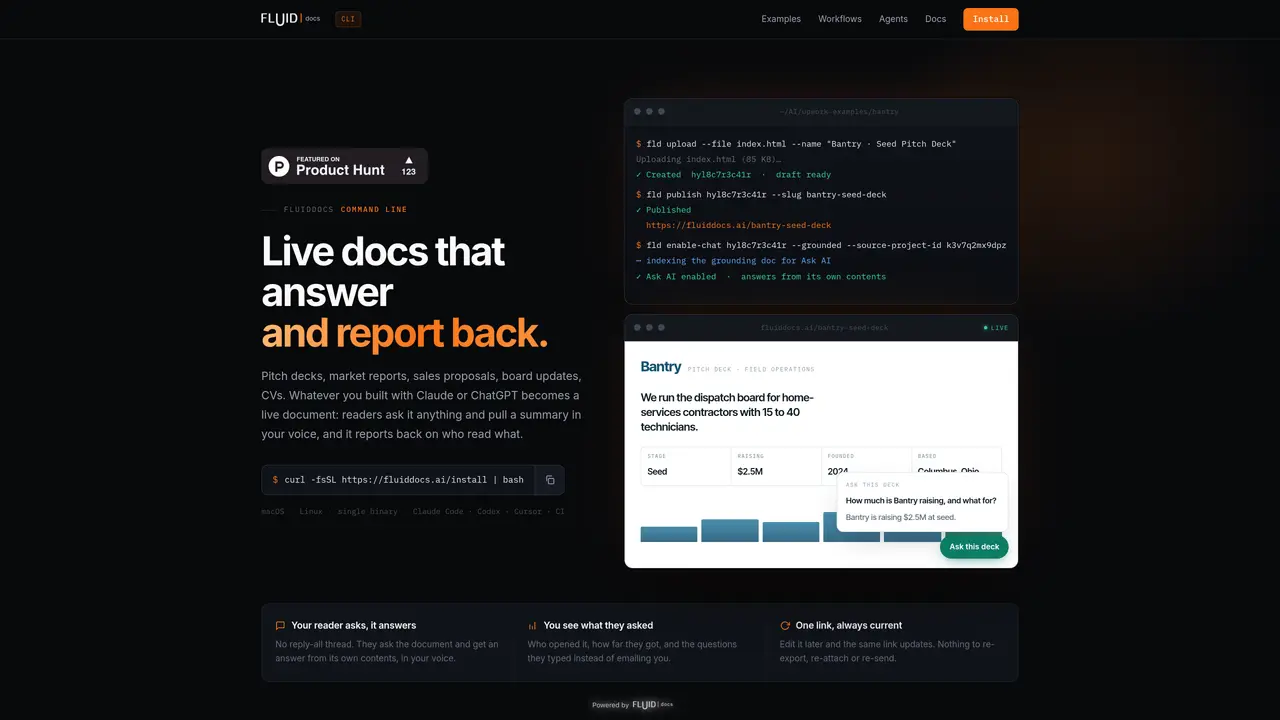
FluidDocs CLI is a command-line interface that converts static documents into interactive, live resources. Users can publish files, directories, or zip archives as documents that answer reader questions in the author’s voice and provide summaries on demand. The tool tracks reader engagement, including who opened the document, how far they progressed, and the specific questions asked, without requiring email threads. Documents remain updatable after publishing; edits propagate to the same link automatically, eliminating the need for re-exporting or re-sending. It supports integration with coding agents like Claude Code, Codex, and Cursor, enabling automated workflows through structured JSON output and predictable commands. The CLI handles tasks such as creating, updating, publishing, and enabling AI-driven interactions, with background job management for long-running operations. Outputs are machine-readable and errors are returned in a structured format, making it suitable for unattended automation.
Key features
- Publish files, directories, or zip archives as live documents
- Enable AI-driven interactions grounded in document content
- Track reader analytics (who opened, progress, questions)
- Automate workflows with coding agents via structured JSON
- Background job management with polling and streaming
- Flat command structure with backward-compatible aliases
- Machine-readable errors and outputs for unattended use
- Single-binary installation for macOS and Linux
Use cases
- Convert sales proposals into interactive documents that answer client questions
- Publish pitch decks with embedded interactive demos for investors
- Transform market reports into queryable resources with real-time summaries
Pros
- Converts static documents into interactive, queryable resources
- Tracks reader engagement and questions without email threads
- Supports automated workflows via coding agents with JSON output
- Documents update automatically via the same link after edits
- Structured errors and machine-readable outputs for automation
Cons
- Requires command-line installation and setup
- No explicit support for Windows mentioned
- Background jobs require polling or streaming for updates
Frequently asked questions about FluidDocs CLI
What is FluidDocs CLI and what does it do?
FluidDocs CLI is a command-line tool that converts static documents into interactive, live resources. It allows users to publish files, directories, or zip archives as documents that answer reader questions in the author’s voice, provide summaries, and track reader engagement without requiring email threads.
Who should use FluidDocs CLI?
The tool is designed for professionals who create and share documents that require ongoing interaction, such as sales proposals, pitch decks, market reports, board updates, or CVs. It is particularly useful for teams or individuals who need to track reader engagement and keep documents updated after publishing.
How does FluidDocs CLI handle document updates after publishing?
Documents remain updatable after publishing; edits propagate to the same link automatically, eliminating the need for re-exporting or re-sending. Users can edit documents later, and the changes are reflected in the live document without requiring manual redistribution.
Can FluidDocs CLI integrate with coding agents like Claude Code or Cursor?
Yes, FluidDocs CLI supports integration with coding agents such as Claude Code, Codex, Cursor, and Windsurf. It provides structured JSON output and predictable commands, enabling automated workflows and unattended automation.
What kind of analytics does FluidDocs CLI provide?
FluidDocs CLI tracks reader engagement, including who opened the document, how far they progressed, and the specific questions they asked. This data is reported back to the author without requiring email threads or manual follow-ups.
How do I get started with FluidDocs CLI?
To get started, install the CLI using a one-line command that detects your OS and architecture. After installation, run `fld login` to authorize in the browser, and then publish your first document using the available commands.