
OpenAI builds and deploys advanced AI models like GPT-4o for autonomous agents and workflows.

Hubble
8.5KMonthly visits
15Popularity
About Hubble
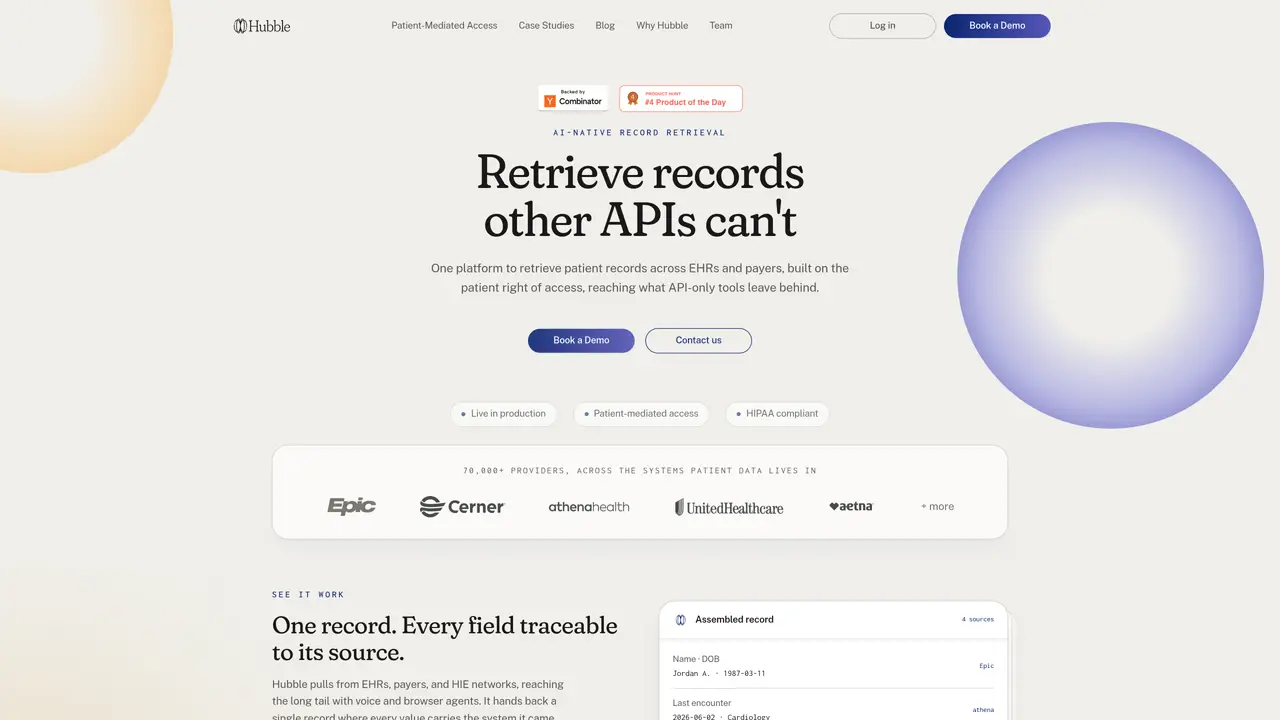
Hubble is a platform designed to retrieve patient records from electronic health records (EHRs), payers, and health information exchanges (HIEs) using patient-mediated access. It consolidates records from multiple sources into a single, normalized file where each data point is traceable to its origin system. The tool uses a combination of APIs, browser agents, and voice/fax agents to reach records that traditional API-only solutions cannot access. Records are retrieved under the patient’s right of access and are HIPAA-compliant with a full audit trail. The platform is intended for teams that need comprehensive patient data, such as legal, insurance, care delivery, and life sciences organizations. Integration is streamlined to avoid per-provider contracts or lengthy engineering efforts, enabling records to flow within days rather than weeks.
Key features
- Patient-mediated record retrieval
- Multi-source consolidation (EHRs, payers, HIEs)
- Normalized record output with source attribution
- API, browser, and voice/fax agents for record access
- HIPAA-compliant with audit logging
- No per-provider contracts
- Rapid deployment (days instead of weeks)
- Supports Epic, athenahealth, UnitedHealthcare, Aetna, and others
Use cases
- Legal and litigation teams assembling patient records for cases
- Insurance and underwriting teams retrieving applicant and claimant records
- Care delivery teams providing full patient history to clinicians
Pros
- Retrieves records from EHRs, payers, and HIEs, including hard-to-reach sources
- Normalizes records into a single file with traceable data sources
- Uses patient-mediated access under the right of access
- HIPAA-compliant with built-in audit trails
- Avoids per-provider contracts and lengthy engineering setup
Cons
- Requires patient-mediated access, limiting use to scenarios with patient consent
- No public pricing or transparent free tier mentioned
- Integration requires a demo or consultation, not self-service signup
Frequently asked questions about Hubble
How long does it take to integrate Hubble?
Integration is designed to be streamlined, enabling records to flow within days rather than weeks. The platform avoids per-provider contracts or lengthy engineering efforts.
How is Hubble different from a FHIR or patient-data API?
Hubble uses a combination of APIs, browser agents, and voice/fax agents to retrieve records that traditional API-only solutions cannot access, including those in the long tail of providers.
Is Hubble HIPAA-compliant?
Yes, Hubble is HIPAA-compliant with a full audit trail, and every action is permissioned, logged, and audit-ready from day one.
Which EHRs, payers, and patient sources does Hubble support?
Hubble supports leading EHRs such as Epic and athenahealth, national networks, and over 70,000 providers, including payers like UnitedHealthcare and Aetna.
Who is Hubble designed for?
Hubble is designed for teams that need comprehensive patient data, including legal, insurance, care delivery, and life sciences organizations.
How does Hubble retrieve records?
Hubble retrieves records through patient-mediated access, leveraging the patient’s right of access to reach systems that traditional methods cannot, and consolidates them into a single normalized file.
Hubble Website Engagement
Last Update: 9 days ago
Total Monthly Visits
0
Bounce Rate
0%
Visit Duration (avg)
0.00s
Pages Per Visit
0
Country Rank
0
United States
Global Rank
0
Category Rank
#0
Universities & Colleges
Monthly Traffic
Traffic Sources
Traffic Share By Country
- United States71.9%
- India28.1%