
OpenAI builds and deploys advanced AI models like GPT-4o for autonomous agents and workflows.

Luminix
$5Starting price
7KMonthly visits
14Popularity
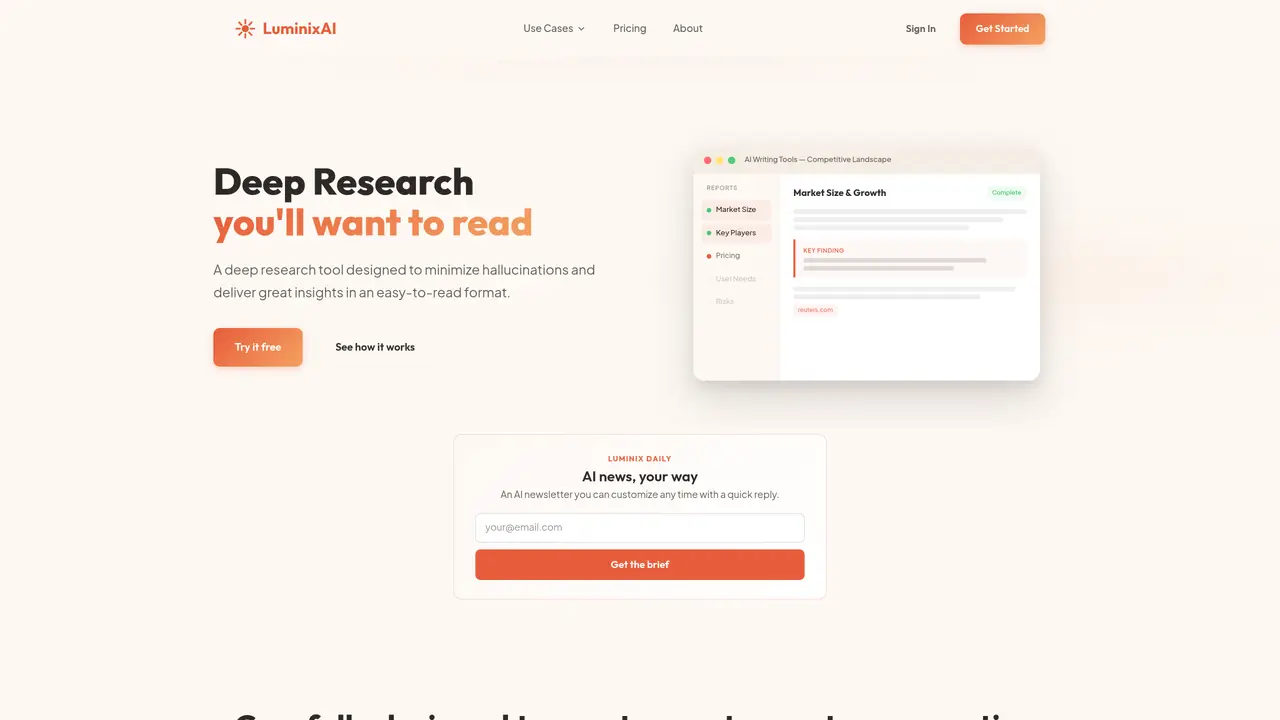
About Luminix
Luminix is an AI-powered research platform designed to break down complex questions into parallel research threads and deploy up to eight specialized AI agents. These agents include a dedicated ‘cynic’ challenger that surfaces counterpoints and validates evidence. The system automates task decomposition, multi-angle investigation, and synthesis, producing a single traceable report with sourced insights. Users can refine results through follow-up queries, enabling iterative refinement of research outcomes. The platform is particularly suited for tasks requiring deep, evidence-based analysis such as market evaluation, competitor tracking, or build-vs-buy decisions. By handling parallelized research and synthesis, Luminix accelerates the process of gathering and connecting information while maintaining transparency through traceable sources and agent interactions.
Key features
- Deploys up to eight specialized AI agents for parallel research threads
- Includes a 'cynic' agent to challenge assumptions and surface counterpoints
- Automates task decomposition and multi-angle investigation
- Synthesizes evidence into a single traceable report
- Supports iterative refinement with follow-up queries
- Provides source-backed insights for decision-making
- Handles market evaluation, competitor tracking, and build-vs-buy analysis
- Maintains transparency through traceable agent interactions and sources
Use cases
- Conducting market research with evidence-backed insights
- Tracking competitor strategies and performance
- Evaluating build-vs-buy decisions for product development
Pros
- Deploys up to six specialized AI agents in parallel for comprehensive research coverage
- Includes a dedicated 'cynic' agent to challenge assumptions and validate counterpoints
- Multi-model orchestration using Claude, Grok, and Gemini for optimized performance at each research stage
- Provides traceable sources and transparent agent interactions for verifiable insights
- Delivers structured, board-ready reports with synthesized analysis rather than raw data
Cons
- Limited to six research threads in standard mode, which may constrain depth for highly complex queries
- Output quality depends on the underlying AI models' current capabilities and limitations
- Requires iterative refinement for nuanced or highly specialized research topics
Frequently asked questions about Luminix
What is Luminix and what does it do?
Luminix is an AI-powered research platform that breaks down complex questions into parallel research threads and deploys specialized AI agents to investigate each path. It synthesizes findings into a single, traceable report with sourced insights.
Who is Luminix best suited for?
Luminix is designed for professionals who need deep, evidence-based analysis, such as market researchers, product strategists, investors, and business leaders making build-vs-buy decisions or tracking competitors.
How does Luminix handle research quality and accuracy?
Luminix uses a multi-model approach with Grok for trustworthy web search, Claude for synthesis, and a 'cynic' agent to challenge findings. All claims are traced back to sources for transparency and validation.
Can I refine or expand research after receiving initial results?
Yes, Luminix allows follow-up questions to build on existing research, enabling iterative refinement of insights and deeper exploration of specific areas.
Does Luminix integrate with other tools or platforms?
Luminix supports document uploads and provides exportable reports in PDF or Markdown format, but its primary integration is with web-based research sources and AI models.
How do I get started with Luminix?
Users can start by signing up for a free account and submitting a research question to generate their first report. No credit card is required for the free tier.
Luminix Website Engagement
Last Update: 9 days ago
Total Monthly Visits
0
Bounce Rate
0%
Visit Duration (avg)
0.00s
Pages Per Visit
0
Country Rank
0
United States
Global Rank
0
Monthly Traffic
Traffic Sources
Traffic Share By Country
- United States56.6%
- India23.3%
- Indonesia7.5%
- France7.4%
- Canada5.1%