
OpenAI builds and deploys advanced AI models like GPT-4o for autonomous agents and workflows.

Rapid AI
FreeStarting price
56KMonthly visits
29Popularity
About Rapid AI
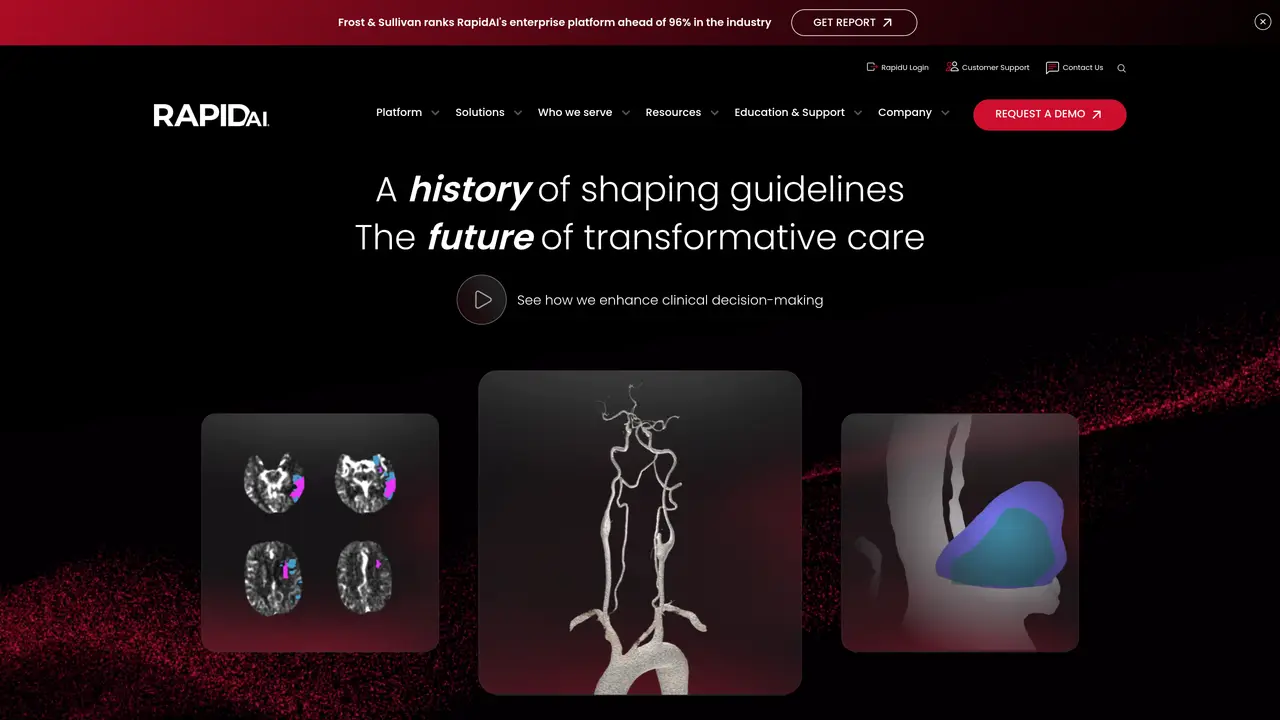
RapidAI provides an enterprise-grade platform designed to deploy deep clinical AI models for healthcare organizations. The platform enhances AI-driven clinical assessment by integrating fine-tuned models tailored to specific service lines, enabling consistent and scalable decision support. It supports workflows across multiple care settings, improving diagnostic accuracy and treatment planning while reducing variability in care delivery. RapidAI is built to transform care pathways by automating routine assessments and surfacing actionable insights for clinicians. The platform is particularly suited for hospitals, health systems, and specialty care providers seeking to standardize and elevate clinical decision-making. By leveraging fine-tuned AI models, it adapts to institutional workflows and integrates seamlessly with existing electronic health record systems. Organizations use RapidAI to streamline triage, prioritize high-risk patients, and optimize resource allocation in time-sensitive scenarios such as stroke, trauma, or cardiac care.
Key features
- Enterprise-scale clinical AI deployment
- Fine-tuned models for specific service lines
- Integration with electronic health records
- Automated clinical assessment workflows
- Standardized decision support across care settings
- Scalable triage and prioritization tools
- Real-time patient risk stratification
- Customizable AI model adaptation
- Multi-specialty care pathway optimization
Use cases
- Automating stroke triage and treatment prioritization
- Enhancing trauma care with rapid clinical assessment
- Supporting cardiac care pathways with AI-driven insights
Pros
- Connects imaging findings directly to clinical action across healthcare systems
- Provides FDA-cleared AI solutions spanning radiology, neurovascular, cardiac, and vascular care
- Integrates seamlessly with existing EHR, PACS, and clinical workflows
- Offers enterprise-grade security and compliance for healthcare environments
- Supports over 2,500 hospitals globally with validated clinical AI models
Cons
- May require significant institutional workflow adjustments for optimal adoption
- Dependent on availability and quality of imaging data for model performance
- Implementation complexity could pose challenges for smaller healthcare providers
Rapid AI videos
Frequently asked questions about Rapid AI
What does RapidAI do?
RapidAI provides an enterprise-grade clinical AI platform that transforms imaging data into actionable clinical insights, supporting radiology, neurovascular, cardiac, and vascular care pathways.
Who is RapidAI suited for?
The platform is designed for hospitals, health systems, specialty care providers, and life sciences organizations seeking to standardize clinical decision-making and improve diagnostic accuracy.
How does RapidAI integrate with existing systems?
RapidAI integrates securely and vendor-agnostically with electronic health records, PACS, and clinical workflows to enable seamless execution of AI-driven insights.
Does RapidAI offer FDA-cleared solutions?
Yes, RapidAI provides FDA-cleared AI solutions across multiple medical specialties, ensuring regulatory compliance for clinical use.
What kind of support does RapidAI provide for implementation?
RapidAI partners with organizations to optimize workflows, provide hands-on implementation support, and deliver professional education through RapidU.
How can I get started with RapidAI?
Prospective users can request a demo or contact RapidAI for inquiries about partnerships, implementation, or general questions through their official website.
Rapid AI Website Engagement
Last Update: 9 days ago
Total Monthly Visits
0
Bounce Rate
0%
Visit Duration (avg)
0.00s
Pages Per Visit
0
Country Rank
0
India
Global Rank
0
Category Rank
#0
Medicine
Monthly Traffic
Traffic Sources
Traffic Share By Country
- United States37.8%
- India32.1%
- Brazil7.5%
- United Kingdom5.2%
- Canada4.1%